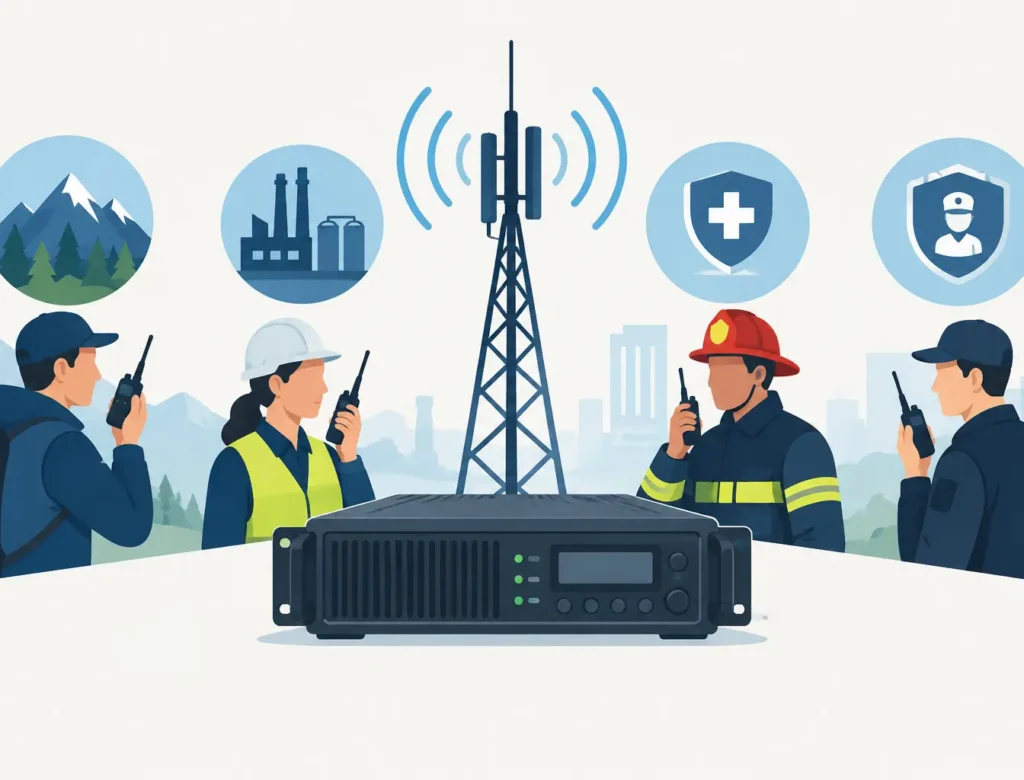
A repeater removed during a system upgrade is not automatically obsolete. For many organizations, it is a recoverable asset with resale, trade-in, parts, or recycling value. The answer to who buys radio repeaters depends on the equipment’s band, condition, age, programming status, and whether it can still serve a real operational need.
That distinction matters when a hospital, municipality, utility, school district, manufacturer, or logistics operation retires radio infrastructure. A repeater may have supported years of reliable coverage, but it can also retain fleet IDs, channel plans, network settings, encryption-related information, and site-specific programming. Disposition must protect both value and the organization’s communications security.
Who buys radio repeaters?
The most dependable buyers are specialized land mobile radio buyers that understand professional LMR equipment, not general consumer-electronics liquidators. They evaluate repeaters in the context of the systems they support: portable and mobile radio fleets, dispatch consoles, base stations, antennas, power supplies, chargers, control stations, and related infrastructure.
Professional buyers generally fall into several categories. Radio lifecycle and buyback companies purchase equipment for resale, trade-in programs, parts recovery, and compliant recycling. LMR dealers and system integrators may purchase compatible equipment for customer projects or inventory. Refurbishers buy tested units that can be returned to service. In some cases, end users purchase repeaters to expand an existing compatible system, particularly where a replacement does not require a full platform migration.
There is also a legitimate market for non-working or incomplete equipment. A damaged repeater may have usable modules, housings, power components, interface boards, or other parts. Equipment that has no resale potential should still be handled through an electronics recycling process that addresses applicable environmental, transportation, and regulatory requirements.
The key is finding a buyer that can assess all of those outcomes. A buyer focused only on resale may decline equipment that still has recoverable parts value. A general scrap vendor may overlook the value of serviceable professional radio hardware altogether.
What makes a repeater valuable to buyers
Radio repeaters are evaluated differently from commodity IT hardware. Their value is tied to technical compatibility, deployed market demand, and the condition of components that keep a radio network operating.
Frequency band is often the first consideration. Low-band, VHF, UHF, and 800 MHz equipment may each have viable markets, but demand varies by model family and installed base. A repeater that matches radios still widely used by utilities, public works departments, transportation operations, schools, or industrial facilities can be more valuable than newer equipment from a platform with limited demand.
Manufacturer, model number, and configuration matter just as much. Buyers will look at whether the unit is analog, digital, trunking-capable, conventional, P25-capable, or designed for a proprietary system. They may also assess installed options, control modules, duplexers, cabinets, power supplies, and accessories. An asset list that identifies these components clearly can support a faster, more accurate quote.
Condition affects the offer, but it is not limited to whether a unit powers on. Buyers consider cosmetic condition, visible corrosion, water damage, missing components, prior repair history, and whether equipment was removed from a functioning site. A complete, rack-mounted repeater system may carry more value than a loose chassis, yet even incomplete equipment can be worth evaluating.
Quantity can improve the economics of disposition. A single unit may have value, but a batch of repeaters, mobiles, portables, chargers, microphones, batteries, and accessories gives a specialist more options for resale and parts recovery. Organizations replacing an entire fleet should view the removed system as a program, not a collection of unrelated devices.
Why conventional buyers often decline repeaters
Many surplus buyers are built to handle laptops, phones, servers, or office electronics. They may not have the product knowledge, testing capability, customer base, or compliance process needed for LMR equipment. As a result, they may offer scrap pricing, require the seller to arrange freight, or reject the equipment entirely.
Repeaters can also create logistics challenges. Cabinet systems are heavy, site equipment may be installed in remote facilities, and packing electronics for shipment requires care. A buyer with nationwide pickup capabilities can remove an administrative burden that otherwise falls on facilities, procurement, or field operations teams.
The other issue is residual information. Radio infrastructure is not a blank appliance simply because it is no longer in use. Configuration files, programmed frequencies, network identifiers, user lists, talkgroup assignments, and other operational data may remain in equipment. For public-sector agencies, healthcare organizations, utilities, and critical operations, that risk makes an undocumented sale or disposal path hard to justify.
Secure disposition is part of the transaction
The best buyer is not simply the one offering a number. The right process protects the organization before, during, and after equipment leaves the site.
Start with an inventory. Record manufacturer, model, quantity, band, serial numbers where available, and whether equipment is operational, untested, damaged, or incomplete. Photographs of labels, front panels, rack configurations, and accessories help a qualified buyer identify equipment without a lengthy back-and-forth.
Next, establish who owns the assets and whether any equipment is leased, grant-funded, or subject to internal retention requirements. This step is especially relevant for public agencies and organizations with formal fixed-asset controls. It prevents a disposal project from becoming an audit issue later.
Then address programming and sensitive data. Equipment should be handled by a provider that offers documented data wiping or sanitization appropriate to the device and its stored information. If encryption keys or sensitive programming are involved, involve the radio system administrator early. A secure process should be planned, not assumed.
Finally, require a clear chain of custody from pickup through payment, resale, or recycling. Documentation supports asset retirement records, sustainability reporting, internal controls, and responsible disposition policies. It also gives leadership confidence that retired communications equipment did not leave the organization through an informal channel.
When resale, trade-in, or recycling makes sense
Resale is usually the strongest outcome when equipment is in demand, complete, and serviceable. It creates direct financial recovery and extends the useful life of equipment that another organization can still use.
Trade-in can be practical when an organization is purchasing replacement radios or infrastructure. Instead of treating retired assets as a separate disposal task, trade-in value can offset the cost of the new system. The best fit depends on the procurement structure, timing of the refresh, and whether the new equipment supplier accepts the specific models being removed.
Recycling is appropriate when equipment is obsolete, damaged beyond economic repair, unsupported, or missing critical parts. It should not be viewed as a failure of the process. Compliant recycling is the correct outcome when reuse is no longer responsible or realistic, particularly for electronics containing batteries, circuit boards, and other regulated materials.
A capable lifecycle partner can evaluate all three paths rather than forcing every asset into the same outcome. Radiowell, for example, combines buyback, trade-in, resale, data wiping, nationwide pickup, and compliant recycling so organizations can retire mixed radio inventories through one accountable process.
Questions to ask before choosing a buyer
Before accepting an offer, ask whether the buyer purchases your frequency band and equipment type, including repeaters, base stations, mobile radios, and related accessories. Confirm how the equipment will be packed and transported, who pays for pickup, how data or programming is handled, and what documentation will be provided.
It is also reasonable to ask what happens to equipment that cannot be resold. A qualified provider should be able to explain its recycling path rather than leaving the organization responsible for rejected assets after pickup. Payment timing matters as well. A transparent quote and a defined payment process make financial recovery easier to forecast and reconcile.
Price should be considered alongside certainty. A slightly higher informal offer may not compensate for freight expense, internal labor, missing data handling, delayed payment, or uncertain downstream disposal. For organizations managing public funds, sensitive operations, or sustainability commitments, the total outcome matters more than a number on an email.
Retired repeaters deserve the same disciplined handling as the communications system they once supported. With the right buyer, a decommissioned radio asset becomes a documented source of recovery value, compliance protection, and responsible reuse or recycling.
More News
-
Prepare Radios for Equipment Retirement Right
Learn how to prepare radios for equipment retirement with secure data handling, accurate inventory, safe packing, value recovery,…
Radio Asset Recovery That Pays and Protects
Radio asset recovery turns retired two-way radios into value while protecting data, meeting compliance duties, and reducing disposal…
How to Sell Motorola Radios for Maximum Value
Learn how to sell Motorola radios with secure data handling, free pickup, fair-market value, and compliant recycling for…

America’s largest buyer of used two-way radio equipment. Maximizing value, compliance, and sustainability for surplus LMR equipment.
Recycle and Partners