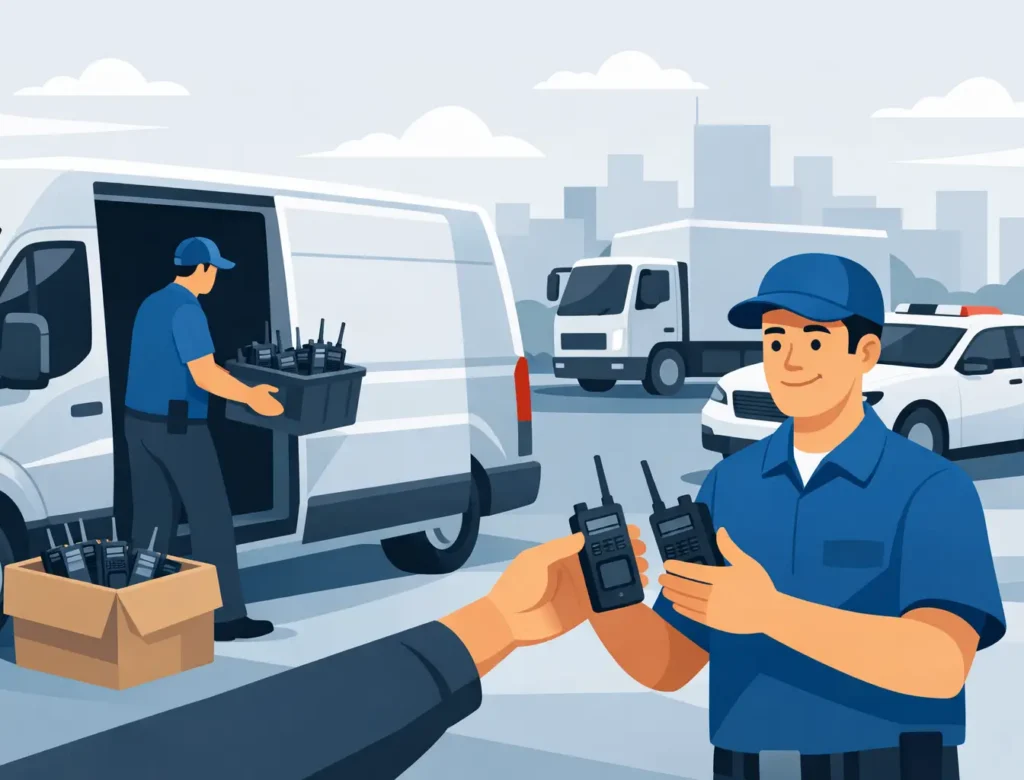
A radio replacement project can leave a facilities department, communications manager, or warehouse team with pallets of equipment that still has value but no longer fits the active system. Free two-way radio pickup changes that equation. Rather than paying staff to sort, pack, store, ship, or dispose of retired assets, an organization can turn surplus land mobile radio equipment into recovered value, documented compliance, and a cleaner transition to its next communications platform.
For hospitals, municipalities, school districts, utilities, manufacturers, logistics operators, and government agencies, this is not simply a matter of clearing storage space. Retired radios can retain customer information, system programming, encryption material, talkgroup configurations, and other operational data. They may also contain batteries and electronic components that require responsible handling. The right disposition process addresses the financial, logistical, security, and environmental sides of the decision at the same time.
What Free Two-Way Radio Pickup Should Include
Free pickup should mean more than a carrier arriving at the loading dock. A specialist should first identify what the organization has, determine whether the equipment has resale or trade-in value, and provide a clear fair-market quote. That assessment may include portable radios, mobile radios, base stations, repeaters, microphones, chargers, batteries, antennas, control stations, and associated accessories.
Professional LMR equipment is not valued like generic consumer electronics. Make, model, band, condition, quantity, demand, accessories, and system compatibility all affect value. VHF, UHF, low-band, 700/800 MHz, and multiband equipment can each serve different secondary-market needs. Even older equipment that is no longer appropriate for the original owner may be useful to another organization, supplied as replacement inventory, harvested for parts, or directed into compliant recycling.
A meaningful pickup service also removes the logistics burden. Many organizations do not have packaging materials sized for radio fleets, staff time to prepare multiple shipments, or an established process for managing lithium-ion and nickel-metal hydride batteries. Pickup arrangements should account for the quantity, location, equipment type, and safe transport requirements. If packing is needed, the provider should make expectations clear before the collection date rather than leaving the work to an already busy operations team.
The phrase “free” deserves scrutiny. In a well-structured program, there should be no surprise deductions for ordinary nationwide collection, no vague estimates that change after pickup, and no pressure to accept a disposal-only outcome for equipment with legitimate market value. A provider may need to evaluate unusually remote locations, hazardous conditions, or highly specialized equipment separately, but those exceptions should be discussed upfront.
Why Radio Fleets Require a Specialist
A general electronics recycler may be able to remove devices from a site. That does not necessarily mean it understands radio programming, regulated batteries, FCC considerations, model-specific resale demand, or the difference between an obsolete subscriber unit and equipment that remains valuable in a compatible installed base.
That distinction affects financial recovery. An organization that sends usable radios into an undifferentiated recycling stream may lose resale proceeds and trade-in opportunities. It may also receive limited documentation about where equipment went, how data was handled, or how batteries and non-resalable materials were processed.
It also affects security. A radio that has been removed from service is not automatically free of sensitive information. Depending on the device and system, it may retain programmed channels, unit IDs, fleet maps, contact lists, Wi-Fi settings, network credentials, encryption keys, or other configuration data. A communications manager may understand this risk immediately, while procurement or sustainability teams may see only a box of old electronics. Both views need to meet in the disposition plan.
Data wiping should be a defined service, not an assumption. Ask how devices are evaluated, what data is removed, when wiping occurs, and what documentation is available. For agencies and enterprises subject to internal security controls, procurement rules, or records requirements, this paperwork can be as valuable as the payment itself.
How Free Two-Way Radio Pickup Works
The most efficient process begins with an inventory, even if it is incomplete. A list of manufacturer names, model numbers, approximate quantities, operating bands, accessories, and locations gives a specialist enough information to begin valuation. Photos of labels and stacked equipment can help where a formal asset list is unavailable.
The next step is a same-day or prompt quote that separates equipment with recoverable value from equipment better suited for compliant recycling. This is where organizations should ask practical questions: Is payment available, can value be applied as trade-in credit, does the quote include accessories, and what happens to equipment that is damaged or obsolete? A clear answer protects budget expectations before equipment leaves the facility.
Once terms are accepted, pickup is scheduled around the organization’s operational constraints. A large distribution center may need a dock appointment. A hospital may require coordination with security and facilities. A municipal agency may have restricted access, property-release procedures, or multiple sites. A capable provider plans for those realities rather than treating every collection as a small parcel shipment.
After receipt and verification, the equipment is processed according to its condition and market potential. Viable assets can be resold into appropriate channels, creating a second life for equipment that still serves a legitimate operational need. Radios with no resale path are dismantled and recycled under applicable e-waste, EPA, FCC, DOT, and battery-handling requirements. Organizations should receive the relevant transaction, payment, and disposition records for their files.
Radiowell applies this model to surplus LMR equipment nationwide, combining valuation, pickup, data wiping, resale, trade-in value, and compliant recycling in one managed process. The benefit is straightforward: the organization retains control of its asset disposition without becoming responsible for every shipping label, pallet, data-clearing task, and downstream decision.
When Pickup Creates the Most Value
The best time to plan pickup is before a replacement rollout is complete. When retired and replacement radios overlap, teams can identify what will be retained as spares, what can be redeployed, and what should exit the organization. Waiting until equipment has sat in storage for years can make inventory harder, reduce battery condition, and create uncertainty about ownership or configuration history.
Large refreshes are obvious candidates, but smaller accumulations can also justify action. A school district may have radios left after a campus upgrade. A manufacturing plant may have replaced a UHF fleet with a newer digital platform. A utility may be consolidating field equipment after a merger. A public agency may have surplus units from a grant-funded communications project. In each case, a specialized evaluation can establish whether the equipment is an expense to manage or an asset to recover.
The trade-off is that not every item will generate payment. Cracked housings, unsupported legacy models, depleted batteries, missing accessories, and nonfunctional units may have little resale value. That does not make pickup less useful. It means the organization needs a provider that can distinguish between resale, parts recovery, and compliant recycling without forcing staff to solve that sorting problem alone.
Questions to Settle Before Scheduling
Before approving a pickup, confirm who has authority to release the equipment and whether asset tags, property records, or grant conditions require review. Organizations should also decide which radios will remain as emergency spares and whether chargers, microphones, programming cables, and batteries are included. Accessories can affect value and should not be discarded automatically.
Ask for clarity on the chain of custody, data handling, payment timing, and recycling documentation. If encrypted radios are involved, confirm the procedure for managing encryption material before devices are transferred. If batteries are stored separately, disclose that fact early so transportation can be arranged correctly.
Finally, align the project with internal goals. Finance may focus on recovered value. IT and communications teams may focus on data security. Sustainability teams may need diversion and recycling records. Facilities may want storage space back quickly. A well-managed pickup supports all of those outcomes without requiring four departments to run separate disposal projects.
Retired radios should not become a long-term warehouse problem or an untracked e-waste risk. With a documented free pickup process, surplus communications equipment can leave the site promptly, responsibly, and with a clear record of the value and compliance work it delivered.
More News
-
How to Monetize Retired Radios Without Risk
Learn how to monetize retired radios with fair valuation, secure data handling, free pickup, resale options, and compliant…
How Radio Resale Partners Protect Asset Value
Radio resale partners help organizations recover value, protect sensitive radio data, manage pickups, and meet recycling obligations with…
How to Document End-of-Life Radio Processing
Document end-of-life radio processing with asset records, secure wiping, pickup proof, and recycling certificates that support audits and…

America’s largest buyer of used two-way radio equipment. Maximizing value, compliance, and sustainability for surplus LMR equipment.
Recycle and Partners