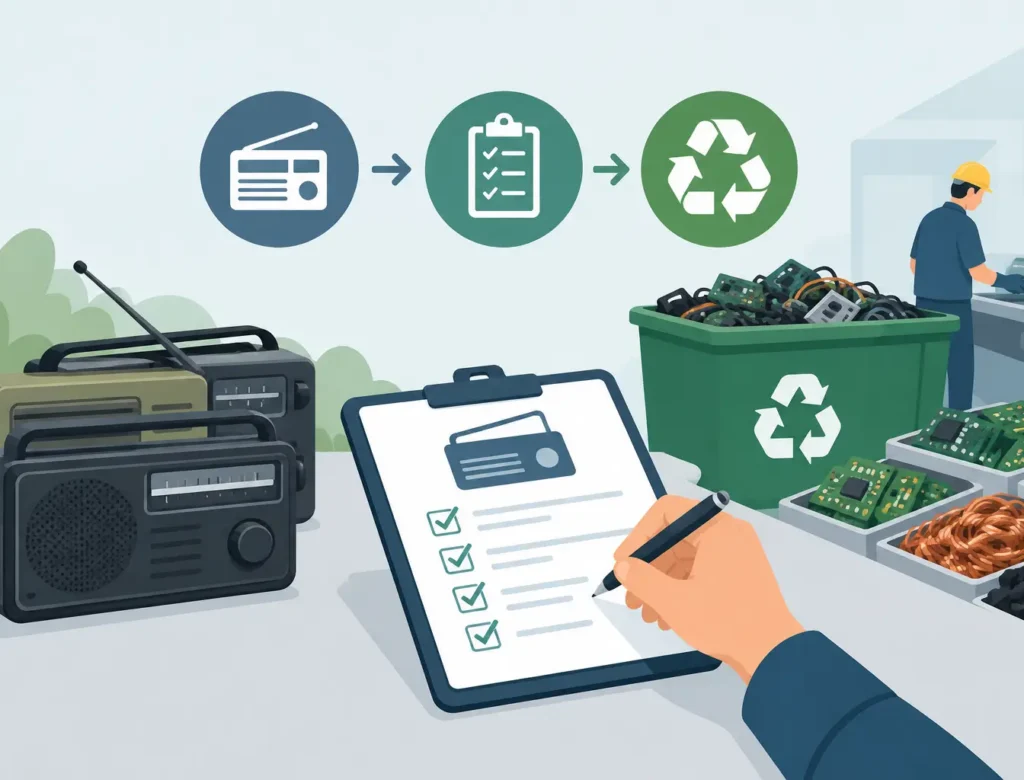
A retired radio fleet does not stop creating risk when it leaves service. Portable radios may retain unit IDs, talkgroup assignments, channel plans, encryption-related settings, contact lists, and records of how an organization operates. Document end-of-life radio processing is how an organization proves those assets were identified, secured, wiped, transferred, and either recovered for value or responsibly recycled.
For hospitals, municipalities, school districts, utilities, manufacturers, and logistics operations, this is more than an IT asset disposition task. Land mobile radio equipment is often spread across departments, vehicles, remote facilities, and storage rooms. A clear documentation process turns a potentially fragmented cleanup effort into an accountable disposition program with financial, security, and environmental results.
Why radio disposition records matter
Radio equipment sits at the intersection of communications security, public operations, and physical asset control. A radio that appears obsolete may still contain active system information. A mobile radio removed from a vehicle may still have a valuable control head, microphone, mounting hardware, or antenna accessory. A base station may include components that require specialized handling.
Without a record of what left the organization and where it went, leaders cannot confidently answer basic audit questions: Which assets were retired? Were they transferred under a documented chain of custody? Was programming data removed? Did the equipment generate resale proceeds, trade-in credit, or recycling documentation? Were non-resalable materials handled through an appropriate downstream process?
The answer is not to create paperwork for its own sake. Good records reduce the time spent reconciling inventories after a replacement project, help finance teams account for recovered value, and give security, procurement, and sustainability teams a common source of truth.
Document end-of-life radio processing from the first inventory
Documentation should begin before equipment is packed, not after the pickup truck leaves. The strongest process starts with a working inventory that connects each radio or equipment group to the organization, location, condition, and intended disposition path.
A complete serial-number inventory is ideal for higher-value portable radios, mobile radios, repeaters, consoles, and encryption-capable equipment. It is not always practical for every low-value accessory or heavily mixed lot. In those cases, organizations should document quantities, model families, condition categories, and representative photographs. The right level of detail depends on the equipment’s value, security profile, and the organization’s internal asset-control requirements.
At minimum, capture the manufacturer, model number, serial number when available, quantity, frequency band, physical condition, and location. Note whether batteries, chargers, speakers, microphones, control heads, vehicle mounts, or other accessories are included. These details improve valuation and prevent a common source of disputes: an inventory that describes complete radio kits when the shipment contains radios only.
For organizations replacing an entire fleet, it also helps to document the reason for retirement. Equipment may be functional but no longer compatible with a new system, surplus after a merger, damaged beyond economical repair, or replaced because coverage and safety requirements changed. That context can guide the resale, trade-in, or recycling decision.
Separate active equipment from surplus equipment
Before finalizing a disposition list, confirm that no radio remains assigned to an employee, vehicle, emergency cache, or mutual-aid function. This simple checkpoint protects continuity of operations. It also prevents replacement projects from creating an unplanned gap in field communications.
Establish a cutoff date for deactivation and identify who has authority to release equipment. For larger fleets, a signed transfer list from the communications manager, facilities lead, or department supervisor provides a useful control. The goal is clear ownership of the handoff, not unnecessary delay.
Treat data removal as a documented event
Professional two-way radios are not generic electronics. Even when a device has no obvious user files, it may hold configuration information that should not follow the radio into resale or recycling channels. Depending on the equipment and system, that can include programming data, unit identifiers, network settings, keys, or other sensitive operational details.
A defensible process records three things: what data may be present, what sanitization method was used, and who verified completion. The method may differ by manufacturer, model, and radio type. Some organizations can remove programming internally before shipment. Others require a qualified downstream processor to perform certified wiping after receipt.
Do not assume that removing a battery, deleting a channel from a programming template, or simply powering off a radio is equivalent to sanitization. Those actions may be operationally useful, but they do not establish that stored information has been removed from every unit.
A data-wiping certificate or completion report should identify the equipment covered, the date of processing, and the sanitization outcome. If a radio cannot be wiped because it is nonfunctional, that exception should be documented and the unit routed to an appropriate destruction or recycling process. Exceptions are normal in mixed-condition fleets. Failing to record them is the problem.
Create a chain of custody that survives an audit
Once equipment is approved for disposition, the record should show each handoff. This is especially important when assets move from multiple campuses, service yards, vehicles, or field offices into a central staging location.
Start with a pickup authorization or bill of lading that identifies the releasing organization, pickup location, date, carrier or processor, and shipment contents. For larger projects, use sealed pallets or containers and record seal numbers. Photos of staged equipment and packed cartons can add useful context when quantities are substantial or conditions are mixed.
At receipt, compare the incoming inventory with the quoted inventory. Variances should be resolved promptly and in writing. A transparent processor will distinguish between equipment that retains resale value, equipment that can be credited toward replacement purchases, and equipment that requires recycling because of condition, age, missing parts, or market demand.
This is also where specialized reverse logistics creates practical value. Radiowell provides free nationwide pickup, documented handling, certified data wiping, and compliant processing for used LMR equipment, helping organizations avoid the cost and administrative burden of coordinating radio disposition through general-purpose channels.
Match documentation to the final disposition path
Not every retired radio should be treated the same way. A current-model portable in working condition may have significant resale value. An older radio with a cracked housing may still be useful for parts. A damaged battery, obsolete accessory, or non-repairable unit may need compliant recycling. Documentation should follow the actual outcome rather than forcing the entire lot into one category.
For equipment sold or traded in, retain the quote, final settlement statement, payment record, and any asset list that supports the transaction. Finance teams may need these records to reconcile proceeds against retired asset values or project budgets.
For equipment recycled, retain the recycling certificate, weight or quantity information when provided, and confirmation of the applicable downstream handling. The objective is traceability. Organizations should be able to demonstrate that non-resalable electronics did not simply disappear into an unverified disposal stream.
Battery handling deserves separate attention. Radio batteries can have different transport, storage, and recycling requirements than the radios themselves, particularly if they are damaged, swollen, leaking, or not safely packaged. Flag these conditions during inventory rather than placing questionable batteries in ordinary cartons. Proper documentation supports safer pickup and prevents shipment delays.
Build a practical retention file
The final file does not need to be complicated, but it should be complete enough for procurement, security, finance, and environmental review. Keep the inventory, approval to dispose, quote or trade-in documentation, pickup record, data-wiping certificate, settlement statement, and recycling certificate together under a consistent project or asset-disposition reference number.
Retention periods depend on internal policy, grant requirements, public-records rules, contractual obligations, and the sensitivity of the radio system. Government agencies and regulated organizations may need longer retention than a private operator. When requirements conflict, follow the stricter applicable standard and involve records-management or legal teams early.
A useful habit is to close each radio retirement project with a short reconciliation. Compare the number of units approved for disposition with the number received, wiped, resold, traded, or recycled. Record unresolved exceptions, such as missing serial numbers, unreturned field units, or equipment held for evidence, training, or emergency spares. That final review is where documentation becomes management information rather than a stack of receipts.
When radio replacement is planned, make end-of-life documentation part of the project scope on day one. The organization that knows what it released, how it was secured, and what value was recovered can retire its communications assets with confidence and move forward without unfinished risk.
More News
-
How to Monetize Retired Radios Without Risk
Learn how to monetize retired radios with fair valuation, secure data handling, free pickup, resale options, and compliant…
How Radio Resale Partners Protect Asset Value
Radio resale partners help organizations recover value, protect sensitive radio data, manage pickups, and meet recycling obligations with…
How LMR Recyclers Protect Value and Compliance
LMR recyclers help organizations recover equipment value, protect sensitive radio data, and meet e-waste requirements with documented handling…

America’s largest buyer of used two-way radio equipment. Maximizing value, compliance, and sustainability for surplus LMR equipment.
Recycle and Partners