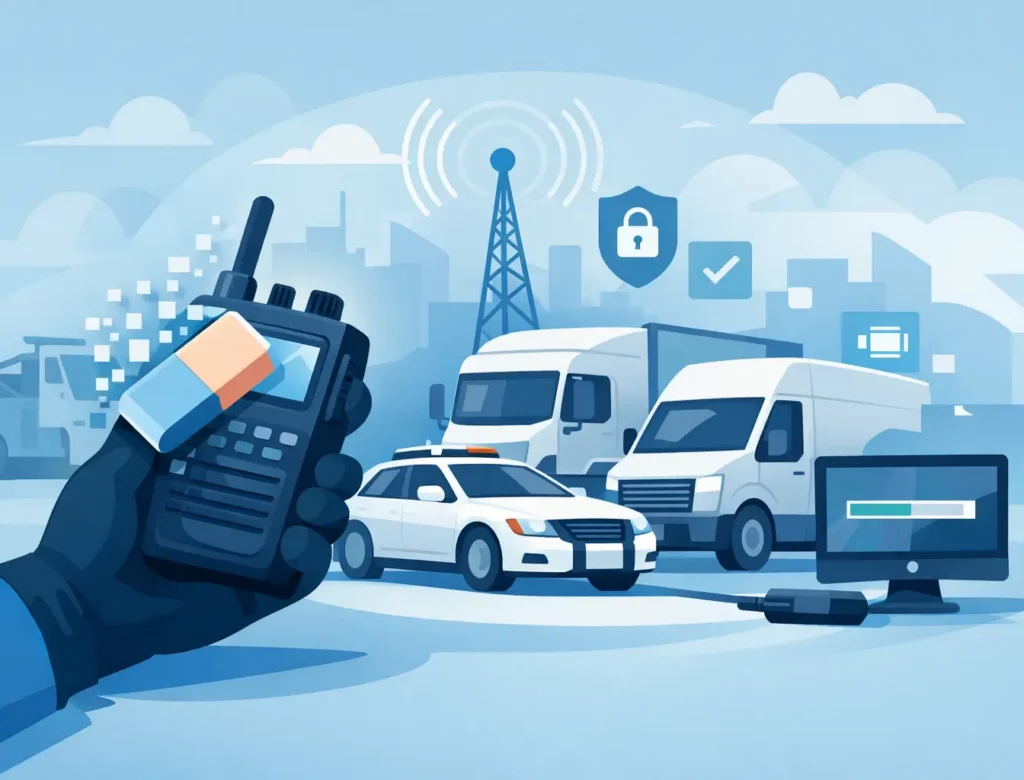
A retired two-way radio can look like a simple surplus asset: remove the battery, place it in a box, and move on. For a hospital, utility, municipality, school district, manufacturer, or logistics operation, that assumption can create a real security gap. Certified radio data wiping addresses the information that may remain inside a device long after it leaves service – including programming files, talkgroup assignments, contact lists, unit identifiers, network settings, and, in some cases, encryption-related material.
The value of a radio disposition program is not limited to clearing storage space. A properly managed process protects sensitive operational information, creates a documented chain of custody, recovers value from usable equipment, and ensures equipment that cannot be resold is handled through compliant recycling channels.
What data can remain on a two-way radio?
Land mobile radio equipment is purpose-built, but it is not data-free. Portable radios, mobile radios, base stations, control stations, repeaters, and accessories can contain configuration details that reveal how an organization communicates. The exact data depends on the make, model, system architecture, and how the equipment was deployed.
A radio codeplug may include conventional frequencies, trunked system settings, talkgroups, scan lists, radio aliases, emergency button behavior, display text, and channel names. In a public-safety, utility, healthcare, or industrial environment, those details may expose operational routines or locations that should not be available to an unknown downstream holder.
Some fleets also contain user records, call logs, Bluetooth pairings, Wi-Fi credentials, GPS settings, or application data. Radios configured for digital systems may store network access parameters, subscriber identities, and security settings. Encryption keys and key-management information require special attention because the appropriate handling method depends on the radio platform and the organization’s security policy.
Even equipment that no longer powers on should be treated carefully. A damaged radio may still contain recoverable memory, and a non-working unit can require controlled recycling rather than casual disposal.
Why a factory reset is not certified radio data wiping
A factory reset may be useful when preparing a device for internal reassignment, but it is not automatically proof that all organization-specific information has been removed. On professional radios, settings can reside in different memory areas, and reset behavior varies by manufacturer and model. A reset may restore certain preferences while leaving configuration records, identifiers, or other data intact.
The same concern applies to simply deleting channels or overwriting a few visible fields. If a fleet has been used for sensitive operations, partial edits are difficult to verify later. They also leave the organization without a defensible record of what was done to each device.
Certified radio data wiping is a controlled process with a defined outcome: data is removed using appropriate methods for the equipment, the work is documented, and the organization receives records that support its asset disposition file. The certification matters because it moves the process from an informal technical task to an accountable control.
For organizations governed by internal security policies, procurement rules, public records obligations, or sector-specific requirements, documentation can be as important as the wipe itself. If a question arises months later, the asset owner should be able to show what equipment was transferred, when custody changed, how it was processed, and whether it was wiped or recycled.
A practical process for secure radio retirement
The strongest outcomes start before pickup. Asset owners do not need to become radio-disposition specialists, but they should identify the scope of the fleet and separate equipment that has different handling requirements.
Build a useful inventory
Start with model numbers, quantities, and general condition. Include portable radios, mobile radios, chargers, speaker microphones, batteries, base equipment, repeaters, and spare parts. If available, record serial numbers or asset tags. A complete inventory improves valuation, supports chain-of-custody records, and reduces the chance that equipment remains overlooked in a vehicle, maintenance room, dispatch center, or remote facility.
Flag radios assigned to secure or mission-critical systems. Your radio administrator, IT security team, communications manager, or system integrator may need to identify models with encryption, special applications, or controlled programming. This step is not about slowing down the project. It prevents a standard disposition workflow from being applied to assets that require a more specific process.
Establish custody before equipment moves
Surplus radios often accumulate over years across departments and sites. Without a clear handoff process, devices can be misplaced, mixed with active inventory, or shipped without matching records. Assign a responsible internal contact and document the transfer of custody when equipment is collected.
For a large distributed fleet, nationwide pickup can eliminate the expense and risk of consolidating radios at one location. It also reduces the burden on facilities teams that would otherwise need to source packaging, coordinate freight, and manage multiple shipments. The right approach depends on quantity, geography, and the sensitivity of the equipment, but control should remain consistent from the first box to final processing.
Wipe, verify, and document each outcome
A qualified radio lifecycle provider evaluates equipment by model, condition, and disposition path. Viable assets can be prepared for resale after data is removed. Equipment with no resale value, significant damage, or obsolete components can be routed to compliant recycling.
Verification should be tied to the actual device or documented asset batch, not treated as a generic statement that every radio was cleared. Ask what the certificate or final report identifies, whether serial numbers are captured when appropriate, and how exceptions are handled. A clear process distinguishes radios that were wiped from units sent directly to recycling because they could not be powered, tested, or economically restored.
Close the financial and environmental loop
Secure disposition does not require giving up asset value. Working radios across low-band, VHF, UHF, and 800 MHz can retain meaningful resale value, especially when organizations replace large fleets on a scheduled refresh cycle. That value may be paid directly or applied as trade-in credit toward replacement communications equipment.
Condition, age, demand, accessories, battery health, and system compatibility all affect the outcome. A newer digital portable in usable condition may have a strong secondary market, while an older analog unit may be worth more for parts or materials recovery. A specialist should make that distinction transparently rather than treating an entire fleet as scrap.
This circular approach also keeps usable communications equipment in service where appropriate and directs non-resalable assets into responsible recycling. It supports sustainability reporting while avoiding the environmental and compliance risks of unmanaged e-waste.
Questions to ask a radio disposition provider
Before releasing a retired fleet, confirm that the provider understands professional LMR equipment rather than treating it like generic consumer electronics. The process should account for radio-specific programming, sensitive system information, serialized assets, batteries, and accessories.
Ask how data wiping is performed for your radio models, what documentation you receive, and how encryption-enabled or otherwise sensitive units are escalated. Confirm who pays for packing and transportation, whether pickup is available across your locations, and how final resale, payment, trade-in credit, or recycling results are reported.
It is also reasonable to ask what happens to equipment a buyer declines. A complete program should not leave your team searching for a second vendor to manage damaged radios, obsolete accessories, or units with no resale market. One accountable disposition path is easier to audit and easier to manage.
When special handling is necessary
Not every radio should enter the same workflow. If a unit contains active encryption keys, belongs to a public-safety system, is subject to contractual restrictions, or may be part of an investigation or records hold, pause the disposition process until the appropriate internal stakeholders approve release.
In some cases, the correct action may be cryptographic zeroization performed by authorized personnel before transfer. In others, the organization may require physical destruction or a specific recycling method. The right decision depends on the device, the data, applicable policy, and the risk associated with the system it supported.
That is why experienced review matters. Speed is valuable when clearing a warehouse or completing a technology refresh, but speed without classification can create avoidable exposure. Radiowell helps organizations combine fast valuation and pickup with documented data handling, resale recovery, and compliant recycling for the equipment that cannot return to service.
Retiring a radio fleet should leave your organization with more than empty shelves. It should leave a clean asset record, protected operational information, recovered value where possible, and confidence that every device reached the right final destination.
More News
-
Municipal Radio Asset Disposition Done Right
Municipal radio asset disposition can recover budget, protect radio data, and ensure compliant recycling when communication fleets are…
Hospital Radio Fleet Replacement Without Waste
Plan a hospital radio fleet replacement with secure data handling, asset recovery, free pickup, and compliant recycling for…
Radio Equipment Chain of Custody Explained
Protect value, data, and compliance with a documented radio equipment chain of custody from retirement through resale, wiping,…

America’s largest buyer of used two-way radio equipment. Maximizing value, compliance, and sustainability for surplus LMR equipment.
Recycle and Partners