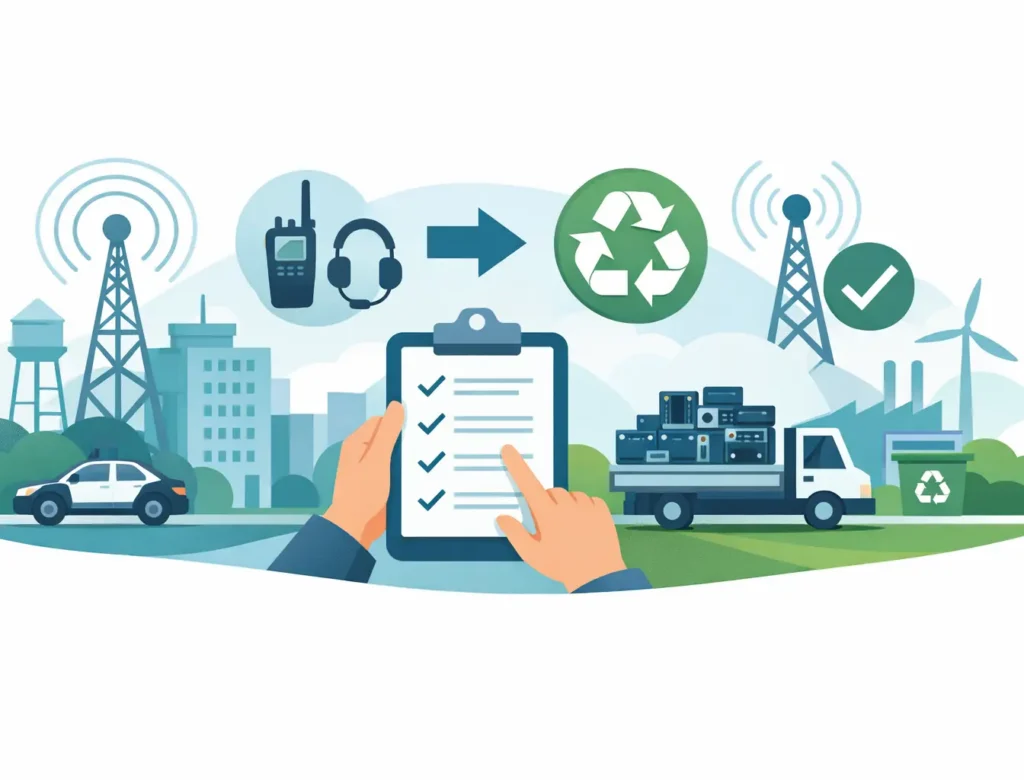
A radio replacement project can leave a municipality with hundreds of portable units, vehicle mobiles, chargers, microphones, repeaters, and accessories sitting in storage. That inventory is not simply obsolete equipment. Municipal radio asset disposition is a budget-recovery, security, and compliance decision that deserves the same discipline as the procurement process that put those assets into service.
The stakes are higher than the resale value of a handheld radio. Retired land mobile radio equipment may retain talkgroup configurations, agency identifiers, fleet maps, encryption material, contact information, and programming details. Improper disposal can create a data exposure, complicate records management, waste taxpayer-funded assets, and send reusable equipment to recycling before its useful life is over.
Why municipal radio assets require a different disposition process
Municipal fleets are rarely uniform. A city may replace police portables on one schedule, retain fire radios longer, and remove older public works mobiles only when vehicles are retired. School districts, transit departments, utility divisions, parks crews, and emergency management teams can all have equipment from different manufacturers, frequency bands, and generations in the same storeroom.
That mix makes a general surplus auction or a generic electronics recycler a poor fit in many cases. A buyer that does not understand professional two-way radio equipment may not recognize the value in a compatible battery platform, a current-generation mobile radio, a tested base station, or a large quantity of accessories. Conversely, a recycler that accepts radios without evaluating programming and data risks may not provide the documentation a public entity needs.
A specialized approach separates what can be reused from what must be recycled, while maintaining chain-of-custody controls from pickup through final processing. It also recognizes that condition, model number, band, firmware generation, included accessories, and market demand all affect value. An older UHF portable may have limited resale value on its own but be valuable as part of a matched fleet. A damaged radio may have recoverable parts. A non-resalable unit still needs responsible handling.
Start disposition planning before the cutover
The strongest outcomes begin before new radios arrive. Once a department has completed its migration, old equipment is often spread across vehicles, lockers, remote facilities, and personal issue records. Time passes, accessories go missing, and no one is certain which units were erased or removed from service.
Include disposition in the project plan at the same time the municipality establishes deployment, training, and cutover milestones. Assign one owner for the retired inventory and decide whether assets will be sold, applied as trade-in credit, retained for approved contingency use, or recycled. This gives finance, procurement, IT, communications, and sustainability stakeholders a shared process rather than a last-minute cleanup task.
An inventory does not need to be perfect before requesting a valuation. It should be sufficient to identify the equipment category, manufacturer, model number, approximate quantity, condition, and location. Clear photos help when available. A qualified radio lifecycle provider can then identify the information needed to establish fair market value and arrange collection.
Record what matters for control and value
Serial numbers are valuable for accountability, but they are not the only useful data point. Document whether radios power on, whether batteries and antennas are included, whether mobile units include control heads and mounting hardware, and whether chargers, speaker microphones, and programming cables are available. Those details can materially change recovery value.
For public safety equipment, record the status of encryption keys, codeplugs, firmware, and agency-specific programming. The objective is not merely to show that equipment left a facility. The objective is to show that sensitive configurations were removed or handled under a documented process.
Protect radio programming and sensitive data
A common misconception is that only smartphones and computers contain sensitive information. Professional radios can store operational data that should not transfer with a used device. Depending on the system and radio configuration, retained information may include channel names, frequencies, unit IDs, contact lists, GPS settings, text messages, Wi-Fi credentials, Bluetooth pairings, and encryption-related information.
The exact sanitization method depends on the radio model, the municipality’s security policy, and whether the equipment is being retained, sold, or recycled. Some agencies perform a verified reset or reprogramming step before release. Others require the disposition provider to conduct certified data wiping as part of its process. Either path can work, provided responsibility is clear and documentation supports the chosen approach.
Do not assume a factory reset removes every relevant element, especially where encryption has been used. Communications managers and system administrators should confirm the required dekeying, reprogramming, and configuration-removal steps for their platform. If a third party will perform wiping, require a certificate or report that identifies the equipment and confirms completion.
Choose the right outcome for each asset class
Disposition is not a single destination. The best path depends on condition, demand, compliance requirements, and the municipality’s financial goals. A specialized buyer can evaluate viable radios for purchase or trade-in, while directing units with no resale potential to compliant recycling.
Four outcomes typically cover a municipal radio inventory:
- Resale for equipment with established secondary-market demand and usable condition.
- Trade-in credit when the municipality is acquiring replacement communications equipment.
- Retention for approved spares, training units, or noncritical uses, with clear ownership and maintenance plans.
- Certified recycling for damaged, unsupported, incomplete, or non-resalable electronics and batteries.
The trade-off is straightforward. Holding equipment for a future need can be sensible when a department has a defined use and compatible infrastructure. Holding it indefinitely because it might be useful someday usually reduces recovery value and increases storage, tracking, and security burdens. Market value often declines as platforms age and manufacturers end support.
Require logistics and documentation that fit public-sector standards
Municipal staff should not have to box, label, palletize, and coordinate freight for surplus radios without support. A capable disposition partner should make collection practical across headquarters, substations, warehouses, vehicle yards, and remote facilities. Nationwide pickup and packing compensation can reduce the administrative cost that often erodes the value of a surplus program.
Before equipment leaves municipal custody, establish what records will be supplied. The appropriate documentation varies by agency policy and asset type, but it commonly includes an itemized inventory or receipt, chain-of-custody confirmation, data-wiping certification when applicable, payment or trade-in records, and recycling documentation for material that cannot be reused.
Compliance matters at every stage. Batteries, circuit boards, displays, and other components require proper handling. A disposition process should account for applicable EPA, FCC, DOT, and e-waste requirements, particularly when transporting lithium-ion batteries or processing equipment that cannot enter the resale stream. Asking how material is handled is not a procedural detail. It is how a municipality protects itself from downstream risk.
Measure the full return, not only the purchase price
The highest quoted price is not always the best disposition result. A municipal team should compare the total value of the service: pickup cost, packing labor, payment timing, data-security controls, recycling practices, documentation, and the buyer’s ability to take the full inventory. A vendor that purchases only the newest radios can leave the municipality paying to manage the rest.
Speed also has value. Prompt evaluation and payment help close capital projects, reconcile fixed-asset records, and return funds to operating budgets. For agencies replacing equipment under a tight fiscal deadline, a same-day fair-market quote and a defined pickup process can remove uncertainty from an already complex deployment.
Radiowell applies this lifecycle model to used LMR equipment by evaluating reusable assets for value, providing nationwide pickup, and managing compliant recycling for equipment that no longer belongs in service. For municipalities, the practical benefit is one accountable path for radios that range from current portable fleets to aging accessories and nonworking units.
A retired radio fleet should leave behind more than cleared shelf space. With an organized municipal radio asset disposition process, it can produce documented security, responsible environmental handling, and financial recovery that supports the next communications investment.
More News
-
Hospital Radio Fleet Replacement Without Waste
Plan a hospital radio fleet replacement with secure data handling, asset recovery, free pickup, and compliant recycling for…
Radio Equipment Chain of Custody Explained
Protect value, data, and compliance with a documented radio equipment chain of custody from retirement through resale, wiping,…
Two-Way Radio Battery Disposal Without Risk
Two-way radio battery disposal protects your organization from fire, shipping, and compliance risk while recovering value from retired…

America’s largest buyer of used two-way radio equipment. Maximizing value, compliance, and sustainability for surplus LMR equipment.
Recycle and Partners