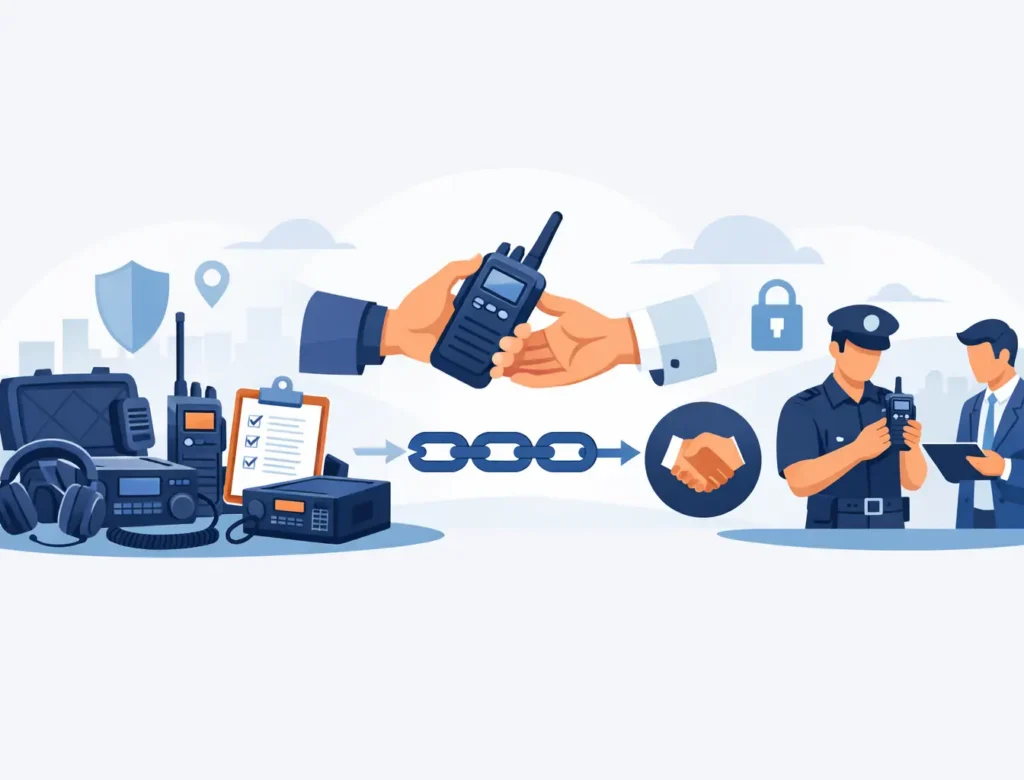
A retired radio fleet does not stop carrying risk when it leaves service. Portable radios, mobiles, repeaters, chargers, and accessories can retain identifiers, programming, encryption material, fleet records, and evidence of ownership. A documented radio equipment chain of custody establishes who handled those assets, when they moved, what condition they were in, and how their final disposition was completed.
For hospitals, utilities, municipalities, school districts, manufacturers, and logistics operations, this documentation is not administrative filler. It is the control that connects asset recovery with data protection, accountable transport, and compliant end-of-life processing.
What a radio equipment chain of custody proves
Chain of custody is the documented record of an asset’s control from the time an organization retires it until it is resold, returned to service, wiped, recycled, or otherwise disposed of. In radio disposition, it should follow both individual units and the shipment as a whole.
The record answers practical questions that can surface months later: Which radios were released? Who approved the transfer? When did a carrier collect them? Did every serial-numbered unit arrive? Were radios assessed for resale, data-wiped, or recycled? Was the final outcome documented?
This matters because LMR equipment is different from ordinary office electronics. A radio can be tied to a department, talkgroup plan, system configuration, subscriber ID, agency ownership, or controlled frequency use. Even an older model with little resale value may require careful handling before it is recycled.
A defensible process does not mean every cable or battery needs a separate report. The level of detail should match the equipment, the organization’s asset controls, and the sensitivity of the deployment. A small commercial radio lot may be documented at the shipment level with a clear inventory. Public safety, healthcare, government, and critical-infrastructure fleets often need unit-level serial-number tracking and stronger release approvals.
The records that matter at each handoff
A reliable chain begins before pickup. The organization retiring equipment should identify the radio types, quantities, approximate condition, and, where required, serial numbers or asset tags. This initial inventory creates the baseline against which every later handoff is checked.
1. Authorization to retire and transfer assets
Someone with authority must approve the disposition. That may be a communications manager, procurement officer, IT asset disposition lead, facilities director, or surplus-property administrator. The approval should identify the equipment category, the disposition path, and the authorized recipient.
This first step prevents a common problem: equipment is removed from a closet or warehouse because it appears obsolete, but the finance, fleet, or radio-system team has not formally released it. Formal authorization protects the organization from disputes over ownership and makes the recovered value easier to reconcile.
2. Inventory and condition documentation
An inventory does not need to slow down a replacement project. It needs to be accurate enough to establish what left the organization. Record model numbers, quantities, and serial numbers when required by policy or asset value. Note accessories separately when they carry material value, such as microphones, control heads, batteries, chargers, antennas, repeaters, base stations, and power supplies.
Condition notes also matter. A working VHF portable, a damaged 800 MHz mobile, and a pallet of untested chargers should not be represented as the same type of asset. Clear condition information supports a fair-market quote and reduces disagreement after inspection.
Photos can help for large lots, fixed equipment, or equipment with visible damage. They are especially useful when multiple departments contribute equipment to a single pickup.
3. Secure packaging, pickup, and transport
The next custody handoff occurs when the equipment is packed and collected. The pickup record should identify the date, pickup location, carrier or receiving party, shipment reference, and number of packages or pallets. A signed bill of lading, receipt, or carrier scan provides evidence that responsibility moved from the retiring organization to the next custodian.
Packaging is part of risk control, not merely a shipping detail. Radios and accessories should be packed to avoid breakage, battery damage, or loose items disappearing during transit. Lithium-ion batteries deserve additional attention because shipping requirements may apply depending on battery type, condition, quantity, and transport method.
Free nationwide pickup can remove a major burden from internal teams, but free pickup alone is not enough. The service provider should be able to document the transfer and account for the shipment on arrival.
4. Receipt, reconciliation, and disposition
At the receiving facility, the shipment should be checked against the expected inventory. Differences are not always a sign of a problem. Organizations may discover extra accessories in storage, inaccurate counts, or model variations that were not visible during the initial review. What matters is that exceptions are identified, resolved, and documented.
Once received, each item should be directed to the appropriate path: resale, trade-in credit, parts recovery, certified data wiping, or compliant recycling. The final record should show the result, not simply that a box arrived at a warehouse.
Data security requires more than a factory reset
Many organizations underestimate what can remain on a decommissioned radio. Depending on the model and configuration, radios may retain channel plans, unit IDs, system keys, encryption-related information, contact lists, text messages, GPS settings, Wi-Fi credentials, network parameters, and operational naming conventions.
A factory reset may be useful, but it is not automatically equivalent to a documented data-sanitization process. Some equipment requires model-specific procedures, authorized software, or a verification step. The right method depends on the radio platform, the sensitivity of its configuration, and whether the equipment will be reused or recycled.
Your chain-of-custody documentation should connect the serial number or asset identifier to the wiping or sanitization outcome when sensitive configurations are involved. A certificate or report should clearly state what was processed and the method used. If a unit cannot be sanitized for reuse, it should be routed for compliant destruction or recycling rather than released into secondary markets.
This is also where using a radio specialist matters. General IT asset disposition providers may understand laptops and phones but lack the equipment knowledge needed to identify proprietary programming, radio-system dependencies, or the resale implications of specific LMR models.
Chain of custody protects financial recovery, too
Documentation is often framed as a compliance cost. Done correctly, it supports value recovery. An accurate inventory helps establish a faster, more defensible quote. It separates viable radios from scrap, identifies high-value accessories, and makes it easier to apply buyback proceeds or trade-in credit to a replacement project.
It also creates a clean audit trail for finance. When a department retires hundreds of radios across several sites, leaders need to know that the approved assets were collected, the final quantities were reconciled, and payment reflects the equipment actually received.
There is a trade-off. Serial-level tracking takes more effort than a broad pallet count. For newer, higher-value fleets or sensitive deployments, that effort is usually justified. For low-value mixed accessories, an aggregated inventory may be the sensible approach. The key is to define the required level of control before pickup, not after equipment has left the site.
Questions to ask a radio disposition partner
Before releasing surplus equipment, ask how the provider documents pickup, receipt, inventory discrepancies, data wiping, resale, and recycling. Ask whether it can handle equipment that is damaged, obsolete, or outside the original buyback scope. Ask how it manages batteries and whether it provides final disposition records that align with your internal compliance requirements.
You should also confirm who is responsible at each stage. A credible provider will make the process clear: quote, approved transfer, scheduled pickup, receiving reconciliation, documented data handling, and payment or trade-in value. Unclear answers at the beginning usually create avoidable work later.
Radiowell applies this specialist approach to used two-way radio equipment, combining nationwide pickup, market-based valuation, documented data wiping, resale, and compliant recycling so organizations do not have to manage separate vendors for each outcome.
Make custody part of the replacement plan
The best time to design a chain of custody is when a radio replacement is being planned, not when surplus units are already stacked in a storage room. Set the approval path, define the inventory standard, identify sensitive radio populations, and choose the records your organization must retain. Then make those requirements part of the disposition provider’s scope before the first shipment moves.
A radio fleet may be retired from daily use, but it still represents organizational value, sensitive operational information, and environmental responsibility. A clear chain of custody gives that equipment a controlled next step – and gives your team proof that the work was done properly.
More News
-
Mobile Radio Resale Guide for Surplus LMR
Use this mobile radio resale guide to value surplus LMR equipment, protect data, arrange pickup, meet compliance obligations,…
Do Radios Store Encryption? A Disposal Reality
Do radios store encryption? Learn where keys and programming data may remain in retired two-way radios and how…
Radio Buyback Versus Scrapping Explained
Radio buyback versus scrapping affects recovery, compliance, data security, and sustainability. See how to choose the right route…

America’s largest buyer of used two-way radio equipment. Maximizing value, compliance, and sustainability for surplus LMR equipment.
Recycle and Partners