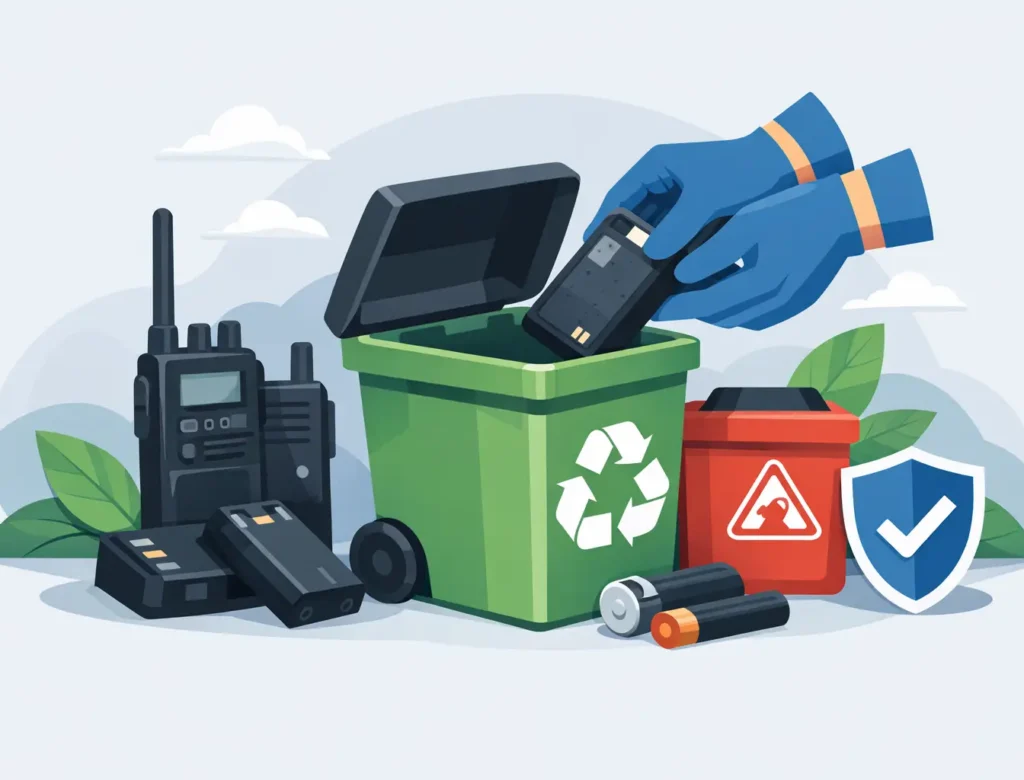
A retired portable radio can look harmless on a storage-room shelf. Its battery may not be. Swollen lithium-ion packs, damaged contacts, aging nickel-cadmium batteries, and loose spare cells create risks that do not disappear when a fleet is taken out of service. Proper two-way radio battery disposal protects people, facilities, and your organization’s compliance record while keeping usable radio equipment out of the scrap stream.
For hospitals, school districts, utilities, municipalities, manufacturers, and logistics operations, the issue is rarely one battery. It is often a mixed inventory accumulated through upgrades, consolidations, device failures, and years of spare-parts storage. The right disposition plan separates batteries by condition and chemistry, preserves equipment with resale value, and documents the final handling of material that cannot be reused.
Why two-way radio batteries need a separate plan
Professional land mobile radio batteries are not ordinary household batteries. Many fleets include lithium-ion packs, nickel-metal hydride batteries, nickel-cadmium batteries, or, in older applications, sealed lead-acid batteries supporting base stations and backup systems. Each chemistry has different safety and recycling requirements.
Lithium-ion batteries demand particular attention because physical damage, terminal contact, heat exposure, and improper packaging can create a fire hazard. A pack that is cracked, swollen, leaking, unusually hot, or visibly corroded should never be placed in a general electronics box or mixed with loose batteries. It should be isolated, handled by trained personnel, and directed to a qualified battery recycler under the appropriate transportation requirements.
Nickel-cadmium batteries present a different problem. Cadmium is a regulated heavy metal, so these batteries should not enter landfill waste or an informal scrap channel. Nickel-metal hydride packs may appear less concerning, but they still contain recoverable materials and should be processed through a recycling program equipped to manage rechargeable batteries.
The operational lesson is straightforward: do not treat a radio fleet as one uniform disposal category. The radios, batteries, chargers, accessories, and infrastructure may each have different value, safety considerations, and end-of-life paths.
Start with an inventory, not a dumpster
The fastest way to create unnecessary cost is to discard everything together. Before arranging pickup or recycling, identify what you have and where it is located. A practical inventory does not need to become a months-long project. It should establish the radio model, approximate quantity, battery type where known, general condition, and whether equipment is still deployed, stored, or damaged.
This review often reveals that the batteries are only one part of a recoverable asset pool. Working portable radios, mobile radios, chargers, speaker microphones, antennas, repeaters, and base-station components may retain resale or trade-in value. Even older equipment that no longer fits your current system can be useful to another organization, provided it is tested and eligible for reuse.
Keep damaged or suspect batteries out of that recoverable inventory. Mark them clearly and store them apart from operational equipment. If a battery remains attached to a radio and shows signs of swelling or damage, do not force removal. Improper removal can damage the contacts or puncture the battery enclosure.
Identify battery chemistry when possible
The battery label is the best starting point. Look for markings such as Li-ion, LiPo, NiMH, NiCd, or SLA. Record the manufacturer and part number when the label is readable, especially for large lots. This information helps a qualified disposition provider determine packing, shipping, recycling, and potential resale options.
When labels are missing or unreadable, do not guess. Treat unknown packs cautiously and have them assessed by a specialist. Batteries from the same radio model are not always identical, particularly when fleets have been maintained over several contract cycles.
Safe storage before pickup or recycling
Battery disposal problems often begin before transportation. A battery may sit in a hot vehicle, be piled into an unmarked bin, or be packed alongside metal accessories that bridge exposed terminals. These are preventable failures.
Store batteries in a cool, dry, secured area away from direct sunlight, flammable materials, and high-traffic work zones. Keep them out of reach of unauthorized personnel. For removable packs, protect exposed terminals from contact with other batteries or conductive materials. Do not place loose batteries in plastic bags with keys, tools, charger contacts, or metal radio parts.
Do not attempt to repair, crush, puncture, disassemble, or incinerate a battery. Do not place rechargeable radio batteries in municipal trash, recycling carts, or universal scrap containers. If a battery is leaking, smoking, hot, or emitting an odor, follow your organization’s emergency procedures and involve facility safety personnel immediately.
Condition matters when deciding how to prepare a shipment. Intact batteries may be eligible for standard collection processes, subject to the carrier and recycler requirements. Damaged, defective, or recalled batteries can require more restrictive packaging, labeling, and transportation controls. That distinction is one reason a specialist review is more reliable than a one-size-fits-all recycling box.
Transportation compliance is not optional
Shipping batteries is regulated because of the hazards involved, especially with lithium-ion chemistry. U.S. Department of Transportation requirements can apply to classification, packaging, terminal protection, labeling, documentation, and carrier selection. The requirements vary based on battery type, watt-hour rating, condition, quantity, and whether the battery is shipped alone or installed in equipment.
Organizations should not assume that placing batteries inside a box of radios makes the shipment compliant. Nor should they send a mixed, unverified battery lot through an ordinary mail or parcel process. A compliant provider can evaluate the material, determine the appropriate handling path, and arrange packaging and transportation that matches the condition of the inventory.
This is particularly relevant for distributed organizations. A school district may have radios at multiple campuses. A utility may have equipment in field offices. A hospital system may have spare batteries stored in engineering, security, and emergency management areas. Centralizing material without a documented chain of custody can create confusion and increase risk. A coordinated pickup plan gives every location a clear process and keeps accountability intact.
Keep data security in the radio disposition workflow
The battery itself does not store radio programming. The radio it powered may. Retired two-way radios can retain talkgroup assignments, channel plans, unit IDs, customer-specific configurations, encryption-related information, and other operational details. Removing the battery does not erase that data.
That is why battery recycling should be part of a broader LMR asset-disposition process. Separate unsafe or end-of-life batteries for compliant recycling, then evaluate the radios and related equipment for data wiping, resale, trade-in, or recycling. The organization needs records showing what was collected, what was wiped, what was remarketed, and what was responsibly processed at end of life.
For public-sector agencies and critical operations, this documentation supports more than environmental goals. It helps demonstrate control over sensitive communications assets after they leave the field. For procurement, finance, and sustainability teams, it also creates a defensible record of value recovery and material diversion.
When batteries may still have value
Not every retired battery is waste. Unused OEM batteries, recently purchased spares, and tested packs with useful service life may have resale value when paired with compatible equipment. The trade-off is that battery condition must be verified. A battery that powers on is not automatically suitable for resale, particularly if it has been stored for years or exposed to demanding field conditions.
Organizations should be cautious about selling untested batteries independently or distributing them internally without assessment. A weak pack can undermine the reliability of a radio system, and an aging lithium-ion pack may pose a greater safety risk than its apparent value justifies. In many cases, resale is appropriate for tested, viable equipment while aged or damaged batteries move directly into a compliant recycling stream.
This is where a circular approach produces better results than blanket disposal. Reuse the assets that can support another user, recover fair-market value where available, and recycle the remainder through the correct channel. Radiowell helps organizations make those distinctions without creating a separate logistics project for internal staff.
Build battery disposal into every radio replacement
The best time to plan battery disposition is before new radios arrive. Add retired batteries, chargers, and accessories to the replacement project scope alongside the radio units themselves. Establish who will collect equipment, where it will be staged, how damaged batteries will be identified, and what documentation is required at completion.
A clear process also prevents the familiar backlog of outdated packs in closets, maintenance cages, and remote sites. Those batteries do not become easier to manage with age. They lose value, occupy space, and can create a safety issue long after the radio system they supported has been replaced.
A well-managed retirement program turns that backlog into a controlled business process: viable LMR equipment is evaluated for financial recovery, sensitive radio data is handled appropriately, and batteries are routed for safe, compliant reuse or recycling. The result is less liability left on the shelf and a cleaner start for the communications system your teams rely on next.
More News
-
Mobile Radio Resale Guide for Surplus LMR
Use this mobile radio resale guide to value surplus LMR equipment, protect data, arrange pickup, meet compliance obligations,…
Do Radios Store Encryption? A Disposal Reality
Do radios store encryption? Learn where keys and programming data may remain in retired two-way radios and how…
Radio Buyback Versus Scrapping Explained
Radio buyback versus scrapping affects recovery, compliance, data security, and sustainability. See how to choose the right route…

America’s largest buyer of used two-way radio equipment. Maximizing value, compliance, and sustainability for surplus LMR equipment.
Recycle and Partners