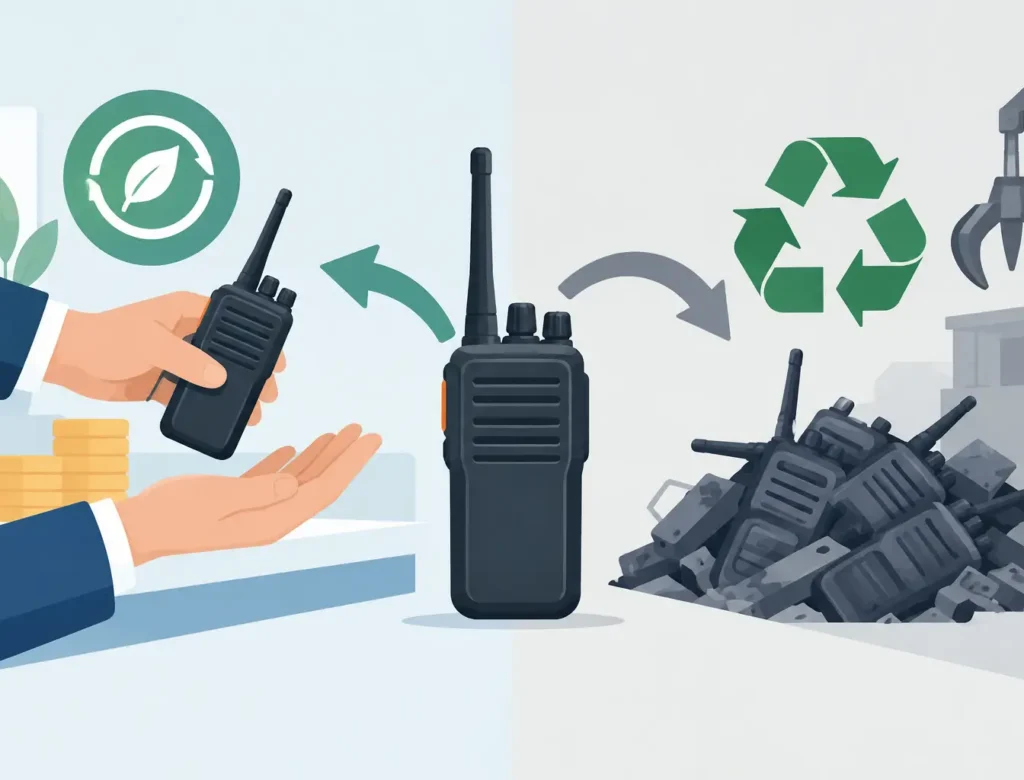
A fleet replacement can leave a hospital, municipality, utility, or warehouse with hundreds of retired radios in storage. The question is not simply where to put them. Radio buyback versus scrapping determines whether those assets produce recovered value, create an avoidable compliance burden, or become a documented sustainability win.
For professional land mobile radio equipment, the right answer is rarely based on age alone. A radio that no longer meets one organization’s operational needs may still have resale value, useful parts, or trade-in potential. Conversely, equipment that cannot be resold still requires secure, compliant handling. The strongest disposition plan separates recoverable assets from material that should be recycled, rather than treating every retired radio as scrap.
Radio Buyback Versus Scrapping: The Business Difference
A radio buyback is an asset-recovery process. A qualified buyer evaluates used portable radios, mobile radios, base stations, repeaters, accessories, and related LMR equipment, then offers payment or trade-in value based on demand, condition, model, frequency band, completeness, and resale potential. Viable equipment can be refurbished and placed back into service, extending its useful life.
Scrapping, by contrast, is the end-of-life path for equipment with little or no recoverable market value. Radios may be dismantled so metals, circuit boards, batteries, and other materials can enter appropriate recycling streams. Scrapping is necessary for some equipment, but it should not be the default simply because a fleet has been replaced.
The financial distinction can be significant. A pallet of working radios with chargers, batteries, antennas, and programming accessories may represent a recoverable asset. If that same equipment is sent directly to a general scrap operation, its value is reduced to commodity material weight. The organization loses the premium associated with tested, identifiable, reusable communications equipment.
That does not mean every retired radio should go through a buyback program. Some units are damaged beyond economical repair, obsolete with no meaningful secondary demand, missing critical components, or restricted in ways that prevent resale. A specialist should assess the lot and identify which assets belong in resale, which can be harvested for usable parts, and which require compliant recycling.
What Creates Value in Used LMR Equipment?
Marketability depends on more than whether a radio turns on. Professional buyers consider the manufacturer and model, supported band, feature set, cosmetic and functional condition, quantity, accessories, and current demand in the secondary market. Common VHF, UHF, 800 MHz, and low-band equipment may retain value when it can support active users, while certain niche or discontinued models may have limited demand.
Fleet consistency also matters. One hundred matching portable radios with chargers and batteries are generally easier to evaluate and resell than a mixed collection of individual units. Complete systems can carry greater value because buyers do not need to source every accessory separately. Mobile radios, control heads, microphones, repeaters, power supplies, base stations, and spare parts should be included in the inventory rather than discarded as incidental hardware.
Condition affects value, but organizations should not self-screen too aggressively. Units with worn housings, weak batteries, missing knobs, or unknown operational status may still have recoverable value. Even radios conventional buyers decline can contain reusable components or recyclable materials. The practical first step is an accurate inventory with model numbers, quantities, and available accessories.
Security Comes Before Resale or Recycling
Retired radios can retain more information than many asset managers expect. Depending on the equipment and system configuration, stored data may include talkgroup assignments, channel plans, frequencies, unit identifiers, contact lists, programming files, encryption-related information, network settings, or operational details. A radio removed from service is not automatically cleared for disposition.
This is where a general electronics recycler and a radio-focused lifecycle provider can differ substantially. The organization disposing of the equipment remains responsible for ensuring that sensitive programming and data are addressed before the equipment changes hands. A defensible process includes documented data wiping or secure handling procedures aligned with the type of radio and the information it may contain.
Encryption requires particular care. Encryption keys and key-management processes should be handled under the organization’s established security controls before equipment leaves the site. Not every device stores sensitive data in the same way, and removal or reset procedures vary by manufacturer and system. Communications, IT, and security teams should establish the requirements before approving a disposition vendor.
A secure process protects more than confidential information. It reduces the risk of unauthorized use, supports internal governance, and gives procurement or asset-disposition teams documentation they can retain for audits and records management.
Compliance Is Not a Scrap Bin Decision
Professional radio disposal can involve environmental, transportation, and regulatory considerations. Batteries require separate handling, especially lithium-ion and other rechargeable battery types. Damaged batteries may present shipping and safety concerns, while electronic equipment and circuit boards should be processed through appropriate e-waste channels rather than placed in general waste.
Organizations also need a clear chain of custody. This is especially relevant for public agencies, healthcare systems, schools, utilities, and operators with distributed locations. Equipment may be collected from multiple facilities, transferred through several hands, and held until final disposition. Without organized pickup, inventory reconciliation, and certificates or reports, it can be difficult to prove what happened to each asset class.
The objective is not paperwork for its own sake. Documented handling gives leaders certainty that retired equipment was managed in accordance with organizational policy and applicable EPA, FCC, DOT, and e-waste requirements. It also prevents the false economy of choosing a low-cost disposal option that later creates administrative work, security exposure, or environmental liability.
When Buyback Is the Better Choice
Buyback is usually the stronger option when equipment is in usable condition, part of a recognizable professional radio line, and available in quantities that justify evaluation and logistics. It is also valuable when an organization needs to clear storage quickly while recovering budget for replacement communications equipment or other operational needs.
Trade-in credit can be particularly useful during a system upgrade. Rather than treating the outgoing fleet as a sunk cost, the organization can apply recoverable value toward newer equipment. This supports more accurate lifecycle budgeting and can help offset the capital impact of a planned replacement.
A specialized buyer should make the process operationally easy: provide a prompt fair-market quote, arrange nationwide pickup, compensate for packing when appropriate, and issue payment without leaving staff to list radios individually or coordinate multiple vendors. For busy facilities, public-safety support teams, and communications managers, reducing internal handling is part of the value.
When Scrapping Is the Right Answer
Scrapping is appropriate when equipment cannot be safely or economically returned to service. Examples include severely damaged radios, unsupported equipment with no secondary demand, depleted or unsafe batteries, and components that fail inspection. It is also the responsible path after a buyer has identified items that do not qualify for resale.
The key is to use compliant recycling, not informal disposal. A proper recycling process separates materials responsibly and provides documentation that supports the organization’s environmental and asset-disposition records. For equipment with no resale value, responsible recycling is still a positive outcome: it keeps e-waste out of inappropriate waste streams and recovers materials where possible.
In many cases, the best solution is a combined program. Resalable radios are purchased, reusable parts are recovered where feasible, and the balance is recycled. That approach maximizes financial recovery without forcing unsuitable equipment into the resale channel.
A Practical Disposition Process for Retired Radios
Start by gathering a high-level inventory. Record manufacturers, model numbers, quantities, radio types, frequency bands, and major accessories. Do not delay the process because every serial number is not immediately available. A qualified evaluator can often begin with photos and a summary of the equipment.
Next, involve the right internal stakeholders. Communications personnel can identify programming and encryption considerations. IT or security teams can confirm data-handling requirements. Procurement, finance, and sustainability leaders can define recovery, documentation, and approval needs. This early coordination prevents a last-minute decision to discard equipment that has value or requires controlled handling.
Then choose a partner that can manage the full outcome, not just make an offer on the easiest units. Radiowell evaluates surplus LMR equipment for buyback, trade-in, resale, and compliant recycling, so organizations can avoid managing separate vendors for valuable radios and non-resalable material. A complete program should include clear valuation, pickup logistics, secure processing, and final records.
Retired radio equipment should not become a storage problem or a line item written off without review. Treat it as a lifecycle decision. The right disposition path can return funds to the organization, protect sensitive operational information, and ensure that equipment no longer needed in the field is handled with the same accountability expected while it was in service.
More News
-
Where to Sell Police Radios for Maximum Value
Where to sell police radios securely: compare buyers, protect programming data, recover fair value, and arrange compliant pickup…
How to Monetize Retired Radios Without Risk
Learn how to monetize retired radios with fair valuation, secure data handling, free pickup, resale options, and compliant…
How Radio Resale Partners Protect Asset Value
Radio resale partners help organizations recover value, protect sensitive radio data, manage pickups, and meet recycling obligations with…

America’s largest buyer of used two-way radio equipment. Maximizing value, compliance, and sustainability for surplus LMR equipment.
Recycle and Partners