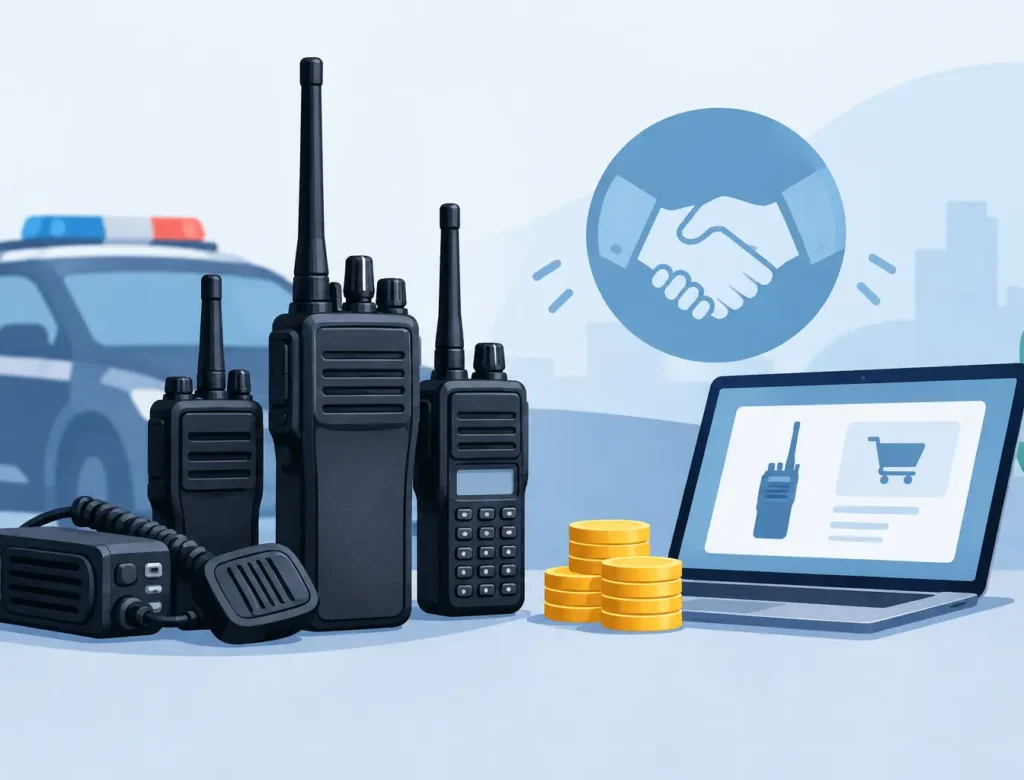
A retired police radio is not ordinary surplus electronics. It may contain agency identifiers, talkgroup information, encryption keys, fleet programming, or accessories that still carry value. If you are deciding where to sell police radios, the right answer depends on the equipment’s ownership, condition, data security requirements, and whether the buyer can handle public-safety communications equipment responsibly.
For municipalities, law enforcement agencies, school districts, hospitals, transit authorities, and other organizations, a specialist buyer is usually the most efficient path. The goal is not simply to clear a storage room. It is to recover fair value, protect sensitive information, document the disposition process, and ensure any equipment that cannot be resold is recycled properly.
Where to Sell Police Radios: Your Main Options
Organizations generally have four routes for retired police radios: a specialized land mobile radio buyer, direct resale, auction or liquidation, and recycling. Each option has a place, but the operational burden and risk are very different.
A specialized LMR buyer is often the strongest fit for a fleet, mixed lot, or public-safety radio system. These buyers understand portable radios, mobile radios, control stations, repeaters, chargers, microphones, antennas, and related accessories. They can evaluate equipment across low-band, VHF, UHF, 700/800 MHz, and other common public-safety bands without requiring your team to research every model individually.
Direct resale through general marketplaces may appear to offer a higher return for a few desirable units. In practice, it requires staff time for photography, listings, questions, packing, shipping, payment management, and returns. It also creates more exposure if radios are released without proper programming removal or if the organization does not have clear authority to sell them.
Auction houses and general surplus liquidators can move large quantities quickly, but they may lack radio-specific expertise. A mixed pallet of older radios, batteries, chargers, and mobile equipment can be undervalued when it is treated as generic electronics. General liquidators may also decline obsolete, damaged, or incomplete equipment that a radio specialist can still assess for reuse, parts recovery, or compliant recycling.
Recycling is necessary for equipment with no resale value, especially damaged radios, failed batteries, obsolete accessories, and broken infrastructure components. However, recycling should not be the first assumption. A knowledgeable buyer can separate reusable equipment from material that has reached its end of life, helping organizations avoid giving away value unnecessarily.
Start With Ownership and Release Authority
Before requesting a quote, confirm that the organization has authority to dispose of the radios. Police radios are often purchased with public funds, grant funding, or through regional communications programs. They may be subject to municipal surplus policies, procurement rules, grant closeout requirements, or agreements with a county, state, or radio system administrator.
This matters even when equipment has been sitting unused for years. A radio that appears to be agency-owned may be part of a shared system, leased program, mutual-aid cache, or contract arrangement. Documenting approval protects the organization and gives the buyer confidence that the transaction is legitimate.
For agencies disposing of subscriber units from an active public-safety network, coordinate with the system administrator before release. Some radios must be removed from the system database, reported as retired, or disabled according to local policy. The radio hardware may be yours to sell, but the network access, identifiers, and configuration information require separate handling.
Data and Encryption Should Be Handled Before Sale
A professional two-way radio can retain more than channel names. Depending on the model and configuration, it may hold radio IDs, unit aliases, talkgroups, emergency settings, scan lists, system keys, Wi-Fi credentials, GPS data, or encryption-related information. Treat every radio as a potential information-bearing device until its contents have been reviewed and cleared.
Do not rely on a casual factory reset as your entire data-handling plan. The appropriate method depends on the manufacturer, model, codeplug structure, and whether encryption or proprietary system credentials were used. Your communications manager, radio shop, or system administrator should identify what must be removed before the equipment leaves agency custody.
A qualified disposition partner should support a documented process for secure data wiping and chain of custody. Ask how the buyer handles programmed radios, how it separates units awaiting processing, and whether it can provide documentation for your records. For public-sector and enterprise asset managers, this documentation is as important as the purchase price.
Encryption creates an additional boundary. Encryption keys, key-loading devices, key-management materials, and certain secure accessories should never be included casually with surplus equipment. Follow your agency’s cryptographic and records-management policies. When there is any uncertainty, consult the system administrator or authorized radio technician before transfer.
What Determines Police Radio Resale Value
Value is based on more than whether a radio powers on. Brand, model, frequency band, generation, features, cosmetic condition, and quantity all matter. Current or widely supported models with working displays, knobs, housings, batteries, chargers, and antennas typically attract stronger offers than incomplete or heavily worn units.
The type of equipment also affects demand. Portable radios are common, but mobile radios, base stations, repeaters, dispatch consoles, control heads, microphones, power supplies, and accessories can all have recoverable value. A buyer that understands LMR equipment can evaluate the full inventory rather than cherry-picking only the easiest items to resell.
Age does matter, but older equipment is not automatically worthless. A discontinued model may still be useful to organizations maintaining an existing fleet, and accessories may remain valuable after the radio platform itself has declined. Conversely, a newer radio may have limited resale potential if it is locked, damaged, unsupported, or tied to a narrow proprietary system.
Quantity can improve both valuation and efficiency. One portable radio may not justify individual packing and shipment. A department replacing 50, 500, or several thousand units has a different disposition opportunity, especially when the lot includes chargers, vehicle mounts, speaker microphones, and spare parts. Provide a complete inventory instead of disposing of accessories separately.
How to Prepare a Radio Inventory for a Quote
A detailed spreadsheet is helpful, but it does not need to become a weeks-long project. Start with manufacturer, model number, quantity, band or system type if known, and a general condition description. Clear photos of representative equipment, labels, and accessories make the process faster.
Include radios that do not work, have cracked housings, are missing batteries, or lack chargers. Do not discard them before a specialist evaluates the lot. Nonworking equipment may still have parts value, and including it allows the buyer to plan recycling for material that cannot be resold.
If available, provide the following information:
- Manufacturer and model numbers
- Quantity of portable, mobile, base, and infrastructure equipment
- Accessories such as chargers, batteries, microphones, antennas, and control heads
- Known operational condition and any physical damage
- Whether programming, encryption, or system credentials have been removed
- Pickup location, number of pallets or boxes, and any deadline for removal
This information supports a more accurate fair-market quote and reduces surprises after pickup. It also helps the buyer determine whether packing support, freight coordination, or onsite collection is appropriate.
Choose a Buyer That Can Manage the Entire Disposition
The best place to sell police radios is a buyer that can manage the transaction from valuation through final disposition. A quote without logistics, data handling, or recycling support can shift the difficult work back to your organization.
Ask practical questions before selecting a partner. Can they quote the entire lot quickly? Do they offer free nationwide pickup? Will they compensate for packing or provide shipping guidance? Can they accept mixed-condition equipment? How is sensitive programming handled? What documentation is available for data wiping, recycling, and payment?
Also ask what happens to equipment that does not qualify for resale. A credible partner should distinguish between reusable assets and end-of-life material, then process each through the appropriate channel. This is especially relevant for batteries and electronic components that require responsible handling under applicable EPA, FCC, DOT, and e-waste requirements.
Radiowell works with organizations that need to retire professional two-way radio assets without adding logistics cost or administrative burden. The focus is straightforward: same-day fair-market evaluation, nationwide pickup, secure handling, rapid payment or trade-in value, and compliant recycling for equipment that cannot be reused.
Avoid the Shortcuts That Create Risk
Do not send active, programmed radios to a general buyer simply because the offer arrives first. A quick sale can become an internal issue if equipment leaves without authorization, data clearing, or a defensible chain of custody. Similarly, do not assume every old radio should go into an electronics recycling bin. That decision may sacrifice recoverable value and leave the organization without disposal records.
Be cautious with batteries. Damaged, swollen, leaking, or untested batteries need appropriate packaging and transportation procedures. Do not combine them loosely with radio equipment or ship them without understanding the carrier and hazardous-material requirements.
Finally, retain the transaction records. Keep the inventory, approval to dispose, quote, pickup confirmation, payment record, and any data-wiping or recycling certificates with your asset disposition files. These records support audit readiness and make the next replacement cycle easier to manage.
A retired police radio fleet can become recovered budget, trade-in credit, and documented sustainability progress – provided the equipment is released through a process built for public-safety communications assets.
More News
-
Radio Buyback Versus Scrapping Explained
Radio buyback versus scrapping affects recovery, compliance, data security, and sustainability. See how to choose the right route…
How to Monetize Retired Radios Without Risk
Learn how to monetize retired radios with fair valuation, secure data handling, free pickup, resale options, and compliant…
How Radio Resale Partners Protect Asset Value
Radio resale partners help organizations recover value, protect sensitive radio data, manage pickups, and meet recycling obligations with…

America’s largest buyer of used two-way radio equipment. Maximizing value, compliance, and sustainability for surplus LMR equipment.
Recycle and Partners