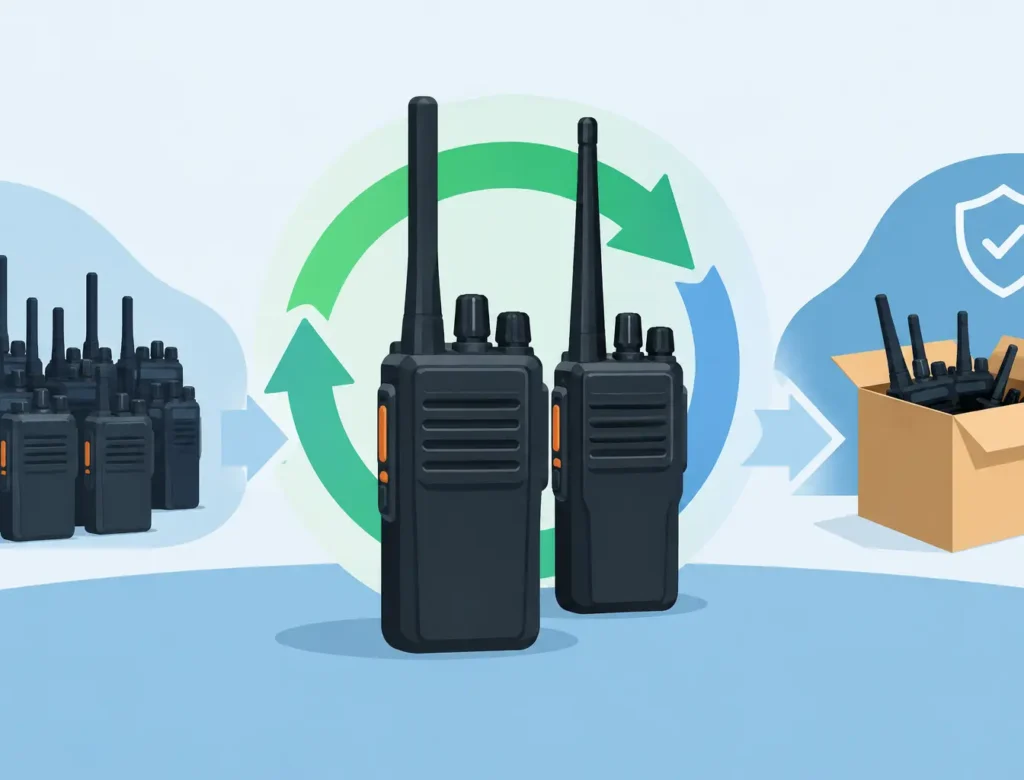
A mobile radio resale guide should start with a simple premise: retired communications equipment is still an asset until its condition, demand, and compliance requirements prove otherwise. Vehicle-mounted radios, control stations, base stations, repeaters, microphones, chargers, and accessories can retain meaningful value, particularly when they are complete, tested, and from supported product lines. The difference between a productive asset recovery project and a costly disposal exercise is the process used to evaluate, secure, and move that equipment.
For hospitals, municipalities, utilities, manufacturers, school districts, logistics operators, and public agencies, radio replacement often happens under operational pressure. A system migration, fleet refresh, frequency change, or technology upgrade can leave hundreds or thousands of radios in storage. Those devices should not become an untracked inventory problem. A structured resale process can generate return, reduce administrative work, protect sensitive information, and provide a documented path for equipment that cannot be resold.
When mobile radios have resale value
Professional mobile radios generally hold value when there is an active secondary market for the make, model, band, and feature set. Current or recently discontinued models tend to be easier to resell than equipment with limited support, obsolete accessories, or damaged control heads. However, age alone does not determine value. A well-maintained analog mobile radio may still be useful to a business with a straightforward coverage need, while a newer unit that is incomplete or locked by a missing component may have limited resale potential.
The highest-value opportunities usually include radios that are operational, have matching control heads and mounting hardware, and are accompanied by microphones, power cables, brackets, speakers, or programming accessories. Quantity matters, but it is not the only factor. A large, mixed lot can still be valuable when the models are clearly identified and grouped by condition.
Frequency band and system capability also affect demand. Low-band, VHF, UHF, and 800 MHz equipment each serve distinct user bases. Features such as P25 capability, trunking, digital operation, GPS, Bluetooth, encryption support, and remote-mount configurations can influence marketability. The right question is not simply, “Are these radios old?” It is, “What are these radios, how complete are they, and who can still use them?”
Mobile radio resale guide: prepare inventory before requesting a quote
A reliable quote begins with accurate equipment identification. Organizations do not need to test every radio or create a perfect asset register before requesting an evaluation. They do need enough information for a specialist to distinguish between similar-looking models and assess whether the lot includes valuable components.
Start by documenting manufacturer, model number, quantity, frequency band, and general condition. Clear photos of front panels, model labels, control heads, accessories, and any visible damage are often more useful than a long narrative. If radios are installed in vehicles, identify whether the sale includes only the radio body or also the control head, microphone, cables, mounting bracket, antenna hardware, and external speaker.
Before releasing equipment, separate items that may contain programming, encryption keys, talkgroup assignments, user IDs, network details, or other operational information. Even when a radio is no longer active on a system, stored configuration data can expose information about agency operations, facility communications, or fleet deployment.
For efficient preparation, capture these details for each model group:
- Manufacturer and complete model number from the product label
- Quantity available and whether units are in serviceable, untested, or damaged condition
- Included accessories, such as microphones, mounting brackets, cables, and control heads
- Whether equipment is conventional, digital, trunked, encrypted, or part of a larger system
- Any known missing parts, display damage, corrosion, battery issues, or vehicle-installation constraints
This level of documentation improves quote accuracy without creating unnecessary workload. It also helps finance, procurement, IT asset disposition, and communications teams work from the same record.
Do not treat programming data as an afterthought
Data handling is one of the most consequential parts of radio disposition. Mobile radios can retain channel plans, unit identifiers, encryption material, fleet mapping, and operational settings. A general electronics recycler may understand e-waste handling but may not have the specialized process required to identify, wipe, and document communications-device data.
Ask prospective buyers how they handle device configuration and sensitive data. The answer should be specific. A qualified radio lifecycle partner should explain the wipe process, provide documentation where applicable, and identify equipment that requires additional controls. If your organization uses encryption, involve the radio system administrator or security team before the equipment leaves your control.
Physical custody matters as well. A documented chain of custody, scheduled pickup, and clear receiving records reduce uncertainty during a fleet retirement. These controls are especially relevant for public safety, government, healthcare, and critical-infrastructure organizations, but they are good practice for any business operating professional LMR equipment.
What affects your mobile radio resale return
Fair-market value is based on more than an online asking price for a single unit. Resale buyers must account for testing, refurbishment, parts availability, demand, logistics, and the risk associated with incomplete or unverified equipment. That is why the best quote is not always the highest number stated before anyone has seen the inventory.
Condition creates a practical trade-off. Fully tested, clean, complete radios generally command more value than untested units, but it may not be cost-effective for an organization to spend staff time testing a large surplus lot. In many cases, a qualified buyer can evaluate mixed-condition inventory and price it accordingly. The objective is to maximize net recovery, not to create an internal labor project that consumes the proceeds.
Completeness also changes the outcome. A mobile radio without its control head may still have value, but its market is narrower. Loose microphones, brackets, power cables, and speakers can improve resale potential when kept with compatible units. Conversely, do not delay a disposition project because every accessory cannot be located. A specialist can determine whether partial inventory is best resold, harvested for components, or recycled.
Timing matters too. Equipment usually has greater value while it remains supported and before a large number of similar units enter the market. Holding retired radios for years can create storage costs, weaken documentation, and reduce recovery. Once a replacement project is approved, plan the disposition path alongside the deployment schedule.
Choose a buyer that can handle the whole disposition process
Selling surplus radios one at a time can be appropriate for a hobbyist with a few units. It is rarely efficient for an organization responsible for dozens or hundreds of assets. Individual listings require photos, testing, buyer communication, packaging, shipping, payment collection, and resolution of returns or disputes. They also create inconsistent handling of sensitive data and equipment records.
For institutional inventories, look for a buyer with a defined process for same-day valuation, nationwide pickup, packing support or compensation, secure data handling, prompt payment, and compliant recycling. The buyer should accept a broad range of LMR equipment, including viable radios and assets that have no resale market. That avoids the common problem of receiving an offer for the desirable units while being left to manage everything else.
Radiowell approaches surplus LMR as a lifecycle management project rather than a simple liquidation event. That distinction is useful when an inventory includes a mix of portable radios, mobile radios, base stations, accessories, legacy equipment, and non-working devices. Resalable equipment can produce payment or trade-in credit, while non-resalable items can move through an appropriate recycling stream without shifting the burden back to your team.
Plan pickup, records, and final disposition
Before pickup, establish who is authorized to release the equipment and what records your organization needs to retain. Depending on your policies, that may include an asset list, photos, serial-number records, transfer documentation, data-wiping confirmation, payment records, and recycling certificates. Keeping these records together supports audit readiness and makes it easier to demonstrate responsible disposition to leadership, regulators, and sustainability stakeholders.
Free pickup can be a substantial operational advantage, especially for equipment spread across field offices, vehicle yards, campuses, warehouses, or multiple states. Confirm the pickup scope in advance: whether the buyer will collect palletized inventory, loose boxes, installed vehicle radios, tower-site equipment, or materials from several locations. The right logistics plan protects your staff from unnecessary packing, shipping, and coordination costs.
Equipment that cannot be resold should not be discarded with ordinary waste. Professional radio equipment may contain electronic components, metals, batteries, and materials requiring regulated handling. A compliant recycling route helps meet EPA, FCC, DOT, and applicable e-waste requirements while keeping recoverable materials in circulation.
The most effective disposition projects begin before storage rooms fill up. Identify retired radios early, preserve the accessories that belong with them, secure the data they contain, and request a specialist evaluation while the inventory is still organized. That approach turns a replacement cycle into a controlled recovery event – with clearer records, lower risk, and more value returned to the organization.
More News
-
Do Radios Store Encryption? A Disposal Reality
Do radios store encryption? Learn where keys and programming data may remain in retired two-way radios and how…
Radio Buyback Versus Scrapping Explained
Radio buyback versus scrapping affects recovery, compliance, data security, and sustainability. See how to choose the right route…
Where to Sell Police Radios for Maximum Value
Where to sell police radios securely: compare buyers, protect programming data, recover fair value, and arrange compliant pickup…

America’s largest buyer of used two-way radio equipment. Maximizing value, compliance, and sustainability for surplus LMR equipment.
Recycle and Partners