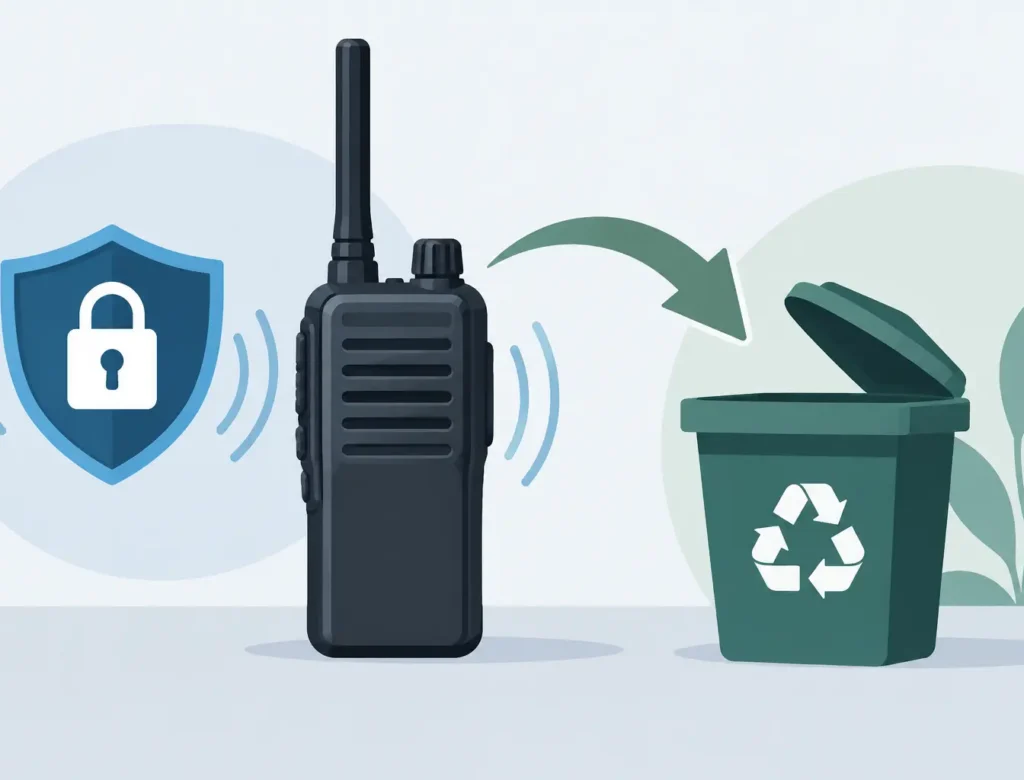
A retired two-way radio can look like a simple piece of surplus equipment. It may no longer be active on the system, its battery may be dead, and a replacement fleet may already be deployed. But do radios store encryption? In many professional land mobile radio environments, the answer is yes. Depending on the model, system design, and configuration, a radio can retain encryption keys, talkgroup assignments, unit IDs, channel plans, and other programming data long after it leaves service.
For hospitals, municipalities, utilities, school districts, manufacturers, and public-safety-adjacent operations, that makes radio disposition a security and compliance decision. The equipment still has resale value, but only after its stored information has been handled correctly.
Do Radios Store Encryption Keys and Data?
Professional two-way radios commonly store more than the frequencies displayed on the channel selector. Their internal memory may contain a programmed configuration file, often called a codeplug, that defines how the radio operates on an organization’s communications network. That file can include channel names, receive and transmit parameters, system identifiers, individual radio IDs, scan lists, signaling settings, and talkgroup information.
Encryption-capable radios may also store cryptographic key material. The exact location and persistence of those keys varies by manufacturer, radio generation, encryption algorithm, and agency policy. Some keys are held in protected memory. Some may be loaded through a key-management device, a key variable loader, over-the-air rekeying, or an approved programming process. Some radios require a specific zeroize command or physical control to erase keys; simply turning the radio off, removing the battery, or deleting a channel does not reliably remove them.
The practical answer is not that every retired radio contains active encryption keys. It is that organizations should not assume it does not. A radio’s operational history, system role, and configuration must determine the disposition process.
What May Remain on a Retired Radio
Encryption keys receive the most attention because of their sensitivity, but they are not the only concern. A retired LMR device can preserve information that reveals how an organization communicates, where personnel operate, or which channels support critical functions.
A radio may retain a combination of the following:
- Encryption keys or key references, depending on the radio and key-management method
- Channel frequencies, talkgroups, network access parameters, and system IDs
- Radio aliases, unit identifiers, fleet maps, and signaling configurations
- Text messages, call logs, contacts, GPS-related settings, or event records on supported models
- Wi-Fi, Bluetooth, or application settings on newer multi-feature devices
- Firmware, feature entitlements, and licensing information tied to the organization’s configuration
Not every radio stores every category of data. An analog-only portable with basic conventional programming presents a different profile from a digitally encrypted portable, trunked mobile radio, dispatch console, or base station. Still, the presence of uncertainty is enough to justify a documented review before equipment is sold, traded in, donated, or recycled.
A codeplug is not the same as an encryption key
This distinction matters. A codeplug can reveal operational programming, but it is not automatically an encryption key. Conversely, wiping routine programming may not erase key material if the radio stores it separately in secure memory.
Organizations should treat both as sensitive until the specific radio model and approved clearing procedure have been verified. General-purpose reset instructions found online are not a substitute for manufacturer guidance, system administrator direction, or an established asset-disposition policy.
Why Encryption Storage Creates a Disposition Risk
The risk is not limited to a lost radio being used on a live channel. Retired equipment can expose information through resale, improper recycling, storage-room theft, or informal transfers to employees or third parties. Even an inactive radio can disclose channel labels, department names, system architecture, or other details that should not travel with the asset.
For organizations operating encrypted systems, improper handling can also create governance problems. Communications managers may have responsibility for key accountability, while procurement or facilities teams may control the physical equipment. IT asset disposition teams may be brought in late, despite the fact that a two-way radio is not handled like a standard laptop or mobile phone.
That gap creates avoidable exposure. The right process assigns responsibility early, documents who authorized the radio for retirement, confirms whether encryption was used, and ensures that the device is cleared before it enters a resale or recycling stream.
How to Retire Encryption-Capable Radios Safely
A secure radio retirement process begins before the equipment is packed for pickup. The goal is to preserve asset value without allowing programming or encryption data to leave organizational control.
First, separate equipment that may have supported encrypted communications from equipment known to be basic or unprogrammed. Inventory records, fleet-management systems, programming archives, and communications staff can help identify which radios were assigned to sensitive channels or systems. When records are incomplete, treat the radios as potentially configured until reviewed.
Next, use the manufacturer-approved method to remove or zeroize encryption keys. This may require authorized personnel, approved key-loading equipment, or a system administrator with access to the relevant key-management process. The required steps differ across platforms. What works for one manufacturer or product line may be incomplete for another.
Then clear radio programming and user-accessible data according to the organization’s policy and the device manufacturer’s documented procedure. This can include removing codeplugs, messages, contacts, Bluetooth pairings, network profiles, and application data where applicable. If radios are being replaced as part of a system upgrade, confirm that the retirement process does not interrupt active fleet operations or remove information needed for the transition.
Finally, document the result. A strong disposition record identifies the equipment, the clearing action taken, the responsible party, date of completion, and final disposition path. For regulated entities and public-sector organizations, this documentation supports internal accountability as well as procurement, records-management, and security requirements.
When internal clearing is not practical
Many organizations do not maintain the tools, access rights, or staff time needed to assess hundreds or thousands of surplus radios individually. That does not mean the equipment must sit indefinitely in a storage room, nor does it mean it should be sent to a general liquidator.
A qualified LMR disposition partner should understand the difference between routine programming, protected encryption material, and equipment that requires specialized handling. The partner should provide a defined data-wiping process, maintain chain-of-custody controls, and separate resalable equipment from items that must be processed through compliant recycling.
Radiowell helps organizations convert surplus LMR assets into financial recovery while supporting documented data wiping, nationwide pickup, and compliant recycling for equipment that cannot be resold.
Resale Value and Security Can Work Together
Security requirements do not eliminate the value of retired radio equipment. Portable radios, mobile radios, base stations, repeaters, accessories, and supporting infrastructure can retain meaningful market value even when they are no longer suitable for the original fleet. Age, condition, frequency band, model demand, accessories, and working status all affect valuation.
The key is to avoid treating secure disposition and asset recovery as competing goals. A proper process protects sensitive programming and encryption data first, then evaluates equipment for resale, trade-in credit, or recycling. This approach can reduce storage burdens, return funds to the organization, and keep usable equipment in the circular economy rather than sending it prematurely to scrap.
There are trade-offs. A radio with missing batteries, damaged housings, or obsolete technology may have limited resale demand. Certain devices may be restricted by policy, system ownership, or licensing conditions. In those cases, compliant recycling is the appropriate outcome. The decision should be based on security, legality, and real market condition, not on a blanket assumption that all used radios are either worthless or safe to resell.
Questions to Ask Before Surplus Radios Leave Your Site
Before approving pickup, resale, trade-in, or recycling, communications and asset-management leaders should be able to answer a few practical questions. Was this equipment ever used on encrypted or sensitive channels? Who is authorized to confirm key removal? Has programming been cleared under the correct model-specific procedure? Is there documentation that links the equipment inventory to the disposition record? And does the receiving provider have the expertise to manage professional LMR equipment rather than generic electronics?
Those questions create a useful handoff between communications, security, procurement, finance, and sustainability teams. They also prevent a familiar problem: discovering after a facility cleanout that a box of radios contained equipment still tied to an active system.
Retiring radios should be treated with the same discipline used to deploy them. When encryption, programming data, and asset value are addressed together, surplus equipment becomes a controlled business process rather than an overlooked security risk.
More News
-
Mobile Radio Resale Guide for Surplus LMR
Use this mobile radio resale guide to value surplus LMR equipment, protect data, arrange pickup, meet compliance obligations,…
Radio Buyback Versus Scrapping Explained
Radio buyback versus scrapping affects recovery, compliance, data security, and sustainability. See how to choose the right route…
Where to Sell Police Radios for Maximum Value
Where to sell police radios securely: compare buyers, protect programming data, recover fair value, and arrange compliant pickup…

America’s largest buyer of used two-way radio equipment. Maximizing value, compliance, and sustainability for surplus LMR equipment.
Recycle and Partners