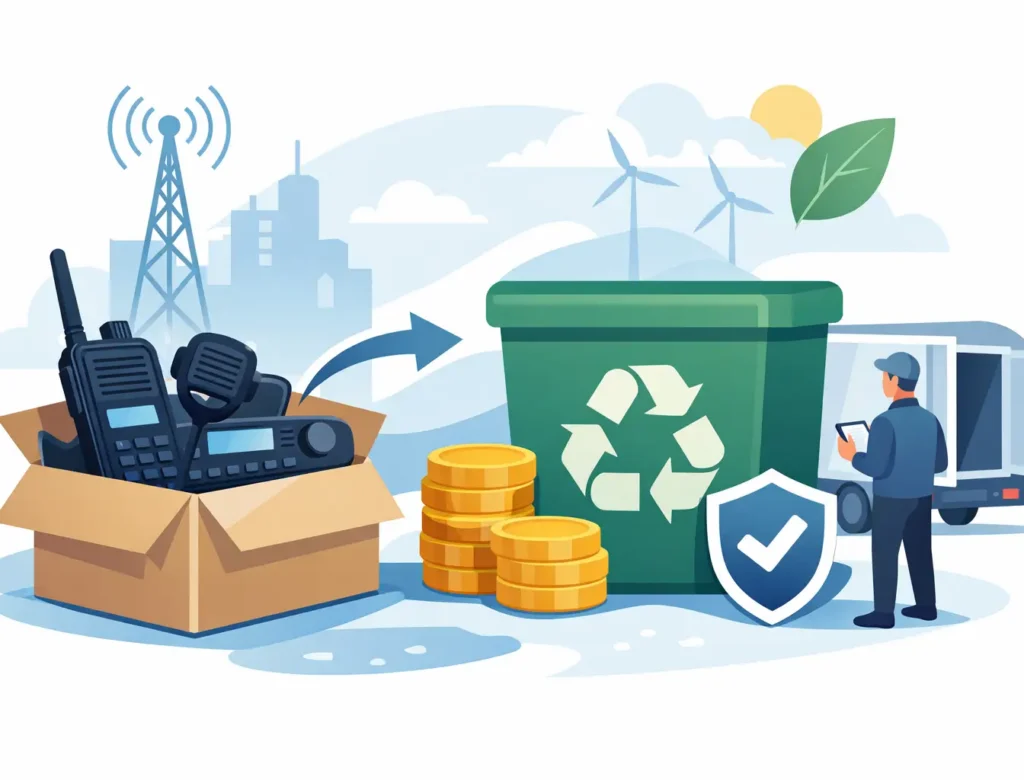
A radio fleet replacement can create an immediate operational problem: hundreds of retired portables, vehicle mobiles, chargers, batteries, repeaters, and accessories need to leave the building without creating a security, compliance, or accounting issue. Land mobile radio disposal is not a janitorial task or a generic electronics pickup. For hospitals, municipalities, utilities, school districts, manufacturers, and logistics operators, it is an asset-disposition decision with financial and risk-management consequences.
The difference between a managed disposition program and a rushed cleanout is measurable. One produces documented chain of custody, data protection, recovered value, and responsible recycling. The other can leave equipment in storage for years, expose programming information, and turn usable assets into a write-off.
Why land mobile radio disposal requires a specialist
Professional two-way radio equipment is different from consumer electronics. Its value depends on manufacturer, model, age, condition, frequency band, accessories, market demand, and whether the equipment can be legally and practically returned to service. A working portable radio may still have meaningful resale value even when it no longer fits the owner’s current system. Related items such as mobile radios, control stations, base stations, microphones, speakers, antennas, batteries, and charging equipment can also affect the value of a lot.
A general liquidator may see a pallet of old electronics. A radio lifecycle specialist can identify equipment across low-band, VHF, UHF, and 800 MHz operations, distinguish marketable components from material that should be recycled, and organize a disposition plan around the fleet’s actual condition.
That expertise matters when equipment is spread across campuses, vehicles, warehouses, remote facilities, or field offices. The internal cost of collecting, sorting, photographing, packing, shipping, and reconciling radios can quickly exceed the value recovered if the process is not designed for LMR equipment.
Retired radios can retain sensitive information
The physical radio is only part of the asset. Depending on the system and configuration, retired equipment may contain channel plans, talkgroup information, unit IDs, contact lists, fleet mapping, operating preferences, network details, and encryption-related data. Even a radio that appears obsolete can reveal information about how an organization communicates and responds during daily operations or emergencies.
The risk is not identical for every fleet. A basic conventional system may require different handling than a large trunked system used by a public agency or utility. But assuming that a radio is harmless because it is powered off, damaged, or no longer activated is not a defensible policy.
A sound disposition process identifies what information may remain on devices before they change hands. It should include documented data wiping appropriate to the equipment, serial-number accountability where required, and a clear record of downstream handling. For organizations with security, privacy, or public-safety obligations, this documentation helps demonstrate that equipment was retired intentionally rather than simply released into an unknown resale channel.
Start with an inventory that supports a fast decision
Perfect inventory records are helpful, but they should not be the barrier that keeps surplus equipment in a closet. Start with what is available: manufacturer, model numbers, quantities, general condition, and any major accessories. Photos of representative equipment, labels, and storage areas can help establish an initial fair-market assessment.
For larger fleets, serial numbers and asset tags should be reconciled where practical. This is particularly useful when finance, IT asset disposition, procurement, communications, and facilities teams all have a role in the retirement process. It creates a common record of what was transferred, what generated value, and what was designated for recycling.
Do not discard equipment just because it is not part of the newest platform. Older radios may have demand in industrial, commercial, education, hospitality, and other applications. Conversely, some equipment may have little resale value due to damage, age, unsupported technology, battery condition, or changes in market demand. An honest evaluation separates these paths early so your team can focus on recovery where it is justified.
Choose the right outcome for every asset
Land mobile radio disposal does not have to mean destruction. The strongest programs use a hierarchy: reuse first when equipment is viable, trade-in when it supports a replacement purchase, and compliant recycling when the equipment cannot be resold.
Resale can turn dormant inventory into budget recovery. This is often the right option for functional portable and mobile radios, infrastructure, accessories, and parts that still serve a legitimate secondary market. Trade-in credit may be more useful for organizations actively funding an upgrade because it ties legacy inventory directly to the next communications investment.
Recycling is the appropriate route for broken, incomplete, obsolete, or non-marketable equipment. It should be handled as regulated e-waste, not ordinary trash. Batteries require special attention because their chemistry and condition affect shipping, storage, and recycling requirements. A qualified provider can direct non-resalable equipment into a documented recycling stream while keeping the process simple for the asset owner.
The correct mix depends on the fleet. A clean, recently replaced radio population may support substantial recovery. A mixed lot accumulated over a decade may yield value from some units and require recycling for others. A specialist should be able to handle both outcomes without forcing an organization to coordinate multiple vendors.
Build compliance into the pickup process
Compliance is not a certificate added after equipment leaves the site. It begins with how radios are gathered, packed, transported, wiped, evaluated, and routed for resale or recycling. The goal is to maintain control from the first collection point through final disposition.
For many organizations, logistics is the point where a disposal project stalls. Equipment may be too scattered for a single shipment, employees may not have proper packing materials, or facilities teams may not have time to prepare pallets. A nationwide pickup model removes that burden when it includes clear shipping instructions, packing support or compensation, and scheduled collection that fits site operations.
The provider should also understand the standards that apply to electronics and transportation handling. EPA, FCC, DOT, and e-waste obligations can intersect in radio-retirement projects, particularly when batteries, specialized infrastructure, and government or public-safety assets are involved. Documentation should be available to support internal environmental reporting, audit requirements, and asset-retirement records.
Avoid the common disposal shortcuts
Storing retired radios indefinitely feels safe, but it usually creates a larger future project. Equipment becomes harder to identify, batteries degrade, inventory records lose accuracy, and potential resale value declines as models age. Storage also consumes space that operations teams need for active equipment.
Selling units one at a time through informal channels may produce occasional returns, but it shifts significant work and risk back to the organization. Staff must test equipment, field questions, process payments, pack shipments, and decide how to handle information left on each device. That approach rarely scales for a fleet retirement.
Dumpsters and generic e-waste events create the opposite problem: speed without adequate accountability. They may not provide radio-specific valuation, data wiping, chain-of-custody records, or confirmation of final processing. The cheapest visible option can become the most expensive if it creates a data, environmental, or audit exposure.
Make disposition a repeatable lifecycle step
The best time to plan for retired radios is when a replacement project is approved, not after new devices are already deployed. Include disposition in the project budget, timeline, and responsibilities from the start. This gives teams time to identify assets, preserve resale value, remove sensitive programming appropriately, and coordinate pickup without disrupting operations.
Radiowell helps U.S. organizations convert surplus LMR equipment into payment or trade-in value while providing free nationwide pickup, certified data wiping, and compliant recycling for equipment that cannot be resold. The practical advantage is certainty: one process can address marketable radios, mixed-condition inventory, and end-of-life material without adding a separate logistics project to an already demanding upgrade.
A retired radio fleet should not become an unmanaged liability waiting in a back room. With the right disposition plan, it can close out a communications upgrade with cleaner records, less risk, responsible environmental handling, and value returned to the organization that invested in it.
More News
-
Who Buys Radio Repeaters and What They Look For
Who buys radio repeaters? See which organizations purchase surplus equipment and how compliant resale preserves value, data security,…
Prepare Radios for Equipment Retirement Right
Learn how to prepare radios for equipment retirement with secure data handling, accurate inventory, safe packing, value recovery,…
Radio Asset Recovery That Pays and Protects
Radio asset recovery turns retired two-way radios into value while protecting data, meeting compliance duties, and reducing disposal…

America’s largest buyer of used two-way radio equipment. Maximizing value, compliance, and sustainability for surplus LMR equipment.
Recycle and Partners