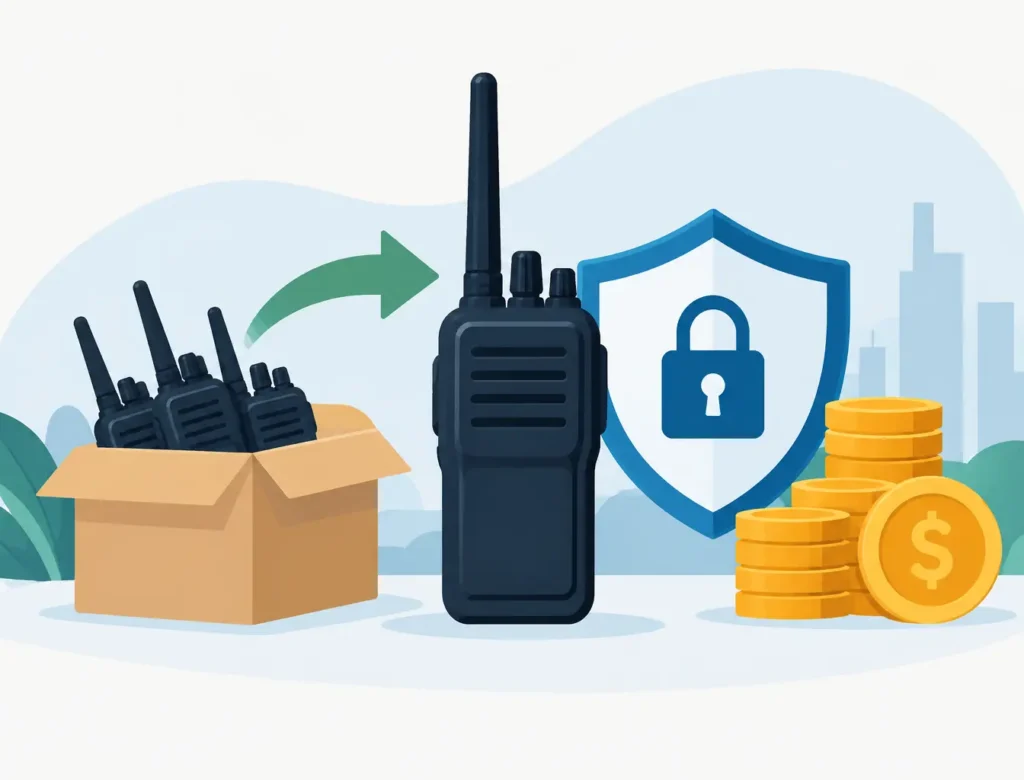
A radio replacement project can leave a facilities manager with pallets of equipment that still has value but no operational home. Portable radios, vehicle mobiles, chargers, repeaters, microphones, and batteries may be sitting in storage while a new system goes live. Radio asset recovery gives organizations a controlled way to convert that retired equipment into financial return, documented risk reduction, and responsible end-of-life handling.
That outcome is different from simply clearing out a warehouse. Professional land mobile radio equipment can retain programming details, talkgroup information, unit IDs, contacts, encryption-related settings, and other operational data. It may also contain components that require compliant e-waste processing. A well-managed recovery program accounts for the equipment’s market value and the obligations that remain after it leaves your site.
What radio asset recovery should accomplish
For public agencies, hospitals, school districts, manufacturers, utilities, and logistics operations, retiring radios is usually part of a larger change: a fleet refresh, a frequency migration, a consolidation, a facility closure, or a move to newer communications technology. The old equipment may be functioning, partially functional, obsolete, or mixed across multiple generations.
The right disposition path should produce four results at once: a fair value assessment, secure handling, manageable logistics, and documented recycling for equipment that cannot be resold. If any one of these is missing, the apparent convenience of disposal can become an administrative or compliance problem later.
Value begins with identifying what is actually on hand. Professional radio markets recognize differences that general electronics buyers often miss, including manufacturer, model, frequency band, feature set, condition, accessory mix, and demand for replacement parts. A VHF portable fleet, UHF mobile radios, 800 MHz equipment, low-band units, control stations, and base station hardware can each have different recovery potential.
A specialized buyer can also recognize value in equipment conventional liquidators decline. Even when a full radio is no longer suited for resale, usable components, accessories, or materials may support a more responsible recovery path than sending everything directly to a landfill stream.
The value of a disciplined radio asset recovery process
Recovery is most effective when it starts before equipment is disconnected, not after every item has been mixed into unmarked boxes. Operations and communications teams do not need to perform a perfect inventory, but basic organization improves valuation accuracy and speeds the project.
Record model numbers where practical, separate portable radios from mobiles and infrastructure equipment, and keep accessories with their corresponding radio families. Batteries, chargers, speaker microphones, antennas, programming cables, and mounting hardware can affect value. If equipment has known defects, label them honestly. A clear condition picture supports a credible quote and reduces surprises during evaluation.
It also helps to identify equipment that may hold sensitive programming or security information. Not every radio contains the same type of data, and not every organization has the same internal security requirements. A school district may focus on unit assignments and staff contacts. A utility or government agency may have stricter controls around system configurations, encryption, or operational identifiers. The disposition process should reflect that difference.
A qualified recovery provider should establish clear handling expectations before pickup. That includes how equipment is collected, where it is evaluated, how data is wiped or managed, and what documentation is available. Chain-of-custody practices matter because retired equipment does not become risk-free merely because it is no longer in service.
What determines the resale value of used radios?
There is no single price per radio. Recovery value depends on the model and market demand, but it also depends on whether the equipment can be tested, resold, harvested for parts, or recycled. Newer digital radio platforms with desirable features and a consistent accessory set generally have stronger demand than discontinued equipment with missing batteries or damaged housings.
Frequency band matters, but it is not the only factor. A well-maintained VHF fleet may have meaningful value, while a newer 800 MHz radio with significant wear or a restricted configuration may require a different evaluation. The same is true for mobile radios, repeaters, dispatch consoles, base stations, and associated infrastructure.
Quantity can improve efficiency, particularly when equipment is centralized and ready for pickup. However, smaller lots can still be worth evaluating. Organizations should not assume that equipment is too old, too mixed, or too incomplete to recover value. The practical question is whether a specialist can create a responsible path for each category of material.
Trade-in credit may also be preferable to a cash payment when an organization is purchasing replacement equipment. It depends on procurement rules, budget timing, and the planned communications architecture. Cash recovery supports a completed retirement project; trade-in credit can help offset the cost of the next deployment. Both should be evaluated against the organization’s financial and operational priorities.
Security and compliance are not add-ons
Radio equipment is often treated as less sensitive than a computer or mobile phone. That can be a costly assumption. Configuration information and identifiers can remain on devices after they leave the field. For organizations with public-safety, healthcare, education, utility, or critical-infrastructure responsibilities, secure data management should be part of the disposition scope from the beginning.
A recovery partner should be able to explain its data-wiping process and provide appropriate documentation. The goal is not simply to reset equipment casually. The goal is to ensure retired assets are handled according to the organization’s data-security policies and the operational realities of professional radio systems.
Compliance also extends to transportation and environmental handling. Batteries and electronic components require care, particularly when stored in volume or shipped across state lines. Equipment that cannot be reused should move through a documented recycling process consistent with applicable EPA, FCC, DOT, and e-waste requirements.
This is where the lowest apparent offer can be misleading. A buyer that offers a few more dollars but leaves packing, freight, data management, and non-resalable material to your staff may not produce the best overall result. Total recovery value includes avoided logistics expense, reduced internal labor, compliance documentation, and confidence that the material will be handled correctly.
A practical path from surplus to recovery
An efficient project generally begins with a same-day fair-market quotation based on a model list, photos, or a high-level description of the inventory. From there, the provider coordinates pickup and packing expectations, evaluates the equipment, processes payment or trade-in credit, and directs non-resalable material to compliant recycling.
The strongest programs remove work rather than creating it. Free nationwide pickup can eliminate a common barrier for distributed organizations, especially those with radios stored at multiple facilities. Packing compensation can further reduce the cost of mobilizing internal teams. These details matter when a communications manager is balancing a retirement project against active operational demands.
Before approving a provider, ask direct questions about timing, pickup responsibility, data wiping, payment terms, recycling documentation, and how exceptions are handled. For example, what happens if a shipment includes radios that differ from the original inventory? How are damaged batteries managed? Will the organization receive records for assets that are recycled rather than resold? Clear answers signal a process designed for institutional accountability.
Radiowell approaches this work as a lifecycle decision, not a warehouse cleanout. For organizations retiring professional two-way radio fleets, the objective is straightforward: recover maximum appropriate value, protect sensitive information, remove logistics burden, and ensure every remaining asset follows a responsible path.
Do not let retired radios become unmanaged inventory
The most expensive surplus equipment is often the equipment nobody owns after the upgrade is complete. It occupies space, ties up staff time, and creates uncertainty around data, batteries, and final disposition. Assigning a recovery path early keeps the retirement project from becoming an open-ended storage problem.
A well-run radio asset recovery program gives every item a destination: resale when it remains useful, trade-in when replacement plans call for it, or compliant recycling when reuse is no longer appropriate. That is how retired communications equipment can leave your organization with value returned, risk addressed, and the next operational priority clear.
More News
-
Who Buys Radio Repeaters and What They Look For
Who buys radio repeaters? See which organizations purchase surplus equipment and how compliant resale preserves value, data security,…
Prepare Radios for Equipment Retirement Right
Learn how to prepare radios for equipment retirement with secure data handling, accurate inventory, safe packing, value recovery,…
How to Sell Motorola Radios for Maximum Value
Learn how to sell Motorola radios with secure data handling, free pickup, fair-market value, and compliant recycling for…

America’s largest buyer of used two-way radio equipment. Maximizing value, compliance, and sustainability for surplus LMR equipment.
Recycle and Partners