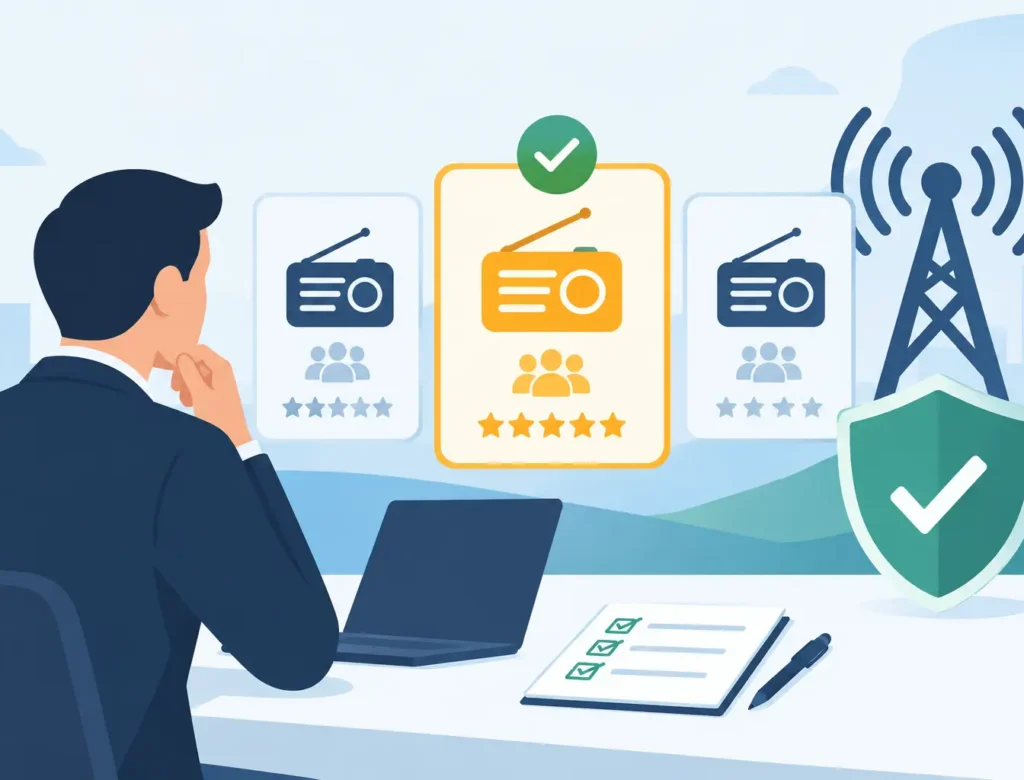
A fleet replacement can leave a communications manager with hundreds of radios, chargers, batteries, mobiles, and accessories occupying secure storage. The right radio buyer selection criteria turns that inventory from an administrative burden into recoverable value, documented risk reduction, and responsible reuse or recycling. The wrong buyer can create delays, understate value, and leave the organization without a clear record of where sensitive equipment and data went.
For hospitals, municipalities, utilities, manufacturers, school districts, and logistics operations, retired land mobile radio equipment is not ordinary surplus. It may contain programming, fleet identifiers, encryption material, user records, or operational channel information. A buyer should be evaluated as a lifecycle partner, not simply as the highest number on a one-line offer.
Why radio buyer selection criteria matter
Two-way radio equipment has a specialized secondary market. Value depends on far more than whether a radio powers on. Model family, band, age, condition, accessories, programming status, market demand, and the quantity available can all affect what an organization can recover.
That specialization is why a general electronics liquidator may not be the best fit for LMR assets. A buyer that understands portable radios, mobile radios, base stations, repeaters, chargers, speaker microphones, and related infrastructure can identify recoverable value across the full lot. It can also distinguish between equipment suitable for resale, equipment appropriate for parts recovery, and material that requires compliant recycling.
Selection also affects internal workload. A disposition program should reduce work for procurement, IT, facilities, sustainability, and communications teams. If staff must sort every accessory, source packing materials, arrange freight, chase payment, and request disposal documents separately, an apparently competitive offer may carry a high hidden cost.
Evaluate technical expertise before comparing offers
Start with the buyer’s depth of experience in professional two-way radio equipment. Ask whether the company routinely purchases the equipment categories in your inventory, including portable and mobile radios across low-band, VHF, UHF, and 700/800 MHz systems. A qualified buyer should be able to recognize common configurations and explain what information is needed to quote accurately.
Useful details include manufacturer, model number, quantity, frequency band, condition, included accessories, and whether units are active, decommissioned, damaged, or untested. Photos can help, but they should not become a substitute for an informed valuation process. A specialist should be able to give clear direction on what is needed without forcing your team into a lengthy cataloging project.
Technical expertise also matters when a lot is mixed. A replacement project may include current-generation radios with resale value, older devices that still have value for parts, and obsolete batteries or accessories that cannot enter the resale market. The buyer should have a practical plan for all categories, not just the most attractive units.
Make data security a non-negotiable requirement
Retired radios can retain more information than many asset owners expect. Depending on the device and system, that may include channel plans, talkgroup assignments, fleet maps, contact lists, Wi-Fi settings, Bluetooth pairings, GPS records, over-the-air programming information, and encryption-related data. The sensitivity of that data is especially high for public safety, healthcare, utilities, government, and critical infrastructure organizations.
Ask the buyer how data is handled before equipment leaves your control. A credible process should define who performs the wipe, what data elements are addressed, how exceptions are managed, and what documentation is provided when the work is complete. If encryption-capable devices are involved, your communications or security team should confirm the decommissioning process for keys and credentials before release.
Do not accept vague assurances that radios will be “reset” or “cleared.” A factory reset may not satisfy an organization’s security policy or fully address retained information on every model. The standard should be documented data wiping that supports your internal asset-disposition, privacy, and security requirements.
Look beyond the headline price
A fair-market quote matters, but it is only one part of the financial outcome. The strongest offer accounts for logistics, packing, testing, data processing, and recycling of material that cannot be resold. A buyer that quotes a high unit price but later deducts freight, rejects expected equipment, or adds handling charges can reduce the actual return.
Request clarity on the valuation method. Is the quote based on an inspection of the listed equipment? Are untested units accepted? What happens if the received condition differs from the description? How are missing batteries, chargers, antennas, or speaker microphones treated? These questions are not obstacles to a sale. They are how both parties establish a fair and predictable transaction.
Speed is another financial consideration. Equipment sitting in storage has an opportunity cost, especially during a system migration or facility consolidation. Same-day quotations, free nationwide pickup, and rapid payment can have more operational value than a slightly higher estimate that takes weeks to finalize.
Compare the logistics model, not just the buyer’s location
A national buyer should be able to serve an organization wherever equipment is stored, whether that means one warehouse, multiple branch locations, or a mix of field offices and vehicle shops. Confirm who coordinates pickup, supplies shipping labels or packing guidance, and pays transportation costs.
For large or dispersed deployments, the logistics plan should account for chain of custody. Your team needs a clear handoff point and a record of what was transferred. This is particularly valuable when several departments own radios or when equipment is being collected during a fast-moving replacement program.
Packing is often overlooked. Radios and accessories may be dense, fragile, and expensive to prepare for shipment. If the buyer compensates for packing or manages the process, that can prevent a surplus project from consuming hours of labor that operations teams cannot spare. Zero logistics cost should mean exactly that, with no surprise freight bill after the pickup is complete.
Require compliance documentation for every disposition path
Not every device will qualify for resale. Batteries, damaged equipment, obsolete accessories, and electronics with no secondary-market demand need a compliant end-of-life route. The buyer should be able to explain how it manages e-waste and the regulations that apply to transportation, environmental handling, and communications equipment.
Ask for documentation that matches your governance requirements. Depending on the transaction, this may include an inventory record, pickup confirmation, data-wipe certificate, recycling certificate, payment record, and disposition reporting. Public agencies and regulated organizations may need more detailed records, but every organization benefits from an auditable file.
A buyer’s compliance program should also protect your sustainability commitments. Reuse is generally the highest-value circular outcome when equipment remains viable. When reuse is not practical, responsible recycling keeps recoverable materials in circulation and helps prevent retired electronics from being handled through unverified channels.
Assess reliability and accountability
Before releasing a radio fleet, evaluate the buyer’s operating history, specialization, accreditation, and reputation for closing transactions as promised. The goal is not simply to find a company that buys radios. It is to identify one that can manage the entire disposition process with consistent controls.
Ask direct questions about timing. When will the quote be issued? How quickly can pickup occur? When is payment made? What reports will be delivered? A dependable buyer answers these questions plainly and does not make you wait until after pickup to learn the details.
Radiowell’s model is built around that accountability: fair-market quotations, nationwide pickup, documented data wiping, payment, resale, trade-in value, and compliant recycling managed through a single specialized process. For asset owners, centralizing those steps helps reduce the gaps that occur when multiple vendors handle a single retirement project.
Questions to settle before approval
Before selecting a buyer, your internal team should be able to answer four practical questions: Does the buyer understand our equipment? Can it protect and document the removal of sensitive data? Will the quoted value hold after logistics and condition review? Can it provide records that satisfy our security, finance, environmental, and procurement requirements?
If any answer is unclear, pause before authorizing shipment. The time to resolve a data-wiping method, freight responsibility, or recycling documentation requirement is before equipment leaves the facility. A well-chosen radio buyer gives your organization a clean handoff, a defensible record, and a practical return from assets that no longer serve the operation.
More News
-
Radio Buyer Reviews for Smarter Asset Recovery
Radio buyer reviews reveal more than pricing. Learn how to assess pickup, payment, data security, compliance, and resale…
Resale or Recycling for Retired Two-Way Radios
Resale or recycling for retired two-way radios? Learn how condition, data security, compliance, and logistics determine the right…
LMR Circular Economy for Surplus Radio Fleets
The LMR circular economy helps organizations recover value, protect sensitive data, and recycle retired two-way radios fully responsibly…

America’s largest buyer of used two-way radio equipment. Maximizing value, compliance, and sustainability for surplus LMR equipment.
Recycle and Partners