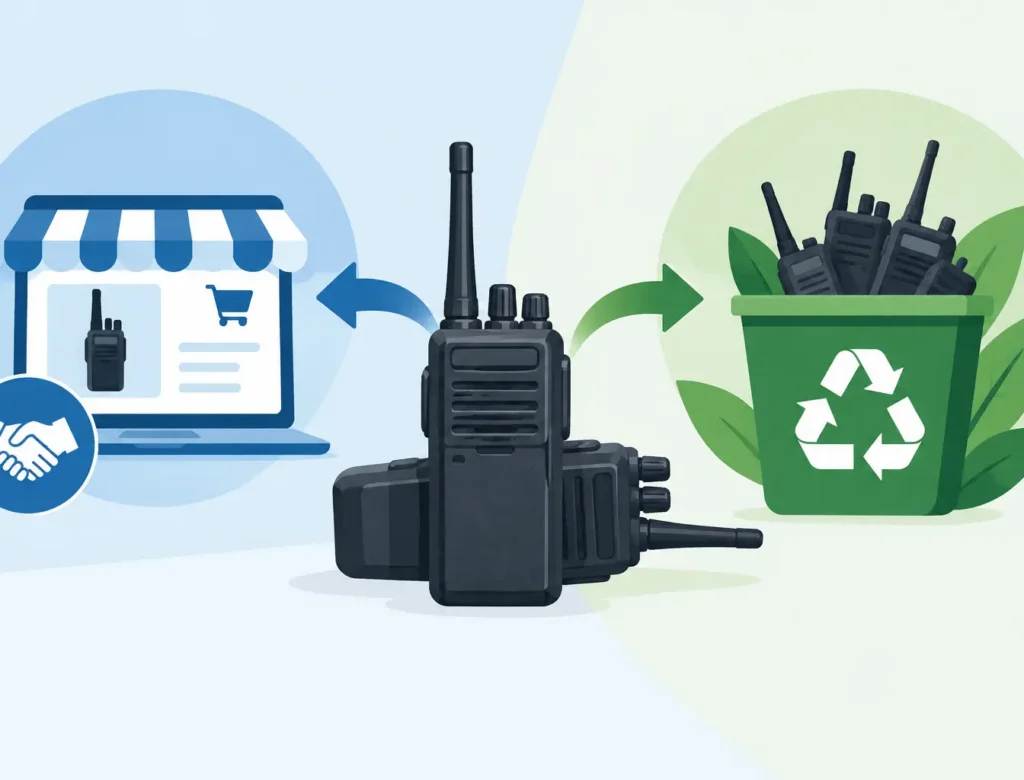
A radio fleet replacement can leave a hospital, municipality, utility, or manufacturer with hundreds of devices that are no longer needed but are far from worthless. The decision between resale or recycling affects more than storage space. It determines how much value the organization recovers, whether sensitive programming is properly removed, and whether every battery, accessory, and electronic component is handled responsibly.
The right answer is rarely all one or the other. Most retired land mobile radio (LMR) fleets contain a mix of equipment: current-model portables with resale demand, older mobiles that retain parts value, damaged units that require material recovery, and accessories that need separate evaluation. A disciplined disposition process identifies the best outcome for each category without creating another project for operations, procurement, or facilities teams.
Resale or Recycling Starts With Equipment Value
Resale is the preferred path when equipment is functional, in demand, and economically practical to process. Professional two-way radios are built for long service lives. A portable radio removed during a system upgrade may still serve a school district, warehouse, contractor, event operation, or smaller agency with compatible needs. Mobile radios, base stations, chargers, microphones, antennas, and repeaters may also have recoverable value when their condition and market demand support it.
Age alone does not decide whether a radio can be resold. The more relevant questions are whether the model remains supported, whether replacement parts are available, whether the unit powers on and communicates properly, and whether its frequency band and feature set have an active secondary market. VHF, UHF, 800 MHz, and low-band equipment can all retain value, but demand varies by manufacturer, model, band, configuration, and quantity.
A large, consistent fleet often creates the strongest resale opportunity. Matching radios, batteries, chargers, and accessories are easier to inspect, process, and place into the secondary market than a small group of unrelated devices. That does not mean mixed lots have no value. It means a specialist should evaluate the equipment as a complete asset pool rather than dismissing it because a few units are damaged or obsolete.
For organizations retiring equipment after a technology refresh, trade-in credit can be another form of value recovery. Instead of treating the outgoing fleet as a disposal expense, the organization can apply its market value toward replacement communications equipment. This can improve project economics while reducing the internal work required to manage surplus assets.
What strengthens resale value
Radios are generally better candidates for resale when they have clean housings, readable displays, intact controls, matching batteries or chargers, and no signs of water damage or corrosion. Quantity matters, but documentation matters too. Model numbers, serial-number ranges, accessories, purchase history, and known operational issues give buyers a clearer picture of what they are evaluating.
The strongest disposition partners do not require an organization to test every radio before requesting a quote. A basic inventory, photographs, and a description of the fleet are often enough to begin. The buyer can then determine whether additional information or inspection is needed. This keeps the evaluation accurate without shifting the workload back to the customer.
When Recycling Is the Responsible Choice
Recycling is the correct outcome for equipment that has no viable resale market, cannot be economically repaired, is too damaged to reuse, or contains components that cannot be safely placed back into service. This includes cracked radios, obsolete models with no buyer demand, swollen batteries, damaged chargers, and equipment exposed to severe contamination, heat, moisture, or corrosion.
Recycling is not a lesser form of disposition. It is a compliance and risk-management decision. Two-way radio equipment can contain circuit boards, metals, plastics, lithium-ion or nickel-metal hydride batteries, displays, and other materials that should not enter ordinary waste streams. A compliant process separates and directs these materials through appropriate downstream channels.
For public-sector entities and regulated organizations, the documentation behind recycling matters as much as the physical process. Asset managers may need records showing that devices were received, data was addressed, and non-resalable material was processed under applicable e-waste requirements. Clear chain-of-custody practices help support audit readiness, sustainability reporting, and internal asset-disposition policies.
Battery handling deserves special attention. Batteries should not be treated as incidental accessories or packed loosely with radios. Damaged, depleted, or aging battery packs can create handling and transportation concerns, particularly when lithium chemistry is involved. A qualified provider should identify battery types and manage packaging and transportation in accordance with applicable requirements.
Recycling does not mean abandoning recovery
A fleet can have both resale and recycling value. For example, a hospital may retire 500 portable radios, including 350 working units, 100 units with broken housings, and 50 incomplete units. The working radios may be purchased for resale, while damaged and incomplete equipment is routed for compliant recycling. Chargers, speaker microphones, belt clips, and programming accessories can be evaluated separately.
This blended approach is usually better than sending everything to a general recycler or attempting to liquidate the lot through an unverified buyer. It keeps viable equipment in use, recovers value where possible, and ensures that the remainder is handled responsibly. It also avoids the false choice of choosing financial recovery over environmental responsibility.
Data Security Must Come Before Disposition
A retired radio may still contain more than a serial number. Depending on the system and configuration, it can hold channel plans, talkgroup information, unit IDs, contact lists, site details, network settings, encryption-related information, and operational programming. For a utility, school district, law enforcement agency, hospital, or logistics operation, that information can be sensitive even when the hardware has reached end of life.
Removing batteries or deleting a few channels is not an adequate data-security policy. Radio data may remain in codeplugs, memory, attached modules, or other configurable components. The disposition provider should have a defined data-wiping process appropriate to the equipment type, along with documentation that confirms completion.
Security should also shape the pickup process. Equipment stored in an unsecured loading area, handed to an unknown courier, or shipped without a documented handoff creates unnecessary exposure. Free nationwide pickup and properly managed packing can reduce internal burden, but the process should still establish where the assets went, who received them, and how they were processed.
Build a Decision Process That Does Not Stall Operations
The most effective asset-disposition process begins before replacement radios arrive. Assign a single internal owner, identify where surplus equipment is located, and gather a practical inventory. For many organizations, the inventory only needs manufacturer, model, approximate quantity, accessories, overall condition, and location. Serial numbers can be added when required for records or valuation.
Next, separate the equipment into obvious groups: functional radios, untested radios, damaged equipment, accessories, and batteries. Avoid spending staff time trying to diagnose every unit unless a particular system has unusually high value. A qualified LMR buyer can assess marketability and determine which devices warrant further inspection.
Then obtain a fair-market quote that clearly explains the proposed disposition. The quote should distinguish between equipment being purchased, equipment receiving trade-in credit, and equipment that will be recycled. It should also state who covers pickup, packing, freight, data wiping, and downstream processing. Hidden logistics costs can erase the apparent value of a higher offer.
Finally, retain the records. Keep the asset list, quote, payment confirmation or trade-in credit, pickup documentation, and data-wiping or recycling records with the project file. These documents turn a one-time cleanup into a defensible business process.
Choose a Partner Built for Radio Assets
General IT asset disposition providers and scrap buyers may be capable of moving electronics, but LMR equipment requires specialized knowledge. Radio value depends on bands, firmware, accessories, system compatibility, parts demand, and the condition of field-used equipment. The security concerns are also specific to radios and their programming environments.
Radiowell evaluates used two-way radios as communications assets, not as undifferentiated e-waste. That distinction supports faster valuation, appropriate resale decisions, documented data handling, and compliant recycling for equipment that cannot return to service. For organizations with distributed sites, nationwide pickup also removes a common obstacle: coordinating boxes, freight, and surplus inventory across multiple locations.
The best time to decide between resale and recycling is before retired radios start collecting dust in a storeroom. A clear evaluation can turn a fleet replacement into recovered budget, documented compliance, and a cleaner handoff to the next phase of your communications program.
More News
-
Radio Buyer Reviews for Smarter Asset Recovery
Radio buyer reviews reveal more than pricing. Learn how to assess pickup, payment, data security, compliance, and resale…
Radio Buyer Selection Criteria That Protect Value
Use radio buyer selection criteria to protect data, recover fair value, simplify pickup, and document compliant reuse or…
LMR Circular Economy for Surplus Radio Fleets
The LMR circular economy helps organizations recover value, protect sensitive data, and recycle retired two-way radios fully responsibly…

America’s largest buyer of used two-way radio equipment. Maximizing value, compliance, and sustainability for surplus LMR equipment.
Recycle and Partners