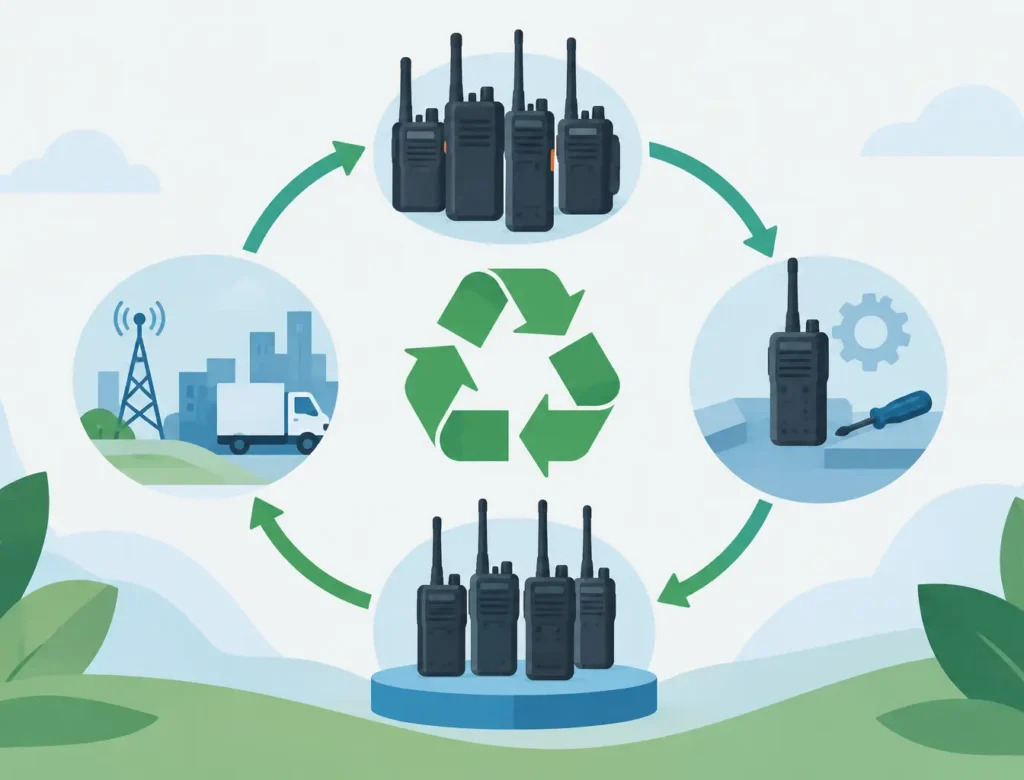
A retired radio fleet is not automatically e-waste. In an effective LMR circular economy, portable radios, mobile radios, control stations, repeaters, chargers, and accessories are evaluated for their remaining operational and financial value before any material is sent to recycling. For hospitals, municipalities, utilities, school districts, manufacturers, and logistics operators, that approach turns a replacement project into an opportunity to recover budget, protect sensitive data, and document responsible disposition.
The alternative is costly in ways that do not always appear on a project spreadsheet. Radios stored in a warehouse can lose resale value as technology ages. Units sent to a general electronics recycler may carry programming, talkgroup, contact, Wi-Fi, Bluetooth, or encryption-related information. And equipment discarded without documented handling can create compliance questions long after the new fleet is deployed.
What the LMR Circular Economy Means
A circular economy keeps usable products and materials in productive circulation for as long as practical. In land mobile radio, that means separating retired equipment into the right path: resale, trade-in, parts recovery, or compliant recycling.
Professional two-way radios are especially well suited to this model. A public agency may replace its fleet because it is standardizing platforms, moving to a new system, or adopting new features. That does not mean every outgoing unit has reached the end of its useful life. A VHF portable radio that no longer fits one organization’s system may still be valuable to a school district, facility, contractor, volunteer organization, or business operating on compatible frequencies.
The same principle applies across low-band, VHF, UHF, and 800 MHz equipment. Value depends on more than frequency. Model, age, condition, quantity, accessories, battery health, display condition, included antennas, programming capability, and current market demand all affect the outcome. A specialized evaluation is necessary because conventional IT asset buyers often do not understand the secondary market for LMR equipment.
Why Disposition Should Start Before Replacement
Many organizations treat retirement as the final task in a radio replacement project. That sequence often leads to unnecessary storage, rushed decisions, and lost value. The better approach is to assess outgoing assets while the replacement plan is still being built.
Early evaluation gives procurement and finance teams a clearer picture of the total project cost. Equipment with resale value may generate payment or trade-in credit. Equipment that is not resalable can be routed into compliant recycling rather than becoming an unfunded disposal problem. When the project includes hundreds or thousands of radios, even modest per-unit recovery can materially improve the budget.
Planning ahead also simplifies logistics. A provider that can quote, pack, collect, document, wipe, and process the equipment reduces the burden on facilities, operations, and communications staff. Rather than assigning employees to sort radios one at a time, organizations can establish a controlled chain of custody from the point of collection.
This matters most when fleets are distributed. A utility with radios across service yards, a healthcare network with multiple campuses, or a municipality with departments in separate buildings needs more than a buyer willing to accept boxes at one location. Nationwide pickup and coordinated packing support can eliminate the friction that causes surplus equipment to sit unused.
Data Security Is Part of the Circular Process
Two-way radios are not simple commodities. Depending on the device and its use, retired units may retain channel plans, unit IDs, contact lists, network settings, location data, text messages, Bluetooth pairings, Wi-Fi credentials, or encryption-related configuration. Even when a radio is no longer active, that information can be operationally sensitive.
A responsible LMR circular economy requires data handling before resale, reuse, or recycling. The process should include documented data wiping appropriate to the equipment type and organizational policy. Removing batteries, changing a channel, or performing a superficial reset is not the same as verifying that retained information has been cleared.
Organizations should also account for accessories and connected components. Subscriber units may have removable storage, programming interfaces, external microphones, vehicle mounts, or network-capable accessories that need review. The exact procedure depends on the make, model, system architecture, and security requirements. For public safety, government, healthcare, and critical infrastructure users, internal security teams may require additional documentation or chain-of-custody controls.
The goal is not to slow down disposition. It is to make the process defensible. A documented wipe and compliant handling record provide assurance that valuable equipment can reenter the market without exposing the previous owner’s operational information.
The Right Path for Every Asset
Circularity does not mean forcing every device back into service. It means making an informed decision about the highest responsible use for each asset.
Resale is typically the preferred path for radios and accessories that remain functional, marketable, and supportable. These assets can serve organizations that need reliable communications equipment without purchasing new. A resale channel also keeps working electronics in use and avoids premature demand for newly manufactured replacements.
Trade-in can be the right fit when an organization is acquiring new equipment and wants to apply the value of its outgoing inventory toward the purchase. This can streamline procurement, although the best financial outcome depends on the equipment mix, timing, and terms of the replacement transaction.
Parts recovery can make sense for equipment that is not suitable for complete resale but contains usable components. Batteries, chargers, antennas, housings, microphones, knobs, and other parts may still have value when they meet quality and safety requirements.
Compliant recycling is the necessary final path for damaged, obsolete, unsupported, or non-resalable items. It should not be treated as a failure of the circular model. Responsible recycling recovers materials while keeping electronics out of improper disposal streams. For LMR owners, the key is using a process that aligns with applicable EPA, FCC, DOT, and e-waste requirements.
What a Strong LMR Disposition Program Looks Like
The strongest programs create certainty from the first inventory review through final reporting. That begins with a fair-market evaluation based on actual radio models, quantities, condition, and accessories, not a generic electronics estimate.
It continues with practical logistics. Free pickup, packing compensation, and centralized coordination can be more valuable than a slightly higher quoted price that requires internal teams to package, ship, and manage every unit themselves. Total recovery should account for administrative time, transportation expense, storage cost, risk exposure, and the likelihood of a delayed transaction.
Documentation is equally important. Organizations should expect records that support internal asset retirement, data handling, and recycling requirements. The level of reporting will vary by organization, but a credible process should clearly show what was collected, how it was handled, and where it was routed.
Speed also matters. A same-day quotation can help teams make disposition decisions while replacement planning is active. Rapid payment after receipt and verification supports cash recovery rather than leaving value tied up in a long liquidation cycle. For organizations managing large refreshes, those operational details can determine whether a circular initiative is adopted or abandoned.
Radiowell applies this specialized approach to used professional radio equipment, helping organizations convert surplus assets into payment or trade-in value while routing non-resalable items through compliant recycling.
Measure More Than Scrap Weight
Sustainability reporting often focuses on pounds recycled. That metric has value, but it is incomplete for LMR equipment. A radio that is securely wiped, tested, and resold extends the useful life of a finished product. That can preserve the value of the energy, materials, manufacturing, and transportation already invested in it.
Financial recovery is also a meaningful circular-economy measure. When an organization receives value for equipment that would otherwise be stored or discarded, it demonstrates that responsible asset management and fiscal stewardship can reinforce each other. The best outcomes combine three results: usable equipment stays in circulation, sensitive information is handled correctly, and non-usable equipment is processed responsibly.
For leadership teams, this creates a clearer story than disposal alone. The organization did not merely remove old radios. It managed a controlled transition from one communications fleet to the next, reduced unnecessary waste, addressed information security, and recovered value from assets that still had a place in the market.
Make Retirement a Controlled Transition
The timing of a fleet refresh is an opportunity to set a higher standard for retired equipment. Inventory the radios early, identify potentially sensitive programming, establish custody requirements, and obtain a specialized market evaluation before equipment begins accumulating in storage.
The right disposition partner should make that process straightforward, not add another layer of coordination. When reuse, financial recovery, data protection, and compliant recycling are handled as parts of one process, the LMR circular economy becomes a practical operating discipline rather than a sustainability statement.
More News
-
Radio Buyer Reviews for Smarter Asset Recovery
Radio buyer reviews reveal more than pricing. Learn how to assess pickup, payment, data security, compliance, and resale…
Radio Buyer Selection Criteria That Protect Value
Use radio buyer selection criteria to protect data, recover fair value, simplify pickup, and document compliant reuse or…
Resale or Recycling for Retired Two-Way Radios
Resale or recycling for retired two-way radios? Learn how condition, data security, compliance, and logistics determine the right…

America’s largest buyer of used two-way radio equipment. Maximizing value, compliance, and sustainability for surplus LMR equipment.
Recycle and Partners