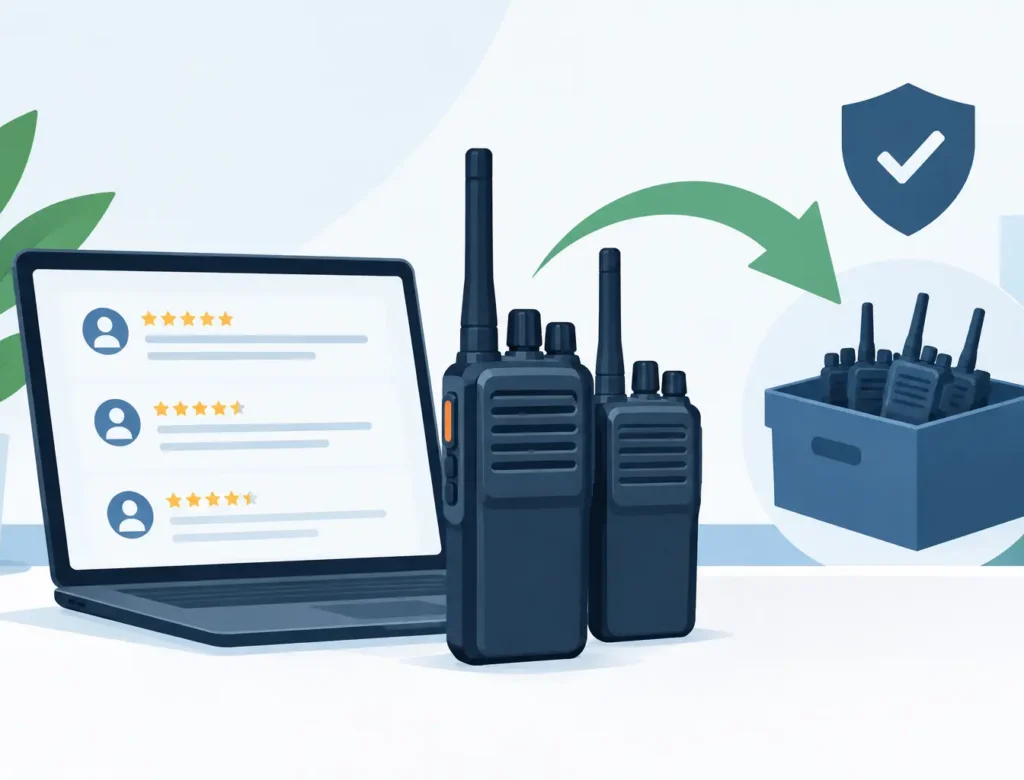
A radio fleet replacement can leave an organization with thousands of dollars in equipment sitting in storage, plus a less visible liability: programmed channels, unit IDs, encryption keys, and asset records still associated with those devices. Radio buyer reviews can help identify a qualified disposition partner, but only when the reviews are read for operational evidence rather than star ratings alone.
For hospitals, municipalities, school districts, utilities, manufacturers, and logistics organizations, selling used land mobile radio equipment is not a consumer transaction. The right buyer should reduce workload, recover fair value, protect sensitive data, and provide a compliant path for equipment that cannot be resold.
What Radio Buyer Reviews Should Actually Tell You
A positive review that says “great service” is encouraging, but it does not answer the questions that matter to an organization retiring professional communications assets. Look for comments that describe a complete process: how quickly the buyer quoted the equipment, whether pickup was coordinated without delays, whether payment arrived as promised, and how the buyer handled radios with limited resale value.
The strongest reviews often include specifics. A facilities manager may mention that a buyer accepted mixed lots of portable radios, mobile radios, chargers, microphones, base stations, and accessories. A public-sector customer may describe documentation supplied for recycling. An IT or communications manager may reference data wiping or the handling of encrypted equipment. Those details are more meaningful than generic praise because they show the buyer understands the realities of fleet disposition.
Reviews also reveal whether a company can work at the scale your organization requires. Selling 20 portable radios is different from retiring equipment from multiple campuses, warehouses, vehicles, or field locations. A capable buyer should have a repeatable process for inventory review, packing support, nationwide pickup, chain-of-custody coordination, and payment.
Separate Price Claims From Total Financial Value
A buyer offering the highest number on a single model is not automatically providing the best outcome. The value of a disposition program includes labor, freight, packing materials, administrative time, storage relief, data handling, and the cost of responsibly processing equipment that has no resale market.
When reading reviews, pay attention to whether customers describe unexpected deductions. Some buyers quote aggressively, then reduce offers after inspection or charge for shipping, packaging, or recycling. Condition-based adjustments are sometimes appropriate, particularly for incomplete, damaged, or obsolete equipment. The issue is whether the evaluation criteria were clear before the equipment left your facility.
A credible quote should account for manufacturer, model, band, condition, quantities, included accessories, and current market demand. VHF, UHF, 700/800 MHz, and low-band equipment can have materially different resale prospects. So can radios with display damage, depleted batteries, missing knobs, or unavailable programming. Accurate valuation requires a buyer that knows the LMR market, not a general electronics liquidator applying a broad estimate.
Look for Proof of a Controlled Pickup Process
Free pickup is valuable only if it removes work from your team. Reviews should indicate whether the buyer coordinated logistics promptly, supplied packing guidance, and handled equipment from more than one location when needed. This matters most for organizations with radio assets spread across departments, vehicles, maintenance shops, remote facilities, and regional offices.
A professional process begins before shipment. The buyer should help determine what is being sold, what should be retained, and which assets need separate handling. For example, a radio system may include subscriber units ready for resale alongside damaged accessories, discontinued batteries, chargers, and infrastructure components that require recycling instead.
Ask how the buyer handles the transition from your possession to theirs. You may not need a complicated procedure for every small lot, but enterprise and public-sector customers should expect clear shipping records, pickup confirmation, and identified points of contact. Reviews that mention responsive communication during this stage are particularly useful, because logistics problems often arise when no one owns the details.
Data Security Is a Disposition Requirement
Retired radios can retain more than channel names. Depending on the model and system configuration, devices may contain talkgroup information, radio IDs, contact lists, site data, programming files, encryption-related material, or other operational details. That information can create risk if radios are resold, donated, discarded, or stored without a documented data-handling process.
Do not assume that removing a battery or deleting a few visible channels is sufficient. A qualified radio buyer should be able to explain its data wiping process and provide documentation when your policy, contract, or regulatory obligations require it. If the equipment uses encryption, ask direct questions about deprogramming, key-management procedures, and whether units are evaluated separately from standard radios.
Radio buyer reviews may not always discuss security in detail because customers avoid publishing sensitive operational information. Even so, look for references to professionalism, documentation, trusted handling, or compliance. Then verify the process directly during the quote stage. A review supports confidence, but it does not replace due diligence.
Compliance Must Cover Equipment With No Resale Value
Not every retired radio is worth reselling. Older analog units, damaged devices, unsupported accessories, depleted batteries, and incomplete systems may have little or no market value. A strong buyer does not treat those assets as an inconvenience or leave your organization to solve the problem after the profitable equipment has been removed.
The disposition provider should offer a responsible route for every item in the lot. That includes reuse where practical and compliant recycling where reuse is not appropriate. For regulated organizations, this is more than a sustainability preference. It supports internal asset-disposition policies and helps reduce the risk of improper e-waste handling.
Reviews can point to this capability when customers mention that a buyer accepted mixed or obsolete equipment without placing the burden back on the seller. Still, ask for the records your organization needs. Depending on your requirements, that may include recycling documentation, certificates of destruction, data-wipe records, or itemized asset reporting.
Questions to Ask Beyond the Reviews
Online feedback should narrow your candidate list, not make the decision for you. Before approving a radio buyer, confirm the operating details that affect your risk and return:
- How is fair-market value determined, and what can cause a quote to change?
- Is pickup truly free, including packing support and transportation from all required locations?
- When and how will payment or trade-in credit be issued?
- What data wiping, deprogramming, and documentation are available?
- How are non-resalable radios, batteries, and accessories processed?
- Can the buyer provide a clear chain of custody and final disposition records?
The answers should be direct. Vague assurances such as “we handle everything” are not enough when communications equipment has security, financial, and environmental implications.
Choose a Specialist, Not Just a Reseller
General electronics buyers may be suitable for common office hardware, but LMR equipment has a specialized resale market and a specialized risk profile. Model compatibility, frequency bands, programming status, public-safety considerations, and accessories all affect value and disposition requirements.
A radio-focused buyer can identify recoverable value in equipment that a broad liquidator may decline or undervalue. The same specialization helps ensure that equipment with no resale path is handled correctly. Radiowell, for example, combines used-radio buyback with nationwide pickup, documented data wiping, payment or trade-in value, and compliant recycling for surplus LMR equipment.
The most useful review is ultimately one that matches your situation. If your organization needs fast payment, focus on evidence of dependable turnaround. If you are managing an encrypted radio fleet, make security documentation the deciding factor. If your priority is clearing multiple facilities with no logistics cost, look for proof that the buyer has done exactly that for similar organizations.
Treat used radios as recoverable business assets until a qualified evaluation proves otherwise. A careful review process can turn a storage problem into financial recovery while giving your team a defensible, responsible path forward.
More News
-
Radio Buyer Selection Criteria That Protect Value
Use radio buyer selection criteria to protect data, recover fair value, simplify pickup, and document compliant reuse or…
Resale or Recycling for Retired Two-Way Radios
Resale or recycling for retired two-way radios? Learn how condition, data security, compliance, and logistics determine the right…
LMR Circular Economy for Surplus Radio Fleets
The LMR circular economy helps organizations recover value, protect sensitive data, and recycle retired two-way radios fully responsibly…

America’s largest buyer of used two-way radio equipment. Maximizing value, compliance, and sustainability for surplus LMR equipment.
Recycle and Partners