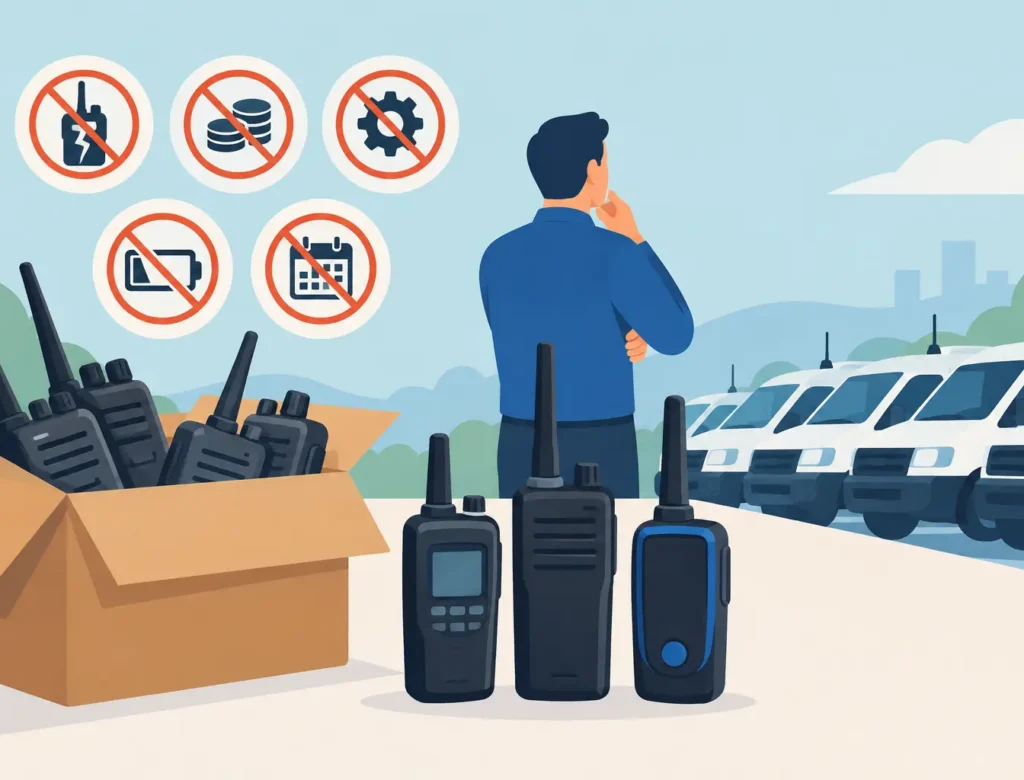
A radio replacement project can look complete when the new equipment is deployed. The costly part often begins afterward. The top radio fleet retirement mistakes happen when surplus portable radios, mobiles, chargers, base stations, and accessories are treated as a disposal task instead of a controlled asset-recovery process.
For hospitals, municipalities, utilities, school districts, manufacturers, and logistics operations, retired land mobile radio equipment may carry recoverable value, sensitive programming, encryption material, and environmental obligations. A disciplined disposition plan protects all three.
Why Radio Fleet Retirement Requires a Plan
LMR fleets rarely retire in a neat, uniform batch. A system migration may leave behind several radio generations, mixed frequency bands, spare inventory, broken units, batteries, speaker microphones, vehicle mounts, and infrastructure equipment stored across multiple sites. Without an owner, an inventory, and a clear chain of custody, those assets can sit for months while their resale value declines.
The right outcome depends on the equipment condition, model demand, accessories, quantity, and whether programming or encryption data remains in the devices. Some equipment is well suited for resale or trade-in credit. Other equipment has no resale market but still requires compliant recycling. The mistake is assuming every item belongs in the same bin.
1. Waiting Too Long to Request a Valuation
Radio value is time-sensitive. Once a manufacturer discontinues a model, demand may remain strong for a period as organizations maintain existing fleets. But that window does not stay open indefinitely. Batteries age, new platform transitions accelerate, and compatible accessories become harder to source.
Many organizations postpone a valuation until after the new system has been installed, old inventory has been moved into storage, and asset records have gone stale. By then, radios may be missing antennas, chargers, battery doors, or labels needed to identify them accurately. The delay creates more administrative work and can reduce recovery value.
Request a market assessment as soon as a replacement is approved or a major migration is being scoped. An early quote helps finance and procurement teams account for potential proceeds or trade-in value before the project budget is final. It also gives operations leaders time to organize equipment by location without disrupting active users.
2. Treating the Fleet as One Undifferentiated Lot
A fleet may contain high-value current-generation radios alongside legacy units, parts-only equipment, and non-radio electronics. Packaging all of it as “old radios” makes accurate valuation difficult and often leaves value on the table.
Separate equipment into practical categories: portable radios, mobile radios, base stations, repeaters, dispatch consoles, chargers, batteries, microphones, antennas, and vehicle accessories. Record manufacturer, model number, quantity, physical condition, and whether the unit powers on when that information is readily available. Clear photos of representative equipment can speed evaluation as well.
This does not mean your team needs to test every radio or build a perfect technical spreadsheet. The goal is a useful inventory, not a burdensome audit. A qualified radio lifecycle partner can help determine what is resalable, what can be used for parts, and what should be recycled. The more clearly the lot is identified, the more confidently it can be priced.
3. Overlooking Programming, Encryption, and Stored Data
A two-way radio is not an empty device simply because it has been removed from service. Depending on the system and radio configuration, retired equipment can retain talkgroup assignments, frequencies, unit IDs, network settings, text messages, contact lists, GPS data, system keys, and encryption-related information.
This exposure matters most for public safety, healthcare, government, utilities, and organizations with sensitive facilities or field operations. Yet it is also relevant to any business that relies on radio communications to coordinate people, vehicles, security, or production.
Do not assume a factory reset is sufficient, or that a radio is clear because its display looks blank. Data-removal requirements vary by manufacturer, model, and system architecture. Establish who is responsible for deprogramming, key management, and documented wiping before equipment changes hands. If your internal radio team cannot perform this work at scale, use a specialist that can provide certified data wiping and maintain a documented chain of custody.
4. Letting Equipment Move Without Chain-of-Custody Controls
A retirement project can involve storage rooms, vehicle shops, remote campuses, field offices, and third-party installers. Each handoff increases the possibility of lost assets, incomplete records, and unauthorized access to equipment that may still contain sensitive configuration data.
Informal collection methods are a common source of trouble. Sending a general email asking employees to “turn in old radios” may recover some units, but it does not establish who returned what, whether accessories were included, or where the radios went next. This can create reconciliation problems for finance, IT asset disposition, and compliance teams.
Use a defined collection process. Assign a site contact, set a deadline, identify approved staging locations, and document quantities as equipment is consolidated. For larger or geographically distributed fleets, nationwide pickup can eliminate the need for staff to arrange shipments, source packaging, or coordinate multiple carriers. The best process protects the equipment from loss and gives leadership a record of final disposition.
5. Paying for Logistics That the Buyer Should Handle
Surplus radios are often stored in boxes that were never intended for commercial shipment. Teams may spend hours locating packaging, preparing labels, comparing freight options, and trying to calculate whether transportation costs will exceed the equipment’s value. In some cases, the project stalls because no department wants to absorb the logistics expense.
This is avoidable. A professional disposition partner should be able to explain pickup requirements, packing expectations, insurance, and timing before the equipment leaves your control. For eligible lots, free nationwide pickup and packing compensation can turn a complicated cleanup into a manageable handoff.
The lowest freight rate is not always the lowest total cost. Consider staff time, damage risk, internal coordination, and the administrative work required to receive payment or produce recycling documentation. A process that looks inexpensive on paper can become costly when it consumes operational resources.
6. Choosing a General Liquidator for Specialized LMR Assets
General surplus buyers may recognize that a radio has resale value, but specialized LMR equipment requires more than a quick auction estimate. Model variations, frequency bands, firmware, accessory compatibility, FCC considerations, programming status, and current demand all affect value and handling requirements.
A buyer without radio-specific expertise may decline usable inventory, price it as generic electronics, or combine viable radios with scrap-bound material. That outcome can reduce proceeds and make compliance documentation harder to obtain.
Evaluate partners based on their ability to handle professional two-way radio equipment across low-band, VHF, UHF, and 800 MHz environments. Ask how they assess condition, manage sensitive data, document recycling, and handle equipment that cannot be resold. Industry specialization matters because the objective is not merely to clear space. It is to recover fair-market value where possible and manage the remainder responsibly.
7. Sending Everything to Recycling Without Separating Resale Value
Recycling is necessary for equipment that is obsolete, damaged beyond economic repair, or not permitted for reuse. But recycling every retired asset by default can erase value that could have supported the replacement project. Usable radios, mobile units, accessories, and infrastructure components may still be needed by organizations maintaining compatible systems.
Conversely, holding onto clearly obsolete material in the hope that all of it can be sold creates another problem: crowded storage, uncertain records, and delayed compliance closure. The right answer is a disposition path based on each asset category, not optimism or convenience.
A circular approach accounts for both outcomes. Resalable equipment can be purchased or credited toward replacement equipment. Non-resalable assets can be routed to compliant recycling with supporting documentation. Radiowell helps organizations make that distinction without forcing them to manage multiple vendors, shipping arrangements, and disposition paths.
Build Retirement Into the Replacement Timeline
The strongest radio replacement projects define the end of life before the new radios arrive. Identify likely surplus equipment, assign data-clearing responsibilities, request a valuation early, and establish collection and pickup procedures that work across every site. Those few decisions prevent value loss while reducing security and regulatory exposure.
Retiring a radio fleet should leave your organization with cleared space, documented handling, and recovered value – not a warehouse full of unanswered questions.
More News
-
Mobile Radio Resale Guide for Surplus LMR
Use this mobile radio resale guide to value surplus LMR equipment, protect data, arrange pickup, meet compliance obligations,…
Do Radios Store Encryption? A Disposal Reality
Do radios store encryption? Learn where keys and programming data may remain in retired two-way radios and how…
Radio Buyback Versus Scrapping Explained
Radio buyback versus scrapping affects recovery, compliance, data security, and sustainability. See how to choose the right route…

America’s largest buyer of used two-way radio equipment. Maximizing value, compliance, and sustainability for surplus LMR equipment.
Recycle and Partners