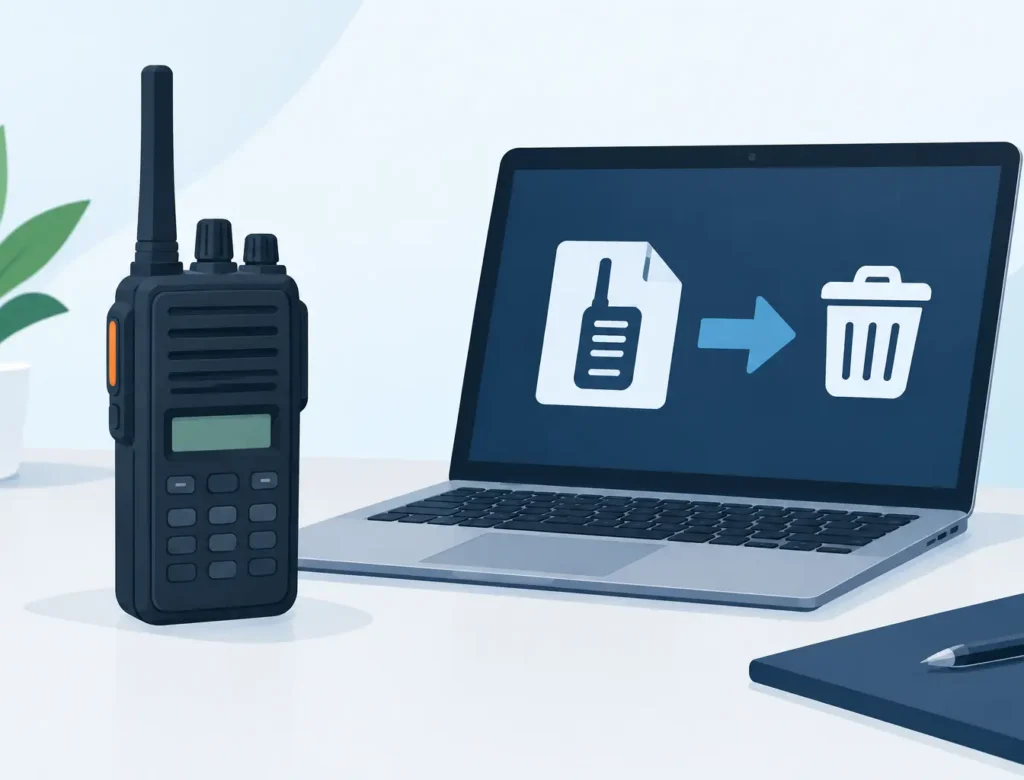
A retired two-way radio can still carry far more than a channel list. When organizations remove radio programming data, they may be addressing talkgroup assignments, system IDs, unit IDs, scan lists, fleet maps, telephone interconnect settings, GPS configurations, and, in some cases, encryption-related material. Treating that information as an asset-disposition issue protects operations while preserving the equipment’s resale or trade-in value.
For hospitals, utilities, municipalities, school districts, manufacturers, and logistics operations, this work should begin before radios leave the property. A factory reset alone may not remove every configuration item, and an unverified reset is not the same as documented data sanitization.
What radio programming data can remain on a device?
Professional land mobile radio equipment stores configuration data in ways that vary by manufacturer, model, firmware version, and system type. A conventional analog portable may hold a limited set of frequencies, transmit power settings, and signaling parameters. A digital trunked radio can contain an extensive codeplug with system affiliations, zone structures, radio IDs, network parameters, subscriber profiles, and feature entitlements.
That distinction matters during replacement projects. A radio that appears inactive can still contain programming that reveals how an organization communicates, where it operates, or which channels support security, maintenance, transportation, emergency response, or field crews.
Common retained data includes channel and frequency assignments, PL or DPL tones, talkgroups, unit and fleet IDs, scan and priority settings, emergency-button behavior, display aliases, contact lists, Wi-Fi or Bluetooth settings, and GPS-related configurations. Accessories and associated equipment deserve attention as well. Mobile radio control heads, dispatch consoles, base stations, programming computers, chargers with management capability, and removable storage can each retain records or configuration details.
Encryption requires separate handling. Encryption keys, key identifiers, and key-management records may be subject to agency policy, contractual requirements, or system-owner controls. Do not assume that erasing a radio codeplug removes all cryptographic material, and do not try to work around manufacturer or system security controls. Follow the approved key-management process for the radio platform and your organization.
Why a factory reset may not be enough
A factory reset is useful, but it is not a universal sanitization method. On some radio models, a reset returns user-accessible settings to default while leaving portions of the codeplug, calibration data, licensing information, or protected configuration areas intact. On others, reset options vary by menu access, firmware, or administrator permissions.
There is also a practical value consideration. An improperly performed reset, unauthorized firmware action, or attempt to erase protected memory can make otherwise marketable equipment unusable. That can reduce recovery value and create avoidable repair costs.
The right standard depends on the equipment and the information it contains. For a small group of conventional radios without sensitive operating details, a qualified technician’s verified reprogramming process may be appropriate. For a large P25, DMR, NXDN, or trunked-radio fleet, the process often needs chain-of-custody controls, a device-level inventory, key-management coordination, and a documented completion record.
How to remove radio programming data before disposition
Start by defining which equipment is in scope. Include portable radios, mobile radios, control stations, base stations, repeaters, microphones with display or control functions, and any programming or key-loading devices assigned to the fleet. Record make, model, serial number, asset tag, condition, battery status, and current location before equipment is consolidated.
1. Separate operational data from resale configuration
Not every programmed setting is sensitive, and not every radio needs to be stripped to the same degree. Identify the information that must be removed under your internal policy, customer agreements, public-safety procedures, or security requirements. This may include frequencies, network and subscriber identifiers, user names, contact lists, GPS data, wireless credentials, and encryption-related material.
At the same time, distinguish this information from data that affects valuation. Model number, band split, physical condition, included accessories, and whether a unit powers on are relevant to resale. Preserving accurate equipment details helps a disposition partner provide a fair quote without retaining operational programming.
2. Use the correct manufacturer software and approved workflow
For programmable LMR equipment, the cleanest approach is generally to use the approved customer programming software and the correct cable, interface, and procedure for the specific model. Read the radio first when policy permits, then confirm the serial number and configuration version. Remove or overwrite the designated fields using an approved blank or neutral configuration, rather than relying on menu changes alone.
This process should be completed by personnel who understand the radio platform. A programming mistake can disable a radio, alter regulatory settings, or prevent a future owner from restoring it to service. If internal staff do not have the tools or expertise, use a qualified radio technician or a specialist that provides documented radio-data wiping.
3. Handle encryption and credentials under a separate control
Before any device leaves your custody, confirm that cryptographic keys have been zeroized through the authorized process and that associated key-management equipment has been accounted for. Record who performed the action, the date, the method, and the affected asset numbers.
Also remove external credentials. This can include SIM cards, SD cards, Wi-Fi profiles, Bluetooth pairings, dispatch application credentials, and labels that expose radio IDs, site names, or sensitive location details. If a radio is managed through a networked platform, remove it from the management system and retire its identity according to your administrator procedures.
4. Verify the result on the radio itself
Verification turns a programming task into a defensible disposition record. Power on the radio and inspect available zones, channels, contacts, aliases, settings, and wireless menus. Where software verification is available, read the radio again and compare it against the approved neutral configuration.
Do not rely only on an employee’s statement that a device was reset. Capture the asset identifier, sanitization date, technician or provider, method used, verification result, and any exception. If a device cannot be powered on or read by software, flag it for a different disposition path rather than representing it as cleared.
Build a documented chain of custody
Large radio retirements often fail at the handoff, not at the programming bench. Equipment may sit in a closet after a system upgrade, be transferred between sites without a count, or be packed with unrelated electronics. That creates uncertainty about whether every asset received the same treatment.
A short disposition log gives operations, procurement, IT asset disposition, security, and finance a common record. At minimum, it should identify the equipment, note its condition, show the data-removal status, and track custody from collection through final resale, trade-in, or recycling.
For fleets that involve sensitive communications, add controls such as sealed containers, count verification at pickup, exception reporting, and certificates describing the disposition service. These measures reduce administrative risk without forcing your team to manage a complex logistics project internally.
When removal is not possible
Some radios are damaged, obsolete, locked, corroded, or missing the required programming interface. Others may have memory faults that prevent a reliable read or overwrite. In those cases, do not send the equipment into an informal resale channel or general electronics bin.
The appropriate response depends on the radio’s data risk and recoverable condition. A qualified lifecycle partner can determine whether the unit can be securely processed for resale, should be used for parts after approved handling, or requires compliant recycling. The goal is not to force every radio into the same outcome. It is to ensure that the outcome matches the equipment’s condition, security profile, and financial value.
Radiowell supports this process with documented data wiping, nationwide pickup, fair-market equipment valuation, and compliant recycling for non-resalable assets. That approach can be especially useful when an organization has mixed models, multiple locations, or a replacement deadline that leaves little room for manual coordination.
A practical release checklist
Before releasing retired two-way radios, confirm these four actions have occurred:
- The asset inventory matches the radios and related equipment being removed from service.
- Programming, credentials, and encryption-related material have been handled through the approved process.
- Data removal has been verified and recorded by serial number or asset tag.
- Pickup, transfer, resale, trade-in, or recycling is documented through final disposition.
A clean radio disposition process does more than prevent old channels from following equipment out the door. It gives your organization a clear record of control, protects sensitive operational details, and helps recover value from assets that still have a useful next life.
More News
-
How to Monetize Retired Radios Without Risk
Learn how to monetize retired radios with fair valuation, secure data handling, free pickup, resale options, and compliant…
How Radio Resale Partners Protect Asset Value
Radio resale partners help organizations recover value, protect sensitive radio data, manage pickups, and meet recycling obligations with…
How to Document End-of-Life Radio Processing
Document end-of-life radio processing with asset records, secure wiping, pickup proof, and recycling certificates that support audits and…

America’s largest buyer of used two-way radio equipment. Maximizing value, compliance, and sustainability for surplus LMR equipment.
Recycle and Partners