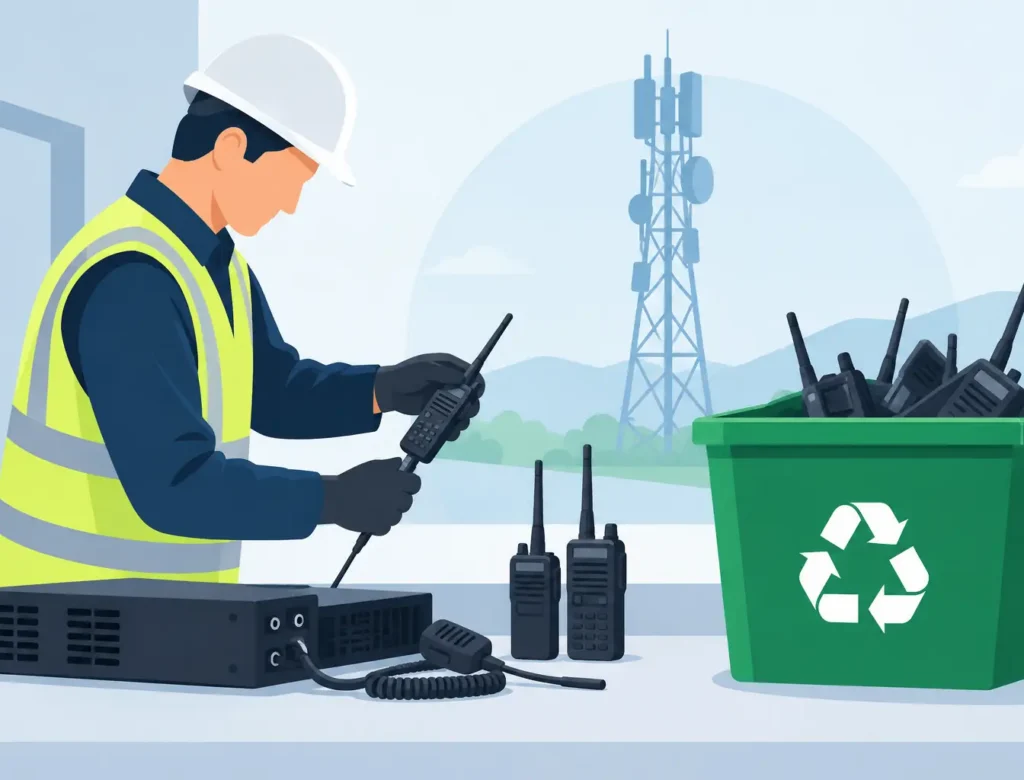
A radio replacement project is not complete when new devices are issued. The retired fleet may still contain programming, talkgroup information, encryption material, subscriber IDs, batteries, accessories, and resale value. Following best practices for radio decommissioning turns that final phase into a controlled asset-recovery process rather than an unplanned storage problem.
For hospitals, municipalities, utilities, school districts, manufacturers, and field-service organizations, the stakes are practical. Poorly managed equipment can create data-security exposure, leave valuable assets stranded in closets, complicate audits, and send reusable electronics to recycling too early. A disciplined process protects the organization while reducing the administrative burden on communications, IT, procurement, and facilities teams.
Best Practices for Radio Decommissioning Start Before Cutover
Decommissioning should be planned alongside the replacement purchase, not after deployment is underway. Once a fleet has been removed from service without an owner, inventory record, or pickup plan, devices tend to scatter across sites. That raises labor costs and makes it harder to verify that every unit has been accounted for.
Assign one internal owner for the disposition project and identify the stakeholders who need visibility. This commonly includes the radio system administrator, IT or security team, procurement, finance, environmental health and safety, and site operations. Their responsibilities are different, but they should agree on the same outcomes: maintain continuity during cutover, protect sensitive information, recover value where possible, and document final disposition.
Build an Inventory That Supports Decisions
A useful inventory does more than count radios. Capture manufacturer, model, quantity, serial number or asset tag, condition, included accessories, and location. Separate portable radios, mobile radios, base stations, repeaters, chargers, microphones, batteries, and specialized accessories. Equipment across low-band, VHF, UHF, and 800 MHz systems may have different demand, handling requirements, and resale potential.
Condition matters, but do not assume that a nonworking radio has no value. A device with a cracked housing or worn keypad may still be useful for parts, while a functioning unit may have limited resale value if it is obsolete or lacks required accessories. An experienced radio buyer can assess the full lot rather than valuing only the most attractive units.
Record whether each device is owned, leased, grant-funded, or subject to a contract restriction. Verify that no equipment must be retained for maintenance obligations, disaster recovery, mutual-aid support, or evidence retention. For public-sector organizations, also confirm any surplus-property or records requirements that apply before transferring title.
Remove Programming, Credentials, and Encryption Material
A retired two-way radio can hold more than channels. Depending on its model and configuration, it may retain unit IDs, contact lists, radio aliases, network parameters, dispatch information, Wi-Fi or Bluetooth credentials, location settings, and encryption keys. The sensitivity varies by organization and radio system, which is why a blanket factory-reset policy is not always sufficient.
Start with the system administrator. They should identify which radios have encryption enabled, what key-management process is in use, and whether a remote disable, rekey, or system-side removal is necessary before devices leave organizational control. Encryption keys and credentials should be retired under the organization’s established security policy. If a vendor handles erasure, require documentation identifying the method, the equipment covered, and the completion date.
Avoid treating data wiping as a checkbox. Some radio models store configuration in areas that are not cleared by a basic reset, and some system information is managed outside the device itself. The right procedure depends on the manufacturer, firmware, system architecture, and security classification of the fleet. When uncertainty exists, preserve the device’s chain of custody until the appropriate technical team has approved release.
Maintain Chain of Custody From Site to Final Disposition
Once equipment is removed from service, accountability must continue through pickup, processing, resale, or recycling. Use a transfer record that states the originating site, item count, date, responsible employee, and receiving party. For higher-risk fleets, document serial numbers at each handoff and reconcile them against the original inventory.
This discipline is especially useful for distributed organizations. A hospital system may collect radios from multiple campuses; a utility may have radios assigned to remote service centers; a municipality may need to gather equipment from police, public works, parks, and administrative offices. Site-level counts prevent one location’s unreturned devices from becoming a systemwide reconciliation issue.
Physical security still matters after radios are inactive. Store collected equipment in a controlled area, limit access, and do not place devices in open loading docks or unsecured recycling bins. If radios are awaiting a scheduled pickup, clearly label containers by project and location so they are not returned to circulation by mistake.
Separate Resale, Trade-In, and Recycling Decisions
The strongest disposition programs use a hierarchy: reuse when equipment remains viable, recover value through resale or trade-in when appropriate, and recycle equipment that cannot responsibly return to service. This approach can reduce the cost of a fleet refresh while supporting sustainability goals.
Do not decide that an entire lot belongs in one category based on age alone. A mixed fleet may include current portable radios with active secondary-market demand, older mobile radios suitable for parts recovery, and damaged batteries that require specialized recycling. Sorting at the model and condition level produces a more accurate valuation and a more defensible environmental outcome.
Trade-in can be useful when replacing a fleet through a new equipment purchase, but it is not automatically the best financial choice. Compare trade-in credit, direct purchase offers, pickup costs, packing requirements, processing time, and the treatment of equipment that is rejected after inspection. A clear quote should explain what is included and how final value is determined.
For non-resalable devices, use a recycler that can process electronic equipment in accordance with applicable federal, state, and local requirements. Batteries deserve separate attention. Lithium-ion and other radio batteries can create transportation and fire risks when damaged, improperly packaged, or mixed with general electronics. Follow applicable DOT shipping rules and the recycler’s packaging instructions rather than improvising onsite.
Plan Pickup, Packing, and Transportation Carefully
Logistics can determine whether a decommissioning project stays efficient. Ask early who supplies boxes or pallets, who pays for packing materials, whether onsite packing support is available, and how equipment will be collected from multiple sites. A process that looks simple for 50 radios may become difficult for thousands of radios, vehicle-mounted units, base stations, chargers, and loose accessories.
Pack radios to prevent damage and avoid mixing batteries loosely with equipment. Keep microphones, antennas, chargers, and other accessories associated with their radio model where practical. This improves valuation and reduces the likelihood that usable items are lost during transport. For mobile radios and base equipment, remove units only after confirming that vehicle, rack, and antenna-system work will not affect active operations.
Free nationwide pickup and packing compensation can eliminate a major source of friction, particularly for organizations with equipment spread across several facilities. The key is to establish the collection schedule before local teams begin clearing storage areas.
Choose a Specialist That Can Document the Outcome
General electronics liquidators may accept radios, but land mobile radio equipment has technical, security, and market-specific considerations. Select a provider that can identify professional radio models accurately, assess market value across bands and manufacturers, manage documented data wiping, arrange transportation, and provide compliant recycling for equipment that cannot be resold.
Ask direct questions about chain-of-custody records, data-erasure documentation, downstream recycling, payment timing, and how the provider handles equipment that differs from the original description. Also ask whether it can purchase a mixed lot rather than cherry-picking only the easiest devices. A complete solution is often more valuable than the highest headline price for a small portion of the fleet.
Radiowell helps organizations turn surplus LMR equipment into payment or trade-in value while coordinating pickup, documented handling, and compliant recycling for equipment that has reached the end of its useful life.
Keep Records Ready for Finance, Security, and Sustainability Teams
Close the project with a final reconciliation. Match pickup records and processing reports to the original inventory, document payment or trade-in credit, retain data-erasure records, and file recycling certificates where applicable. Finance may need support for asset retirement, while sustainability teams may need material-diversion data and security teams may need proof that sensitive programming was addressed.
The most effective decommissioning program is one that can be repeated at the next refresh without rebuilding the process from scratch. Establishing clear ownership, secure handling, and a qualified disposition path now gives every future radio replacement a faster, more certain finish.
More News
-
Radio E-Waste Compliance Guide for LMR Fleets
Use this radio e-waste compliance guide to protect data, document disposal, recover equipment value, and manage retired LMR…
How to Erase Radio Encryption Keys Safely
Erase radio encryption keys safely with documented workflows that protect sensitive communications, support compliant disposition, and preserve asset…
How to Calculate Radio Trade-In Credit Fairly
Learn how to calculate radio trade-in credit using model, condition, accessories, demand, and compliance factors to recover more…

America’s largest buyer of used two-way radio equipment. Maximizing value, compliance, and sustainability for surplus LMR equipment.
Recycle and Partners