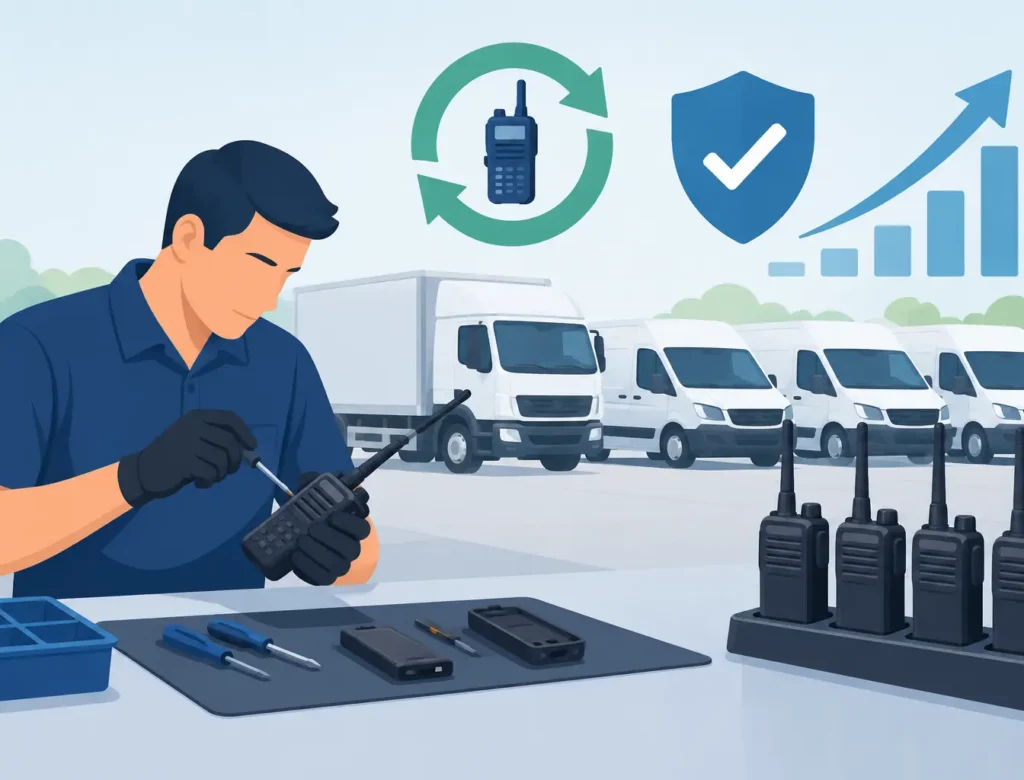
A retired two-way radio may still have years of useful service left, but its value depends on far more than whether it powers on. Radio refurbishment is a disciplined process of evaluating, restoring, testing, and preparing land mobile radio equipment for reuse. Done correctly, it can recover value from surplus assets, support sustainable equipment lifecycles, and help organizations avoid the risk of informal resale or incomplete disposal.
For hospitals, municipalities, school districts, utilities, manufacturers, and logistics operations, the question is not simply whether old radios are usable. The question is whether each unit can be returned to service reliably, securely, and in a manner that meets the organization’s operational and compliance standards.
What Radio Refurbishment Actually Involves
Refurbishment is not a cosmetic cleanup or a quick battery replacement. Professional two-way radio refurbishment begins with equipment identification and condition assessment. Portable radios, mobile radios, base stations, chargers, microphones, antennas, and accessories may all have recoverable value, but each requires a different inspection process.
Technicians evaluate physical condition, power performance, display and keypad operation, audio quality, connector integrity, charging behavior, and transmit and receive function. On compatible equipment, programming ports and internal components are also assessed. A radio that looks clean but fails a functional test is not ready for redeployment. Conversely, an older unit with normal exterior wear may remain a viable asset if it performs consistently and can be properly configured for its next use.
Refurbishment may include cleaning, replacement of worn external components, battery or accessory evaluation, firmware review where appropriate, functional testing, and preparation for resale. The exact work depends on the model, its age, available parts, market demand, and the intended application. Not every radio should be refurbished. Some equipment is better suited for parts recovery or compliant recycling.
Why Refurbished Radios Require More Than a Power Test
A basic power-on check can create false confidence. Professional LMR equipment often contains configuration files, fleet identifiers, channel plans, contact lists, unit IDs, and, in some cases, sensitive operational or encryption-related information. A unit can appear dead to the person sorting surplus equipment while still retaining recoverable data or programmed settings.
That is why data handling belongs at the center of a refurbishment decision. Before equipment changes hands, organizations should know how programming and stored information will be removed, whether data wiping is documented, and how units that cannot be resold will be managed. This is particularly relevant for public safety, healthcare, government, education, and critical infrastructure organizations, where radio configurations may reveal operational details that should not travel with a retired device.
Functional reliability matters just as much. A radio placed into another organization’s communications environment must be tested for the functions it is expected to perform. The standard should be practical: Is the unit suitable for reuse, and has it been processed by a party equipped to make that determination? A low acquisition price does not offset the cost of failures in a warehouse, on a campus, or during an emergency response.
When Refurbishment Creates the Most Value
Radio refurbishment can be especially effective during a fleet refresh. Organizations often replace equipment because they are moving to a new platform, adding features, consolidating systems, or standardizing across locations. That does not automatically mean the outgoing radios have reached the end of their useful lives.
Well-maintained professional radios can retain meaningful secondary-market value. Popular models, complete equipment packages, working accessories, and larger quantities typically offer the strongest recovery opportunity. Mobile radios, repeaters, control stations, microphones, chargers, speaker microphones, and compatible accessories may also contribute value when evaluated together rather than discarded separately.
Condition is only one part of the equation. Demand changes by manufacturer, model family, frequency band, feature set, age, and availability of replacement parts. Equipment in VHF, UHF, 700/800 MHz, and other bands may have different resale prospects depending on the market. An experienced buyer evaluates the whole inventory instead of relying on a generic scrap estimate.
This is where asset disposition becomes a financial decision, not a storage-room cleanup. Surplus radios can produce direct payment, trade-in value toward replacement equipment, or a combination of resale recovery and no-cost recycling for assets that no longer qualify for reuse.
The Trade-Off: Reuse, Resale, or Recycling
The most responsible outcome is not always refurbishment. Reuse generally delivers the highest environmental benefit because it extends the service life of equipment already manufactured. It can also create the greatest financial return when radios remain desirable and functional.
However, reuse is appropriate only when the equipment can meet reasonable quality and security requirements. A radio with extensive damage, obsolete support, missing critical components, or uncertain internal condition may not be a good candidate. Trying to force resale of marginal equipment can create downstream reliability issues and weaken the value of the entire disposition program.
Equipment that cannot be refurbished should be processed through compliant electronics recycling. Radio equipment can contain circuit boards, metals, batteries, and other materials that require responsible handling. Organizations should avoid disposal methods that place e-waste in the general trash stream or leave equipment sitting indefinitely in unsecured storage.
A capable lifecycle partner separates viable assets from non-resalable material, documents the handling process, and ensures that recycling follows applicable environmental, transportation, and communications requirements. That approach gives organizations a clear outcome for every item, rather than requiring staff to sort, list, ship, and dispose of equipment through multiple vendors.
How to Prepare a Radio Fleet for Refurbishment
The process starts with visibility. Gather radios, mobiles, chargers, batteries, microphones, repeaters, and related accessories from field locations, closets, vehicles, and storage areas. A full inventory is helpful, but it does not need to be perfect before requesting an evaluation. Clear photos, model numbers, quantities, and a general condition description are usually enough to begin.
Do not spend internal labor trying to repair, test, or individually list every item before seeking a quote. That effort often costs more than it returns, especially for organizations managing hundreds or thousands of assets across multiple sites. Instead, identify any radios that may contain sensitive programming or encryption-related material and communicate those requirements early.
It also helps to preserve equipment groupings. A radio paired with its charger, battery, antenna, and speaker microphone may be easier to evaluate than loose parts spread across several locations. Original packaging is useful when available, but it should not be a barrier to disposition. A specialized buyer can coordinate packing guidance and pickup logistics based on the volume and location of the equipment.
Before releasing assets, confirm the commercial and compliance details in writing. A sound process should define the quoted value, pickup responsibilities, payment timing, data-wiping procedures, and the disposition path for equipment that does not qualify for resale. These details reduce uncertainty for procurement, IT asset disposition, facilities, finance, and sustainability teams.
Choosing a Partner for Radio Refurbishment
General electronics buyers may accept radios, but professional LMR equipment requires category-specific expertise. The difference shows up in valuation accuracy, data awareness, testing capability, handling of specialized accessories, and knowledge of what can be resold versus recycled.
Look for a partner that can provide a fast fair-market evaluation, nationwide logistics, documented data handling, and compliant recycling for non-viable equipment. The best process also minimizes administrative burden. Your team should not have to source boxes, arrange freight, reconcile multiple buyers, or chase payment after the equipment has left the facility.
Radiowell helps organizations convert used two-way radio fleets into payment or trade-in value while managing pickup, data wiping, resale, and responsible recycling. That single-path approach is particularly useful when a fleet includes a mix of high-value radios, older accessories, damaged units, and equipment with no resale market.
Build Refurbishment Into the Replacement Plan
The strongest time to plan for refurbishment is before the replacement radios arrive. Include outgoing equipment in the project scope, assign ownership for asset release, and establish how sensitive programming will be handled. This prevents old devices from becoming an untracked inventory problem after deployment deadlines have passed.
A well-managed radio lifecycle does more than clear space. It turns a retiring fleet into a documented outcome: usable equipment returns to the market, recoverable assets generate value, sensitive data is addressed, and obsolete material is kept out of improper disposal channels. That is a practical result worth planning for before the next radio is taken out of service.
More News
-
Utility Radio Upgrade: Plan Value, Risk, and Recovery
Plan a utility radio upgrade with secure migration, asset recovery, compliant disposal, and practical steps that protect operations…
In-House Versus Outsourced Disposition for Radio Fleets
Compare in-house versus outsourced disposition for retired two-way radios to protect data, cut logistics work, recover value, and…
LMR Data Sanitization Guide for Retired Radios
Use this LMR data sanitization guide to protect radio programming, encryption keys, contacts, and fleet records before resale…

America’s largest buyer of used two-way radio equipment. Maximizing value, compliance, and sustainability for surplus LMR equipment.
Recycle and Partners