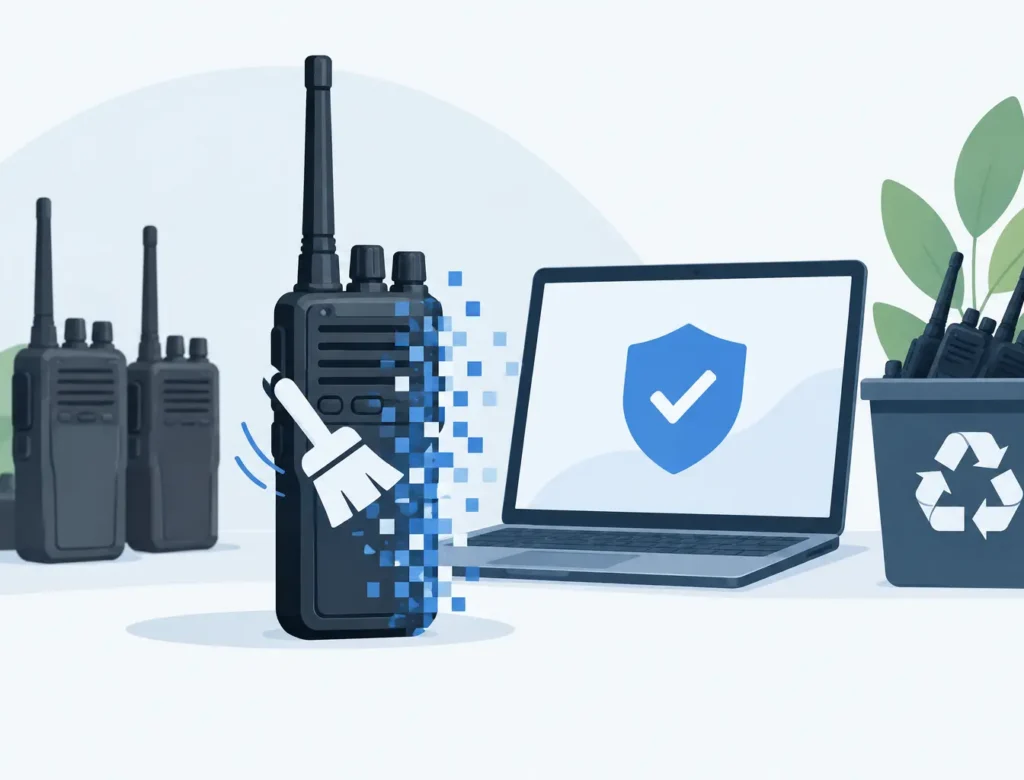
A retired two-way radio can still contain the operational blueprint of your communications system. Channel plans, unit IDs, contact lists, talkgroup assignments, network settings, location data, and encryption material may remain in a portable, mobile radio, base station, control head, or accessory long after it leaves service. Treating that equipment as ordinary surplus creates an avoidable security and compliance gap.
This LMR data sanitization guide explains how to remove sensitive information before equipment is sold, traded in, redeployed, or recycled. The objective is straightforward: protect your organization while preserving the resale value of viable equipment and maintaining a documented disposition process.
What Data Can Remain on LMR Equipment?
Land mobile radio equipment does not store data in the same way as a laptop, but its programming can be highly sensitive. A radio codeplug may reveal frequencies, channel names, interoperability arrangements, unit identifiers, fleet maps, signaling configurations, and system access settings. In hospitals, utilities, manufacturing facilities, logistics operations, schools, municipalities, and public-safety environments, that information can expose operational procedures or critical communications infrastructure.
The level of risk depends on the radio platform and how it was deployed. Conventional analog radios may primarily retain channel and identifier information. Digital radios and trunked-system equipment can hold considerably more configuration data, including talkgroups, roaming parameters, site information, radio authentication settings, and over-the-air programming configurations.
Encryption requires special attention. Keys, key references, keyloader relationships, and encryption-enabled configurations must be handled under the policies established by your communications and security teams. Removing a radio from inventory does not automatically revoke its access or eliminate the possibility of sensitive data remaining on the device.
Start the LMR Data Sanitization Process Before Pickup
The most effective sanitization process begins before surplus equipment is boxed, palletized, or transferred to a buyer. Once radios are mixed with chargers, microphones, batteries, control stations, and accessories from multiple locations, identifying what belongs to which fleet becomes slower and less certain.
Create a retirement inventory that records the manufacturer, model, serial number, quantity, location, assigned department, and disposition decision. Note whether each item is a portable radio, mobile radio, base station, repeater, control head, console component, or accessory. This inventory establishes chain-of-custody accountability and helps reconcile the final payment, trade-in credit, recycling certificate, or destruction record.
At the same time, identify assets that require special review. Radios assigned to executive protection, public safety, utilities, hospital security, emergency response, or other sensitive functions should not move forward based on a generic reset procedure alone. Involve the radio system administrator, communications manager, IT security lead, or authorized key custodian before disposition.
Identify the Right Sanitization Method
A factory reset is not always data sanitization. On some LMR models, a reset may restore user-facing settings while leaving certain configuration elements, service records, or encrypted programming intact. On others, a properly performed reset and reprogramming procedure may be sufficient for the data stored on the device. The correct approach depends on the manufacturer, model, firmware, radio architecture, and organizational policy.
A defensible process generally uses one or more of these methods:
- Authorized programming software to read, remove, overwrite, or replace the radio configuration.
- Key-management or keyloader procedures to zeroize encryption keys and remove related access material.
- Manufacturer-approved reset, erase, or recovery functions where they are documented to clear relevant memory.
- Physical destruction and compliant recycling when a device cannot be sanitized, cannot be verified, or has no resale value.
The key distinction is verification. A team should be able to demonstrate that the method used was appropriate for the device and that the device was cleared before it entered the resale or recycling stream.
Handle Encryption and System Credentials Separately
Encryption-capable radios should be placed in a separate workstream from general surplus. The radio itself may be only one part of the security picture. Your organization may also need to retire or revoke records in a key-management system, remove devices from fleet-management software, update authorization lists, and account for associated keyloaders or programming hardware.
Do not assume that deleting a channel personality removes encryption risk. Depending on the equipment and configuration, authorized personnel may need to perform a formal zeroization process. If a radio cannot be powered on, cannot be accessed with approved tools, or has an unknown programming history, the conservative decision may be physical destruction rather than resale.
This is one area where policy matters more than resale value. A working radio can have meaningful market value, but not if releasing it would conflict with your security controls, customer commitments, grant requirements, or agency procedures.
Do Not Overlook Mobile Radios, Base Stations, and Accessories
Portable radios receive most of the attention, but a complete LMR data sanitization guide must account for the rest of the ecosystem. Vehicle-mounted mobile radios may retain fleet-specific programming even after they are removed from a vehicle. Base stations, repeaters, consoles, gateways, and network-connected equipment may contain configuration files, IP settings, user accounts, logs, or remotely managed credentials.
Accessories can also matter. Bluetooth adapters, wireless microphones, recording devices, GPS accessories, and connected control equipment may retain pairing information or operational data. Batteries and chargers typically present more of a safety and recycling concern than a data concern, but they should still be counted and handled through the proper disposal path.
For complex sites, create equipment groups rather than treating every item as an isolated asset. A base station may have related controllers, power supplies, antennas, programming cables, manuals, and rack equipment. Grouping the assets makes it easier to determine what can be resold, what needs data review, and what should be recycled.
Verify, Document, and Maintain Chain of Custody
Sanitization without records is difficult to defend during an audit, incident review, or procurement review. Keep documentation proportional to the risk and value of the equipment. For a small group of non-encrypted radios, a serial-number inventory and signed disposition record may be sufficient. For a large fleet with sensitive programming or encryption capability, the record should be more detailed.
Document the date of sanitization, the responsible person or provider, the method used, the asset identifier, and the verification result. If equipment is transferred offsite for sanitization, record the handoff date, carrier or pickup details, receiving party, and final disposition. Photos of packed equipment and pallet counts can be useful for larger projects, especially when assets come from multiple facilities.
A documented chain of custody protects both sides of the transaction. Your organization can show that equipment was managed responsibly, while the disposition provider has clear instructions about what may be resold, what requires wiping, and what must be destroyed or recycled.
Choose a Disposition Partner That Understands LMR
General electronics recyclers and broad IT asset disposition providers may be experienced with computers and phones, but LMR equipment introduces different questions. A qualified partner should understand radio models, frequency bands, radio programming, encryption-sensitive equipment, serial-number tracking, transportation requirements, and the resale market for used communications assets.
Ask how the provider distinguishes viable radios from non-resalable equipment, how it handles units with unknown programming status, what documentation it provides, and how it manages downstream recycling. Also confirm who pays for packing and pickup, how quickly payment or trade-in credit is issued, and whether the provider can coordinate projects across multiple U.S. locations.
For organizations retiring large or mixed fleets, a specialist such as Radiowell can combine asset valuation, nationwide pickup, certified data wiping, resale, and compliant recycling in one disposition process. That reduces administrative burden while helping ensure that recoverable equipment is not unnecessarily scrapped.
Build Sanitization Into Your Replacement Cycle
The best time to plan secure radio disposition is when you approve the replacement purchase, not when old radios begin filling a storage room. Add sanitization, inventory reconciliation, pickup coordination, and final documentation to the project plan for every fleet refresh.
This approach gives communications, procurement, finance, security, and sustainability teams a shared process. Security controls are addressed before radios leave the organization, finance can recover value from working equipment, and sustainability teams can document responsible reuse or compliant recycling.
Retired radios should leave your organization with their operational data removed, their custody documented, and their next destination clearly defined. That is how an equipment refresh becomes a controlled business outcome rather than a lingering security liability.
More News
-
Utility Radio Upgrade: Plan Value, Risk, and Recovery
Plan a utility radio upgrade with secure migration, asset recovery, compliant disposal, and practical steps that protect operations…
In-House Versus Outsourced Disposition for Radio Fleets
Compare in-house versus outsourced disposition for retired two-way radios to protect data, cut logistics work, recover value, and…
Radio Refurbishment for Reliable Fleet Value
Radio refurbishment can extend equipment value, but only when testing, data removal, documentation, and compliant disposition are handled…

America’s largest buyer of used two-way radio equipment. Maximizing value, compliance, and sustainability for surplus LMR equipment.
Recycle and Partners