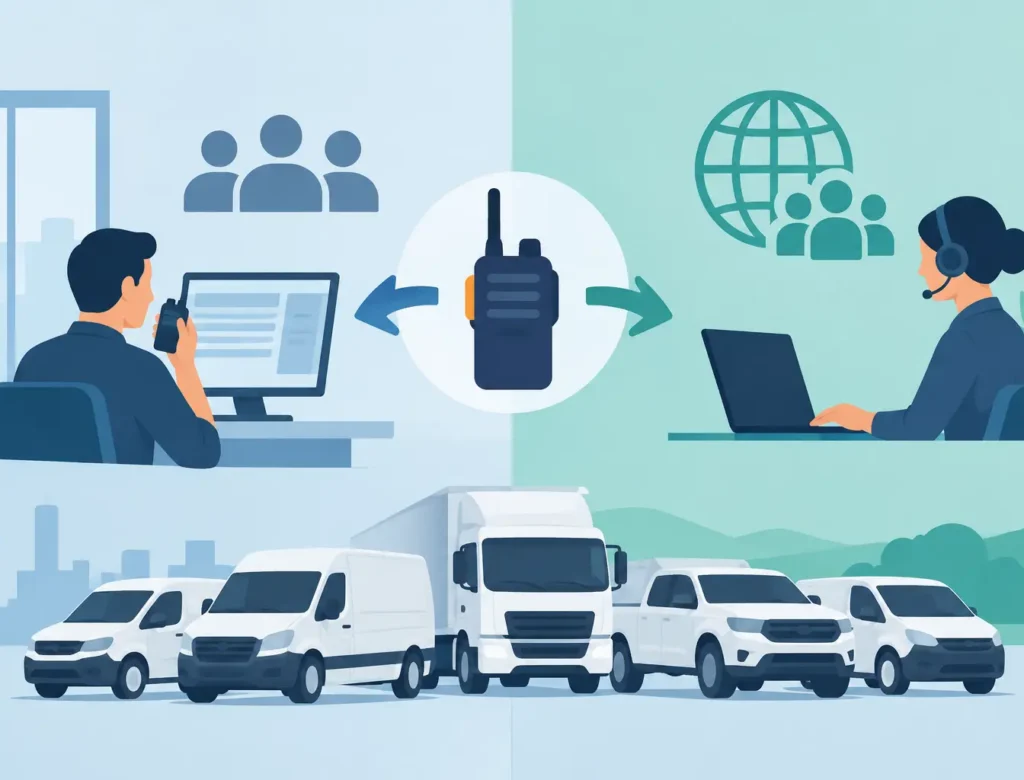
A radio replacement project can look complete the moment new units are deployed. The harder work often begins afterward: collecting retired radios from field locations, identifying what still has value, removing sensitive programming, and proving that unusable equipment was handled correctly. In-house versus outsourced disposition is not simply a staffing decision. For organizations with professional two-way radio fleets, it determines how much value is recovered, how much risk remains, and how much internal time is pulled away from active operations.
A few surplus portable radios may be manageable internally. A fleet refresh involving hundreds of radios, mobile units, chargers, batteries, accessories, repeaters, or base stations is a different operational event. Equipment may be spread across campuses, vehicles, warehouses, departments, and remote sites. Models, conditions, ownership records, and stored configurations often vary. A disposition plan has to account for that reality before the first box is packed.
In-House Versus Outsourced Disposition: What Changes
The central difference is ownership of the process. An in-house program keeps valuation, collection, storage, data handling, resale, recycling, and reporting under the organization’s direct control. An outsourced program transfers most or all of those tasks to a qualified specialist, while the organization retains approval authority and receives documented results.
Neither route is automatically right. The better choice depends on fleet size, internal expertise, time constraints, security requirements, and the condition of the equipment. The mistake is treating retired LMR equipment as ordinary office electronics or as scrap with no remaining commercial value.
When In-House Disposition Can Make Sense
An internal approach can work when an organization has a small, centralized inventory; experienced communications and asset-management staff; secure storage space; and an established process for resale or compliant recycling. It can also be appropriate when equipment is being reassigned internally and the organization has accurate records of unit IDs, accessories, battery condition, and programming status.
Direct control can be useful
Keeping the process in-house gives leaders immediate visibility into every radio and every decision. A communications manager may know which models can be retained for spares, which accessories are compatible with the new fleet, and which units have unusually high resale demand. That knowledge can help prevent usable equipment from being discarded too early.
Internal control also supports organizations with specialized approval requirements. Some public-sector agencies, utilities, and healthcare systems need multiple signoffs before an asset leaves the premises. When retirement volumes are low and the approval path is already established, internal management may avoid adding another vendor workflow.
The hidden cost is administrative effort
The challenge is that disposition is rarely one task. Staff must collect equipment, reconcile inventories, assess condition, find buyers, create listings or negotiate sales, pack shipments, manage freight, document payment, and coordinate recycling for items that cannot be resold. Those activities can consume far more time than anticipated, particularly when equipment is scattered across multiple locations.
There is also a risk of inconsistent outcomes. One department may hold radios for months, another may ship them without complete records, and a third may send usable units to an electronics recycler because no one has time to evaluate them. Value declines while storage space fills. Internal teams can perform this work well, but they need a repeatable process, accountable ownership, and enough capacity to run it.
What Outsourced Disposition Changes
Outsourcing uses a specialist to turn retired equipment into a controlled, documented process. For LMR fleets, a qualified partner can evaluate radios and related equipment, provide a fair-market quote, arrange collection, coordinate packing, remove or wipe data, resell viable equipment, and recycle non-resalable materials through appropriate channels.
It reduces the logistics burden
For distributed organizations, pickup coordination can be one of the largest practical benefits. A partner that manages nationwide collection removes the need for local teams to source boxes, prepare shipments, compare freight options, and track multiple deliveries. That matters when field personnel should be focused on patient care, utility restoration, manufacturing output, public safety, or transportation operations rather than surplus equipment.
Outsourcing also creates a single destination for mixed equipment. A retirement project may include portable and mobile radios, microphones, chargers, batteries, antennas, control stations, repeaters, and older equipment across VHF, UHF, 800 MHz, or other bands. A specialist can determine what has resale potential and route the rest to compliant recycling without requiring internal staff to manage several vendors.
Security and compliance become defined deliverables
A factory reset is not the same as documented data handling. Retired radios can retain programming details, unit identifiers, contact lists, talkgroups, network settings, and, depending on the system, other sensitive configuration information. Organizations should require a clear process for data wiping or sanitization, chain of custody, and certificates or reports that support internal audit requirements.
The same standard applies to environmental handling. Batteries, circuit boards, and damaged electronics need appropriate processing. An outsourced provider should be able to explain how non-resalable equipment is managed, what documentation is available, and how its process supports applicable EPA, FCC, DOT, and e-waste requirements. Compliance should not depend on a verbal assurance after the equipment has left the facility.
How to Choose Between In-House and Outsourced Disposition
The decision becomes clearer when leaders evaluate the full cost of the project, not just a resale price. A higher sale price achieved internally may not produce a better financial outcome if staff hours, packing materials, freight, storage, failed transactions, and compliance exposure consume the difference.
Consider these five questions before selecting a disposition model:
- How much equipment is involved? Small, uniform lots may be simple to manage. Large or mixed fleets create collection, sorting, and documentation demands that increase quickly.
- Where is the equipment located? Equipment stored in one secured facility is easier to control than radios distributed across schools, ambulances, service vehicles, plants, or regional offices.
- What information may remain on the devices? If programming, identifiers, or system settings are sensitive, documented sanitization and custody controls should carry significant weight.
- What is the realistic net recovery value? Account for internal labor, shipping, storage, marketplace fees, and the likelihood that equipment will remain unsold.
- Can the organization prove compliant final disposition? Asset records, data-wiping documentation, recycling certificates, and payment records should be available when finance, procurement, sustainability, or auditors ask for them.
For many organizations, the right answer is not purely in-house or fully outsourced. It may be a managed program in which internal communications staff identify equipment to retain while a specialist handles the collection, valuation, resale, data wiping, and recycling of the remaining fleet.
A Practical Hybrid Model for Radio Fleets
A hybrid approach protects institutional knowledge without turning technical staff into liquidation teams. Internal personnel decide which radios are still suitable for backup inventory, training, temporary deployments, or compatible parts. The disposition partner then receives a defined surplus lot with approval to evaluate and process it.
This model is especially effective after a system migration. The communications team can retain only the equipment with a clear operational use, while older or incompatible units move out of storage quickly. It prevents a common pattern in which surplus radios stay on shelves because no one wants to make a final decision, only to lose value and become harder to track over time.
Radiowell supports this type of outcome by combining fair-market quotations, nationwide pickup, data wiping, resale, trade-in value, and compliant recycling for used two-way radio equipment. The goal is not merely to remove equipment. It is to create a documented path from surplus assets to financial recovery or responsible end-of-life processing.
What a Defensible Disposition Process Looks Like
Whether the work stays internal or is assigned to a specialist, the process should be clear enough to withstand review. Begin with an inventory that captures model numbers, quantities, serial numbers when available, accessories, operating condition, and location. Separate equipment intended for reuse from equipment approved for disposition before collection begins.
Next, define who can authorize release, who handles custody at each handoff, and what records are required. If equipment includes encrypted or sensitive configurations, establish the approved sanitization method before it is moved. Do not rely on an assumption that radios are empty because they are powered off or no longer connected to the system.
Finally, measure the outcome. A sound program records the value recovered, the equipment resold, the material recycled, the documentation received, and the internal labor avoided. Those results help justify future replacement projects and give sustainability, finance, and operations leaders a shared view of performance.
The best disposition decision is the one that lets your team retire equipment with certainty: value has been captured where possible, sensitive information has been addressed, and every remaining asset has a responsible destination. Build that standard into the next radio refresh before the first retired unit reaches a storage shelf.
More News
-
Utility Radio Upgrade: Plan Value, Risk, and Recovery
Plan a utility radio upgrade with secure migration, asset recovery, compliant disposal, and practical steps that protect operations…
Radio Refurbishment for Reliable Fleet Value
Radio refurbishment can extend equipment value, but only when testing, data removal, documentation, and compliant disposition are handled…
LMR Data Sanitization Guide for Retired Radios
Use this LMR data sanitization guide to protect radio programming, encryption keys, contacts, and fleet records before resale…

America’s largest buyer of used two-way radio equipment. Maximizing value, compliance, and sustainability for surplus LMR equipment.
Recycle and Partners