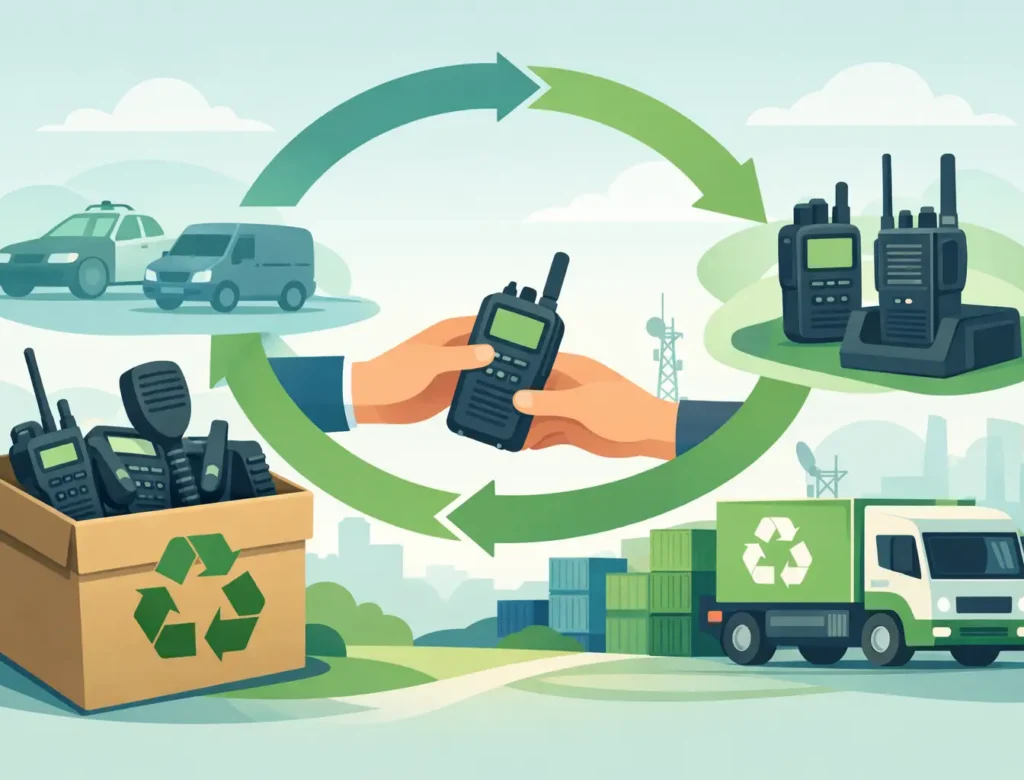
A retired radio fleet is not just a stack of old electronics. It may contain programmed frequencies, unit IDs, talkgroup information, contact lists, encryption keys, and accessories that still have market value. Effective radio recycling gives organizations a controlled way to retire those assets while protecting sensitive information, meeting environmental responsibilities, and recovering value where possible.
For hospitals, municipalities, school districts, utilities, manufacturers, and logistics operations, the decision often arrives during a system upgrade. Hundreds or thousands of portable radios, mobile radios, chargers, batteries, microphones, repeaters, and base-station components may need to leave service at once. The right disposition process prevents that transition from becoming a security, compliance, or storage problem.
Radio recycling starts with asset recovery
The best outcome for retired land mobile radio equipment is not automatically material recycling. Many professional two-way radios retain value after an organization has moved to a new platform or frequency plan. A radio that is no longer operationally useful to one fleet may still be serviceable for another organization, supplied with parts, or refurbished for resale.
That is why a disciplined disposition process begins with identification and evaluation. Equipment should be sorted by manufacturer, model, band, condition, quantity, included accessories, and operational status. Portable radios, mobile radios, control stations, base stations, repeaters, speakers, microphones, batteries, and chargers can all affect the value of a lot.
This approach creates a practical hierarchy: reuse when equipment is viable, recover parts when full resale is not practical, and recycle materials only when there is no remaining reuse value. It reduces waste while helping an organization capture fair-market value from assets that might otherwise be written off.
The result depends on the equipment. Current-generation units in working condition with batteries, chargers, and matching accessories generally have stronger resale potential. Older analog radios, damaged units, discontinued models, or incomplete equipment may have limited resale value, but they still require responsible processing. A specialist should be able to evaluate both categories without forcing an organization to manage multiple vendors.
Why retired radios require secure handling
A radio can appear harmless after it is powered down, yet its configuration may reveal information an organization would not want circulating outside its control. Programming data can identify system structure, channel assignments, agency names, facility locations, and user groups. Depending on the system, retired equipment may also hold encryption-related material or other security-sensitive settings.
Simply removing a battery, deleting a few channels, or sending equipment to a general electronics recycler does not necessarily address that exposure. The disposition partner needs a repeatable process for identifying equipment capable of retaining data and securely wiping it before resale, reuse, or downstream processing.
Documentation matters as much as the wipe itself. Facilities leaders, IT asset disposition teams, procurement staff, and public-sector administrators may need records that show what equipment was transferred, how it was handled, and how data-bearing assets were processed. Clear chain-of-custody practices reduce uncertainty when an audit, policy review, or internal question arises later.
Security also extends beyond the radio body. Programming cables, laptops, subscriber-management records, removable storage, and fleet documentation should be considered during a retirement project. Not every item belongs in the same disposition stream. Separating communications hardware from supporting IT assets at the outset helps prevent accidental loss of records or incomplete data handling.
Compliance is not a general e-waste issue
Land mobile radio equipment sits at the intersection of electronics recycling, communications regulation, and transportation requirements. That makes a compliant process more involved than placing devices in a standard recycling bin or arranging a one-time pickup with an unspecialized buyer.
Batteries are a central concern. Lithium-ion, nickel-metal hydride, nickel-cadmium, and other battery types require appropriate sorting, packaging, and downstream processing. Damaged or swollen batteries may create additional handling requirements. Shipping large quantities without proper planning can create avoidable safety and regulatory risk.
Radio equipment may also include components subject to e-waste controls, while its operational history can create FCC-related considerations. Organizations should look for a disposition provider that understands EPA, FCC, DOT, and applicable e-waste requirements rather than treating communications equipment as a generic commodity.
A compliant process should account for the full chain: inventory, packing, pickup, transportation, data handling, evaluation, resale where appropriate, and material recycling for non-resalable equipment. The goal is not merely to make equipment disappear. It is to create a defensible record of what happened to it.
A practical process for radio recycling
The most efficient projects follow a simple sequence, but preparation determines whether the process stays fast. Start with a preliminary inventory. A detailed spreadsheet is helpful for large fleets, though it does not need to be perfect before requesting a quote. Model numbers, estimated quantities, condition, accessories, and photos of representative equipment are often enough to begin an evaluation.
Next, separate active assets from retired assets. Radios still assigned to employees, installed in vehicles, awaiting incident review, or needed as contingency stock should not be mixed into the disposition lot. This is especially important for hospitals, public safety-adjacent operations, and utilities where communication continuity matters.
Then establish the disposition objective. Some organizations prioritize immediate cash recovery. Others prefer trade-in credit toward replacement equipment. Some have a mixed lot where newer radios should be sold and obsolete or damaged units need compliant recycling. A qualified specialist can structure a solution around the actual condition of the fleet rather than applying a one-size-fits-all liquidation model.
Before pickup, confirm how packing and freight will be handled. Large radio projects create hidden labor costs when internal teams must locate boxes, package equipment, palletize loads, and coordinate carriers. Free nationwide pickup and packing compensation can materially change the economics of a project, particularly for distributed organizations with assets at multiple sites.
Finally, retain the transaction and processing records. Payment documentation, asset lists, data-wipe confirmation where applicable, and recycling records support finance, compliance, sustainability, and procurement teams. These records also make the next equipment refresh easier because the organization has a clearer baseline of what left service.
Common mistakes that reduce value or increase risk
The most expensive mistake is allowing retired equipment to sit indefinitely in storage rooms, maintenance shops, or vehicle bays. Radios can lose resale value as models age, batteries deteriorate, accessories get separated, and replacement parts become harder to source. Unmanaged storage also increases the chance that sensitive programmed devices leave the facility without authorization.
Another common mistake is treating all equipment as scrap. A mixed fleet can contain high-value radios alongside equipment that belongs in recycling. Selling everything by weight may be simple, but it can leave significant recovery value on the table.
Organizations also lose value when they discard chargers, antennas, microphones, speaker mics, belt clips, and other accessories without evaluation. Individual accessories may not seem consequential, but complete, matched equipment packages are often more useful in the resale market than bare radio bodies.
Avoid choosing a provider based solely on the highest preliminary offer. A quote should be considered alongside pickup costs, data-wipe practices, payment timing, downstream accountability, and the provider’s experience with professional two-way radio equipment. A higher number is not a better outcome if it comes with uncertain logistics or incomplete compliance documentation.
Measuring the business value of responsible disposal
Radio recycling can support several goals at the same time. Finance teams gain a recovery path for surplus assets. Operations teams regain valuable storage space and avoid managing a low-priority logistics project. Security and IT teams reduce exposure from retained programming and sensitive data. Sustainability teams can document reuse and responsible recycling instead of sending equipment to landfill.
For organizations replacing fleets on a recurring cycle, the process becomes even more valuable when it is planned before new equipment arrives. Building disposition into the replacement timeline prevents old and new inventories from overlapping for months and helps fund a portion of the upgrade through resale or trade-in value.
Radiowell works with organizations that need this process to be fast, documented, and practical: same-day fair-market quotes, nationwide pickup, secure data wiping, payment or trade-in value for viable equipment, and compliant recycling for the rest.
The next time a radio fleet reaches retirement, treat it as an asset transition rather than a disposal task. A short inventory and an early evaluation can protect sensitive information, reduce internal workload, and turn equipment that has finished its first mission into measurable value and responsible material recovery.
More News
-
Who Buys Radio Repeaters and What They Look For
Who buys radio repeaters? See which organizations purchase surplus equipment and how compliant resale preserves value, data security,…
Prepare Radios for Equipment Retirement Right
Learn how to prepare radios for equipment retirement with secure data handling, accurate inventory, safe packing, value recovery,…
Radio Asset Recovery That Pays and Protects
Radio asset recovery turns retired two-way radios into value while protecting data, meeting compliance duties, and reducing disposal…

America’s largest buyer of used two-way radio equipment. Maximizing value, compliance, and sustainability for surplus LMR equipment.
Recycle and Partners