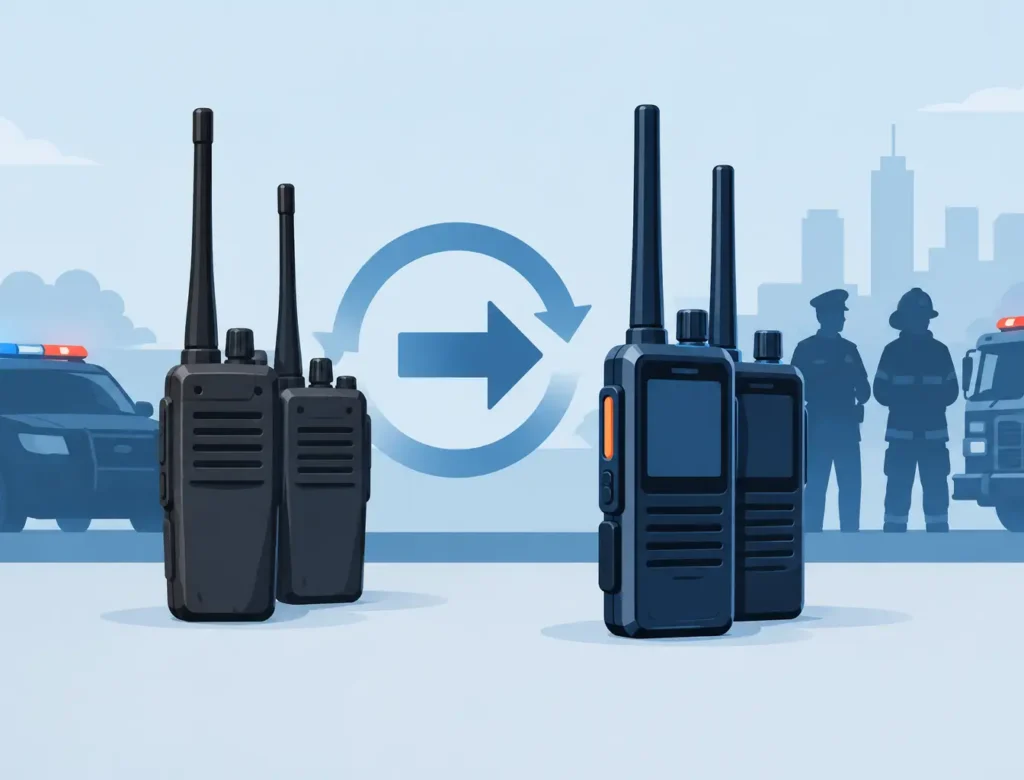
A radio fleet can appear functional right up until it becomes an operational liability. A model reaches end of support, replacement batteries become inconsistent, a critical accessory is no longer available, or mutual-aid partners move to a different standard. For agencies and public institutions, a public safety radio replacement guide is not just a purchasing resource. It is a continuity plan for the people who depend on communications when conditions are least forgiving.
The strongest replacement projects begin well before the first new portable radio is issued. They account for coverage, interoperability, programming, user adoption, funding, and the controlled disposition of equipment leaving service. Treating these decisions as one lifecycle process reduces risk, protects budget value, and keeps retired assets from becoming a data-security or compliance problem.
Start With the Operational Trigger
Replacement should be based on the system’s ability to support the mission, not simply the age of the radios. A five-year-old fleet may still be serviceable if it has manufacturer support, dependable batteries, available parts, current firmware, and adequate coverage. Conversely, a newer fleet may warrant replacement when it cannot meet changing interoperability requirements or has become costly to maintain.
Document what is creating pressure to replace. Common triggers include end-of-life announcements, recurring repair failures, inability to source batteries or chargers, migration to a P25 system, encryption changes, coverage gaps, or a need to standardize equipment across departments. For a school district, the trigger may be unreliable campus communications. For a municipality, it may be a countywide system transition. For a utility or hospital, it may be the need to align field teams, security, facilities, and emergency response personnel on dependable channels.
Define the consequence of not acting. That distinction helps procurement, finance, leadership, and frontline users evaluate urgency on the same terms. A repair backlog is a cost issue. A radio that cannot participate in a mutual-aid incident is an operational issue. A retired unit with active encryption material is a security issue.
Build a Complete Radio Asset Baseline
Before selecting replacement equipment, establish exactly what you own and where it is deployed. Many organizations have more radio assets than their central inventory reflects: spares in lockers, mobile radios in vehicles awaiting disposal, base equipment in closets, legacy chargers, microphones, antennas, repeaters, and accessories held for parts.
A useful baseline records the manufacturer, model, serial number, frequency band, condition, assigned location, user group, programming status, and accessory compatibility for each asset. Separate portable radios, mobile radios, control stations, base stations, repeaters, and supporting equipment. Include low-band, VHF, UHF, 700/800 MHz, and multiband assets where applicable.
This inventory does more than support a purchase order. It identifies which units can remain in service during a phased migration, which accessories may transfer, which equipment has resale value, and which items require compliant recycling. It also prevents an avoidable problem: paying to replace radios that were never actually deployed or cannot be located.
Separate Mission-Critical Needs From Preferences
Replacement specifications should begin with real operating conditions. Ask how users communicate, where they work, what they carry, and what happens when communications fail. Fire, law enforcement, emergency management, transit, public works, healthcare security, and school operations may all require different configurations even within the same organization.
Coverage, audio quality, battery endurance, emergency button functions, environmental ratings, encryption requirements, and interoperability should carry more weight than cosmetic preferences. A smaller radio may be easier to carry, but a larger battery may be essential for extended shifts. A multiband radio can reduce the number of devices a command user carries, but it may increase acquisition cost and programming complexity.
Avoid writing specifications around a familiar model number alone. Specify the capabilities that support the mission, then evaluate whether the proposed equipment, system design, and support model meet those requirements.
Plan the Migration Before Ordering Equipment
A successful cutover is organized around people and processes, not shipping dates. New radios must be programmed, labeled, tested, assigned, and introduced without creating confusion on active channels. If a new system requires new talkgroups, encryption keys, subscriber templates, or dispatch configurations, those dependencies should be settled before field deployment begins.
Phased deployment is often the safer choice for larger fleets. Pilot the equipment with a representative group of users, including personnel who work in difficult coverage areas or use specialized accessories. Validate audio performance, channel layouts, charging routines, emergency functions, vehicle installations, and dispatch interaction. Then adjust the rollout plan before issuing radios at scale.
Training should be concise and role-specific. Users need to know more than where the push-to-talk button is. They need to understand channel zones, emergency activation, battery care, accessory use, charging expectations, and any new operational procedures. Supervisors and communications staff need a clear escalation path for programming errors, lost radios, and equipment swaps.
Keep the old fleet available only as long as necessary. Extended overlap can create confusion, especially when channel plans, encryption, or system access differ. Establish a cutoff date, retrieve legacy equipment against the inventory, and document exceptions for units that remain temporarily assigned.
Budget for the Full Lifecycle, Not Just the Radio
The unit price is only one part of a replacement decision. Agencies should budget for batteries, chargers, speaker microphones, headsets, vehicle installation, programming, system integration, training, warranty coverage, spare units, and future maintenance. A lower initial equipment cost can become expensive if accessories fail early or support is difficult to obtain.
At the same time, a replacement project can create financial recovery from the outgoing fleet. Used LMR equipment may retain market value depending on model, quantity, condition, frequency band, completeness, and current demand. Even equipment that is no longer useful to its original owner may be suitable for resale, parts recovery, or compliant material recycling.
That value should be evaluated early, while the asset list is complete and before radios are scattered, damaged, or discarded. A trade-in or buyback approach may offset acquisition costs, but only when the receiving partner can accurately identify equipment, handle nationwide logistics, and provide a clear disposition path for all assets, including items with little or no resale value.
Treat Retired Radios as Sensitive Assets
A radio leaving service may still contain far more than its physical components suggest. Subscriber programming can reveal channel structures, talkgroup names, fleet mappings, unit identifiers, site information, and operational conventions. Depending on the equipment and configuration, radios may also contain encryption keys or other security-sensitive material.
Do not treat retirement as a storeroom cleanout. Establish chain-of-custody procedures from collection through final disposition. Limit who can access unprogrammed units, reconcile serial numbers, remove credentials and encryption material according to agency policy, and retain documentation of the process. The exact steps depend on the radio platform and security requirements, but the standard should be clear: no retired device leaves organizational control with sensitive information intact.
A specialist disposition partner can support this work with documented data wiping, serialized reporting, resale management, and compliant recycling. Radiowell helps organizations turn surplus two-way radio equipment into recovered value while managing pickup, secure processing, and responsible downstream handling.
Choose a Disposition Path for Every Asset
Not every radio should follow the same path. Working, in-demand equipment may be appropriate for buyback or trade-in. Serviceable accessories and components may have value even if complete radios do not. Damaged, obsolete, or non-resalable assets should be processed through compliant e-waste recycling rather than placed in general waste or held indefinitely.
The right partner should be able to accept the full mix, not just the easiest items to resell. Ask how pickup is managed, whether packing support is available, how serial numbers are tracked, what data-wiping documentation is provided, how payments or credits are issued, and how non-resalable material is recycled. For public-sector owners, documentation and consistency matter as much as the quoted value.
Use This Public Safety Radio Replacement Guide as a Control Point
A replacement project should leave the organization more capable than it was before: better equipment aligned to the mission, a cleaner inventory, defined support procedures, and no unaccounted-for legacy radios. That result comes from connecting procurement and deployment with secure asset retirement instead of treating them as separate projects.
The next time a fleet approaches end of support, begin with an inventory and a decision timeline. That early discipline gives your team room to test the right equipment, protect operational continuity, recover value from the outgoing assets, and make every retired radio accountable.
More News
-
How to Monetize Retired Radios Without Risk
Learn how to monetize retired radios with fair valuation, secure data handling, free pickup, resale options, and compliant…
How Radio Resale Partners Protect Asset Value
Radio resale partners help organizations recover value, protect sensitive radio data, manage pickups, and meet recycling obligations with…
How to Document End-of-Life Radio Processing
Document end-of-life radio processing with asset records, secure wiping, pickup proof, and recycling certificates that support audits and…

America’s largest buyer of used two-way radio equipment. Maximizing value, compliance, and sustainability for surplus LMR equipment.
Recycle and Partners