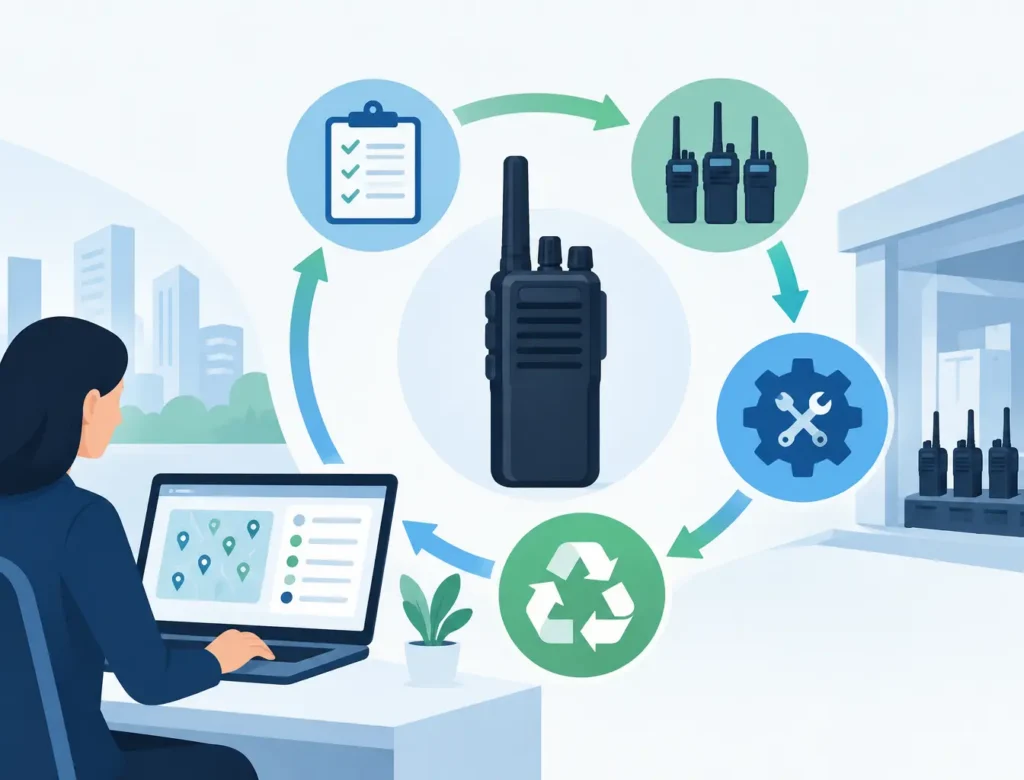
A radio fleet rarely fails all at once. More often, a hospital replaces one department’s portables, a utility migrates a region to a new platform, or a municipality finds aging mobiles accumulating in storage. Without a defined enterprise radio lifecycle management guide, those radios become an untracked liability: capital tied up in surplus equipment, sensitive programming left exposed, and disposal decisions delayed until they become urgent.
For organizations that depend on land mobile radio (LMR), lifecycle management is not simply an inventory exercise. It is a disciplined process for keeping communications equipment operational when needed, recovering value when it is replaced, and documenting responsible handling at every stage.
Start with a complete view of the radio fleet
The first lifecycle problem is usually visibility. Radio fleets often span portable radios, vehicle mobiles, control stations, repeaters, chargers, batteries, microphones, antennas, and spare parts. Equipment may be distributed across campuses, field offices, vehicles, warehouses, and remote facilities. Records can be split among communications, IT, procurement, fleet, and facilities teams.
Build an asset record that identifies the manufacturer, model, serial number, band or frequency range, condition, location, assigned user or department, accessories, purchase date, and service history. For programmable radios, record the current system relationship and whether the device contains encryption material, programmed channels, talkgroup details, subscriber IDs, or other operational settings.
The goal is not paperwork for its own sake. A complete record helps leaders answer practical questions: Which radios can be redeployed? Which assets are nearing replacement? Which equipment has resale value? What is sitting idle? Which units need controlled data removal before leaving the organization?
A yearly physical count is useful, but it should not be the only control. When equipment is issued, repaired, reassigned, or removed from service, update the record at that point. The organizations with the cleanest disposition projects are usually the ones that have maintained usable data throughout the operating life of the fleet.
Set replacement rules before failures force the decision
LMR equipment should be replaced based on operational risk, supportability, and total cost, not just age. A five-year-old radio may remain a productive asset if it is supported, compatible with the system, and reliable in its assigned environment. A newer radio may need replacement sooner if it no longer meets safety, coverage, feature, or security requirements.
Establish review points for fleet segments rather than waiting for a system-wide crisis. Consider manufacturer support status, repair frequency, battery performance, accessory availability, firmware requirements, interoperability needs, and the cost of keeping older units in service. In public safety, healthcare, utilities, and industrial operations, downtime and missed communications can carry a cost far beyond a repair invoice.
There is a trade-off. Replacing equipment early can improve standardization and reduce repair exposure, but it can also leave recoverable value on the table if capable radios are retired without a disposition plan. Extending use can defer capital spending, but only if the organization can still support the fleet without compromising operations. The right timing depends on the mission, system architecture, and availability of replacement equipment.
Separate operational retirement from physical disposal
A radio removed from frontline use is not automatically ready for recycling. It may be suitable for reassignment to a lower-demand role, retained as a contingency spare, traded in against replacement equipment, or sold through a qualified LMR buyer. Each path should be intentional.
Create clear status categories such as active, spare, repair, quarantine, approved for resale, approved for trade-in, and approved for recycling. This avoids the common problem of surplus radios returning to circulation after they were supposed to be deprogrammed or retired.
Quarantine is particularly valuable for radios awaiting security review. Store them in a controlled area, limit access, and prevent them from being issued, donated, or discarded informally. A radio can look like ordinary electronics while still containing operationally sensitive information.
Protect data and programming before equipment leaves control
Retired LMR equipment can retain more than channel names. Depending on the model and configuration, it may contain frequency information, talkgroups, unit IDs, fleet maps, contacts, text messages, GPS-related data, Wi-Fi credentials, network settings, and encryption keys. For hospitals, government agencies, utilities, schools, and logistics operators, this information may reveal communications practices, personnel details, or system design.
Your retirement procedure should specify who is authorized to remove programming and encryption material, what method is required for each radio family, and how completion is documented. This is not always a simple factory reset. Different devices, software versions, and feature sets require different handling. Encryption key management may also involve separate policies and system-level controls.
Maintain a chain of custody from the time equipment is collected through final disposition. At minimum, document the asset identifier, transfer date, responsible party, disposition path, and the evidence of data wiping or destruction when applicable. If a third party handles the equipment, require written confirmation of its process and completion records.
This protects the organization operationally and legally. It also makes audits, procurement reviews, and security inquiries far easier to answer. The standard should be certainty, not an assumption that old radios are harmless because they are no longer in use.
Evaluate value before choosing a disposition path
Used LMR equipment can retain meaningful value, especially when it is functional, from a recognizable manufacturer, and accompanied by usable accessories. Portable radios, mobile radios, base stations, repeaters, control equipment, chargers, microphones, and certain parts may have a resale market across low-band, VHF, UHF, and 800 MHz systems.
Do not assume a radio has no value because it is older or because one department no longer needs it. Conversely, do not assume every unit can be resold. Condition, model demand, availability of replacement parts, programming status, completeness, and quantity all affect fair-market value.
A qualified buyer should review the equipment at the fleet level, not simply cherry-pick the newest units. This matters when a project includes mixed generations, damaged equipment, accessories, and items that conventional buyers may decline. A practical disposition partner can separate resalable assets from material that requires compliant recycling while keeping the project moving.
For replacement projects, trade-in credit may be more useful than a separate payment. It can reduce the cost of new equipment and simplify procurement. For other organizations, direct payment provides a clearer financial recovery path. The best option depends on budget timing, replacement plans, and internal purchasing rules.
Build the logistics plan around speed and control
Surplus radio projects often stall because no one owns packing, shipping, freight coordination, or receiving. The result is equipment sitting in closets, vehicle bays, or storage rooms long after its operational life has ended. That creates inventory confusion and increases the chance of loss or unauthorized reuse.
Assign one internal project owner and define how assets will move from locations to a secure collection point. For a distributed organization, nationwide pickup can eliminate the burden of coordinating multiple shipments. Confirm whether packing support or compensation is available, who prepares serial-number records, and how exceptions will be handled when the physical count differs from the initial estimate.
Before releasing equipment, reconcile the list against the collection total. Small differences are normal in large fleets, but unexplained gaps should be resolved before final transfer. The same discipline applies to accessories. A charger, battery, speaker microphone, or antenna can affect both resale value and the completeness of the records.
Radiowell supports this process with same-day fair-market quotations, free nationwide pickup, rapid payment, documented data wiping, and compliant recycling for equipment that cannot be resold. For organizations managing a mixed surplus lot, that combination can reduce administrative work while preserving financial and compliance accountability.
Document compliance and environmental outcomes
Radio disposal has environmental, regulatory, and reputational consequences. Devices and accessories can contain batteries, circuit boards, metals, plastics, and other materials that should not enter ordinary waste streams. Transportation, storage, and recycling practices must also account for applicable EPA, FCC, DOT, state, and e-waste requirements.
Ask for disposition documentation that matches the risk and scale of the project. A useful record package may include inventory reconciliation, certificates of data wiping or destruction, payment records, recycling confirmation, and chain-of-custody details. Keep these records with the asset file, especially for regulated industries, public entities, and organizations with formal sustainability reporting.
Responsible recycling is not a fallback that erases value. It is the correct end-of-life path for non-resalable assets after viable equipment has been identified for reuse. This circular approach reduces waste, supports more productive use of equipment, and gives leadership a defensible account of what happened to retired assets.
Make lifecycle management a recurring operating practice
The strongest program is not a one-time cleanout. It connects asset records, replacement planning, security controls, financial recovery, and environmental responsibilities into a repeatable workflow. Review surplus at planned intervals, involve communications and asset-disposition stakeholders early, and select disposition partners before a large migration or facility closure creates pressure.
A well-managed radio lifecycle gives organizations more than an orderly storeroom. It gives them faster replacement projects, fewer security gaps, documented compliance, and a measurable return from equipment that would otherwise be forgotten. When the next fleet transition begins, the right process turns retirement from an operational burden into a controlled business outcome.
More News
-
Where to Sell Police Radios for Maximum Value
Where to sell police radios securely: compare buyers, protect programming data, recover fair value, and arrange compliant pickup…
How to Monetize Retired Radios Without Risk
Learn how to monetize retired radios with fair valuation, secure data handling, free pickup, resale options, and compliant…
How Radio Resale Partners Protect Asset Value
Radio resale partners help organizations recover value, protect sensitive radio data, manage pickups, and meet recycling obligations with…

America’s largest buyer of used two-way radio equipment. Maximizing value, compliance, and sustainability for surplus LMR equipment.
Recycle and Partners