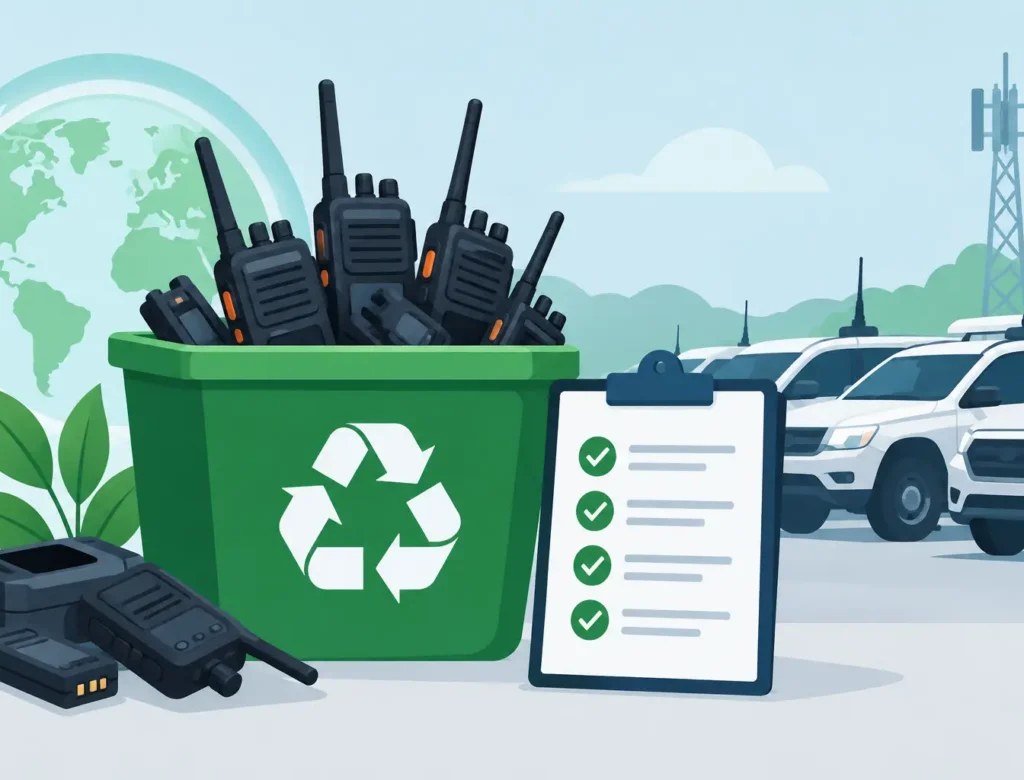
A retired radio fleet is not just a stack of obsolete hardware. It may contain programming files, encryption material, subscriber identifiers, GPS history, batteries, chargers, and accessories that each require a different disposition decision. This radio e-waste compliance guide helps U.S. organizations retire land mobile radio equipment without creating an avoidable data, regulatory, or environmental liability.
For a hospital replacing portable radios, a utility upgrading mobile units, or a municipality changing systems, the goal is not simply to clear a storage room. The goal is to create a documented chain from asset removal through resale, reuse, or compliant recycling – while recovering fair value from equipment that still has a useful second life.
What radio e-waste compliance actually covers
Radio e-waste compliance is the controlled disposition of retired two-way radios and related equipment in accordance with applicable environmental, transportation, data-security, and communications requirements. The details depend on the equipment, its condition, its batteries, the jurisdictions involved, and whether devices can be reused.
Professional LMR fleets often include portable radios, mobile radios, base stations, repeaters, control stations, microphones, antennas, chargers, batteries, and programming accessories. Treating all of it as one waste stream is inefficient. A current-model portable with a worn battery may have resale value. A damaged charger may be recyclable. A radio containing sensitive programming must be sanitized before either path.
Compliance is therefore a process, not a single certificate. It should establish who controlled the asset, what data was removed, where the equipment went, and how non-resalable materials were handled.
Start with an asset and risk inventory
Before equipment leaves the facility, identify what is being retired. A workable inventory does not need to become a months-long audit, but it should be detailed enough to support valuation, security decisions, and transfer records. Capture the manufacturer, model, quantity, serial number where practical, condition, included accessories, and battery type.
The risk profile matters as much as the model number. Radios used by public safety, healthcare, utilities, transportation, education, and government organizations may hold more than basic channel settings. They can contain talkgroup assignments, unit IDs, emergency-button configurations, network settings, encryption keys, or location information. Even a small number of radios can expose operational details if devices are sold or discarded without appropriate controls.
Separate equipment into logical groups: reusable radios, damaged but potentially repairable units, non-working electronics, lithium-ion batteries, and accessories. This improves the quote process and prevents viable assets from being unnecessarily scrapped.
Do not overlook peripherals and batteries
Batteries deserve their own handling plan. Lithium-ion batteries can present fire risk when damaged, loose, or improperly packaged, and their transportation is subject to U.S. Department of Transportation requirements. Swollen, leaking, or damaged batteries should be isolated and handled by a qualified provider rather than packed loosely with radios.
Chargers, speaker microphones, cables, vehicle mounts, and control heads may also retain value or require separate recycling. Leaving them out of the inventory can reduce recovery and complicate downstream reporting.
Secure radio data before resale or recycling
A radio that powers off is not necessarily a radio that is clear of data. Removing a battery does not erase internal memory, and a factory reset may not address every configuration, feature, or encryption-related element. The appropriate sanitization method depends on the radio platform and the data it stores.
Your organization should define a documented disposition standard for each equipment category. For routine commercial radios, this may mean removing customer-specific programming and verifying that the unit is ready for resale. For higher-risk fleets, the process may require authorized personnel to remove or zeroize encryption material, erase sensitive configuration data, and retain records of that action.
The key distinction is accountability. A verbal assurance that devices were cleared offers little protection during an audit or incident review. Ask for data-wiping documentation that identifies the equipment or batch, the method used, the completion date, and the responsible party.
If encryption is involved, engage the radio-system administrator or security owner early. Some keys and credentials are governed by internal policy, contractual obligations, or public-safety procedures that go beyond normal asset disposition. A recycler or buyer can manage equipment logistics, but the organization that owns the system must authorize and verify the release of sensitive communications data.
Understand the regulatory lines that affect retired radios
There is no single federal rule that labels every retired radio as hazardous waste. Electronic-waste obligations often vary by state, and organizations may also have internal sustainability policies, procurement requirements, or public-sector records rules. The practical question is whether your downstream partner can identify the applicable requirements and document the final outcome.
FCC considerations are separate from e-waste processing. Selling or recycling a radio does not transfer an FCC license, frequency authorization, or system access to another party. Before release, remove labels, settings, and programming that could create confusion about authorized use, and maintain control of any licensing records required by your organization.
Transportation requirements become especially relevant when batteries are included. A nationwide pickup program should account for packaging, carrier selection, and condition-based handling. Organizations should not assume that a standard office box is suitable for a mixed shipment of radios and lithium batteries.
For recycling, request clear downstream accountability. Useful records may include pickup confirmation, serial-number or batch-level inventory, data-sanitization documentation, and a certificate or report showing compliant recycling for material that cannot be resold. The right documentation depends on your industry and policy requirements, but it should be sufficient to demonstrate that equipment was not simply discarded or exported through an unknown channel.
Build a defensible chain of custody
The strongest compliance programs make the handoff process routine. Assign a single internal owner, such as an IT asset manager, communications manager, facilities lead, or procurement representative. That person does not need to perform every task, but they should coordinate approvals, inventory, pickup, and final records.
A clear chain of custody should answer four questions: What assets left the organization? Who received them? What security steps occurred before and after transfer? What was the final disposition? If any answer relies on assumptions, tighten the process before the next fleet refresh.
For distributed organizations, this often means consolidating equipment at one location or coordinating site-by-site pickups under a common inventory format. Centralization may reduce administrative effort, but local pickup can be the better choice when radios are spread across campuses, warehouses, vehicles, or field offices. The best approach depends on fleet size, security requirements, and operational disruption.
Recover value before you recycle
Compliance and financial recovery are not competing goals. Reuse is often the preferred outcome when equipment remains serviceable, properly sanitized, and marketable. Organizations can receive payment for surplus radios or apply trade-in credit toward replacement equipment, while avoiding the cost and waste associated with premature destruction.
Value depends on demand, model, frequency band, condition, quantity, included accessories, and whether programming or security restrictions have been addressed. Older low-band, VHF, UHF, and 800 MHz equipment can still hold value in the right market, even when a conventional buyer declines it. Conversely, equipment with significant damage, obsolete technology, or unresolved data concerns may be better directed to compliant recycling.
A specialist disposition partner should make that distinction quickly. Radiowell combines fair-market evaluation, nationwide pickup, documented data wiping, resale, and compliant recycling so organizations do not have to manage multiple vendors for one retirement project. The practical benefit is fewer handoffs, clearer records, and a defined outcome for every unit.
Make compliance part of the replacement plan
The best time to plan disposition is before new radios arrive. Include retired-equipment handling in the purchase or migration schedule, identify the system administrator responsible for programming and encryption removal, and establish a deadline for inventory approval. This prevents retired radios from accumulating in closets, vehicle bays, and unsecured storage areas where accountability erodes.
A well-run radio retirement program protects sensitive information, keeps batteries out of the wrong waste stream, supports environmental commitments, and returns value to the budget. More importantly, it lets your team complete a communications upgrade with the same operational discipline that justified the upgrade in the first place.
More News
-
Best Practices for Radio Decommissioning
Best practices for radio decommissioning help organizations protect data, recover asset value, meet compliance duties, and simplify fleet…
How to Erase Radio Encryption Keys Safely
Erase radio encryption keys safely with documented workflows that protect sensitive communications, support compliant disposition, and preserve asset…
How to Calculate Radio Trade-In Credit Fairly
Learn how to calculate radio trade-in credit using model, condition, accessories, demand, and compliance factors to recover more…

America’s largest buyer of used two-way radio equipment. Maximizing value, compliance, and sustainability for surplus LMR equipment.
Recycle and Partners