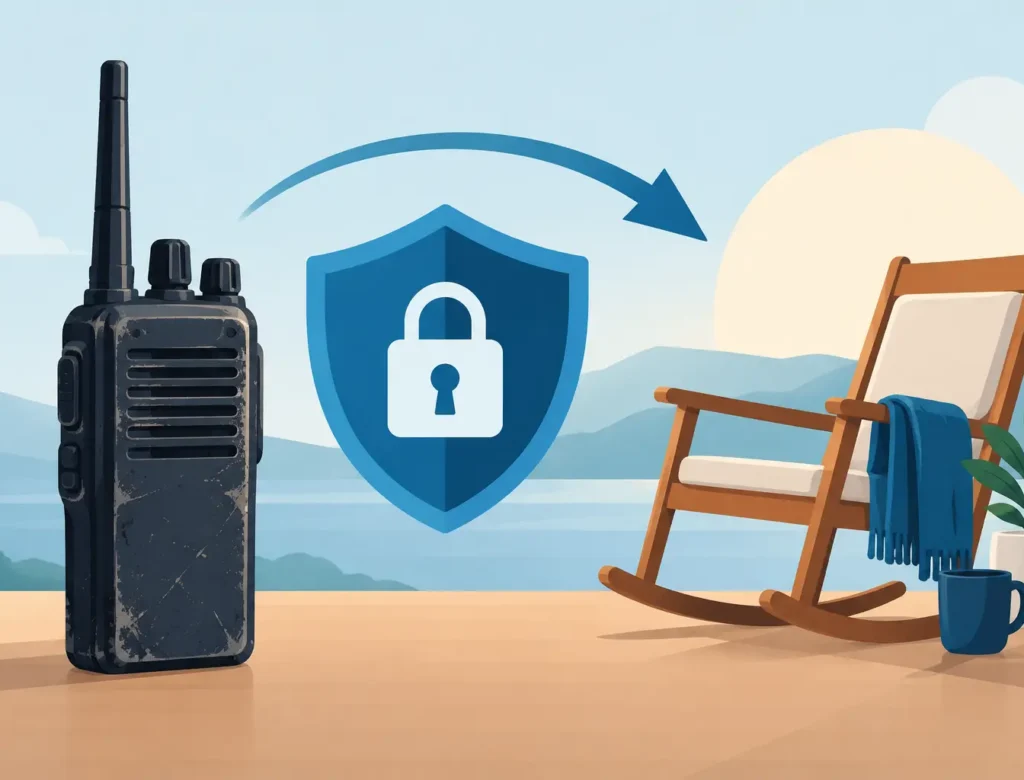
A radio fleet can be physically retired long before its security exposure is retired. That is the central encryption retirement case for hospitals, utilities, municipalities, schools, manufacturers, and other organizations replacing professional two-way radios. A surplus portable or mobile radio may still contain encryption keys, active talkgroup assignments, unit IDs, fleet maps, contact information, or programming that reveals how an organization communicates.
Treating those devices as ordinary surplus creates an avoidable gap between a replacement project and a defensible security process. The right disposition plan protects operational information, establishes accountability, preserves resale value where possible, and routes non-resalable equipment into compliant recycling.
Why Retired Radios Need an Encryption Retirement Case
Encryption protects voice traffic while a radio is in service. Retirement requires a different discipline: ensuring the device, its configuration, and the credentials associated with it are no longer able to expose the system. This matters whether an organization uses AES encryption, proprietary key-management tools, over-the-air rekeying, or a mixed fleet with both encrypted and unencrypted channels.
A radio that has been removed from daily use can still be programmed for sensitive operations. In public safety-adjacent environments, that may include mutual-aid channels, emergency procedures, and site-specific channel naming. In healthcare, it can expose staff roles and facility operations. In logistics, manufacturing, and utilities, it may reveal coverage areas, dispatch structure, maintenance activity, or facility locations.
The issue is not limited to portable radios. Mobile radios, base stations, control stations, repeaters, consoles, programming cables, and associated storage media can all require review. The encryption retirement case becomes stronger when the organization treats the full communications asset set as one controlled project rather than a pile of equipment headed for a storeroom.
There is also a financial reason to manage retirement carefully. Many professional LMR assets retain market value, even when the retiring organization no longer has a use for them. The distinction is critical: encryption-capable equipment is not automatically worthless, but it must be handled in a way that prevents the transfer of sensitive programming or key material.
What Encryption Retirement Should Accomplish
A defensible retirement process should produce four outcomes: the organization knows what it retired, sensitive content has been removed or rendered inaccessible, the chain of custody is documented, and each asset reaches the right downstream path.
That starts with inventory. Capture model numbers, serial numbers, quantities, condition, accessories, and current locations before equipment moves. For large fleets, group assets by site or department, but maintain serial-level records for higher-risk devices. This record supports finance, procurement, security, and environmental reporting while making it easier to reconcile equipment after pickup.
Next, separate radio disposition from system-level encryption administration. Removing a radio from service is not the same as retiring its key relationship. Communications administrators should follow their own approved procedures to revoke, supersede, or otherwise manage keys within the applicable key-management environment. The correct action depends on the radio platform, the encryption architecture, the reason for retirement, and whether radios are being replaced in phases.
A common mistake is assuming that a factory reset alone resolves the issue. In some circumstances, it may remove programming. In others, it may not address every element that matters, especially if configuration, keys, or system credentials are managed through platform-specific methods. The proper method should be confirmed by personnel who understand the equipment and the organization’s security requirements.
Finally, determine the equipment’s destination. Tested, clean radios may be eligible for resale or trade-in value. Obsolete, damaged, unsupported, or non-resalable equipment should be processed through compliant e-waste recycling. These are different outcomes, but neither should bypass secure handling.
Zeroize, reset, and wipe are not interchangeable
The language used during retirement can create confusion. A zeroize function is generally intended to remove encryption key material from a device. A reset may restore certain settings, but its effect varies by manufacturer and configuration. Data wiping is a broader disposition control that addresses stored programming and other potentially sensitive information according to an established process.
For that reason, organizations should not rely on casual terminology in internal handoffs. Specify the required outcome: which radios must be zeroized, which settings must be cleared, who is authorized to perform the work, and what evidence must be retained. If an outside disposition partner performs certified data wiping, define the scope and documentation before equipment leaves your control.
Build a Controlled Retirement Workflow
The strongest process is practical enough for a field operation and structured enough for security review. It should begin before the replacement radios are deployed, not after old units begin accumulating in closets and vehicle bays.
First, assign ownership across the teams involved. Communications staff should direct technical decommissioning. IT or information security should define handling requirements for sensitive data. Asset management or finance should validate inventory and value recovery. Facilities, procurement, or operations can coordinate collection. One accountable project owner should keep these functions aligned.
Second, establish a segregation area for retired equipment. Keep radios awaiting review separate from units that have been cleared. Label containers by status, not just location. A simple distinction between “pending security review,” “cleared for resale,” and “recycling only” prevents an otherwise well-run project from losing control during packing and transportation.
Third, document each transfer. The documentation does not need to be burdensome, but it should answer basic questions: who released the equipment, what was transferred, when it moved, and who received it. This is especially useful for multi-site organizations and fleets collected from vehicles, remote facilities, or department-level storage.
Before requesting a quote or arranging pickup, prepare a clear equipment list and state the required security handling. A specialist buyer can assess fair-market value, coordinate nationwide pickup, and separate resale candidates from material that should be recycled. For organizations with mixed fleets, this reduces the administrative burden of finding different destinations for radios, chargers, batteries, microphones, mobile mounts, and infrastructure equipment.
A useful pre-pickup checklist includes:
- Serial-number or quantity-based inventory, matched to sites or departments
- Security instructions for encryption-capable and programmed equipment
- Clear segregation of cleared, pending, and recycling-only assets
- Chain-of-custody contacts and approved release authorization
- Required certificates, reports, or payment documentation
Balance Security, Value, and Compliance
Some organizations assume the safest option is to destroy every retired radio. Physical destruction can be appropriate when policy, risk level, or equipment condition requires it. But it is not automatically the best response to every encrypted-radio retirement. When approved decommissioning and data-removal procedures are followed, usable equipment may still support legitimate resale and generate budget recovery.
That is where a specialized LMR disposition partner matters. General electronics recyclers may not understand radio platforms, radio-market demand, accessories, frequency bands, or the practical distinction between a disabled asset and a resalable one. General liquidators may focus on resale without providing the security controls, documentation, or compliant recycling path required for communications equipment.
Radiowell approaches this as a lifecycle decision: assess usable equipment for fair-market value, provide pickup and packing support, document secure handling, and recycle non-resalable assets through an appropriate downstream process. The benefit is not simply clearing storage space. It is converting an operational transition into measurable value recovery and compliance protection.
Compliance requirements also vary by organization. Government agencies may have records retention and security rules beyond standard asset controls. Healthcare organizations may apply stricter internal safeguards because radio programming can reveal operational details. Utilities and critical-infrastructure operators may have heightened concerns around site information and emergency-response communications. The right workflow is therefore not one-size-fits-all, but every workflow should be documented, authorized, and repeatable.
Questions to Settle Before Equipment Leaves the Site
Before handing over retired radios, leadership should be able to answer a few direct questions. Have the relevant keys and programming been addressed under the organization’s approved technical procedure? Has the fleet been inventoried and reconciled? Are cleared radios physically separated from unreviewed units? Does the receiving partner understand that the equipment may contain sensitive communications data? What documentation will prove the final disposition?
If the answer to any of these is uncertain, pause the release. A short delay at this stage is usually far less costly than trying to reconstruct custody, configuration status, or asset counts after a truck has left the facility.
Retiring encrypted radios is not merely an end-of-life task. It is the final control point for a communications system that may have supported daily operations, emergency response, and sensitive coordination for years. Give that final control point the same attention you gave the deployment, and the equipment can leave your organization with security, value, and accountability intact.
More News
-
How Reverse Logistics Firms Recover Radio Value
Reverse logistics firms help organizations recover value from retired two-way radios while protecting data, meeting regulations, and reducing…
Asset Recovery for Retired Two-Way Radios
Asset recovery turns retired two-way radios into value while protecting sensitive data, simplifying logistics, and meeting applicable recycling…
Which Radios Need Data Wiping Before Disposal?
Learn which radios need data wiping before resale, trade-in, or recycling, and how to protect keys, contacts, network…

America’s largest buyer of used two-way radio equipment. Maximizing value, compliance, and sustainability for surplus LMR equipment.
Recycle and Partners