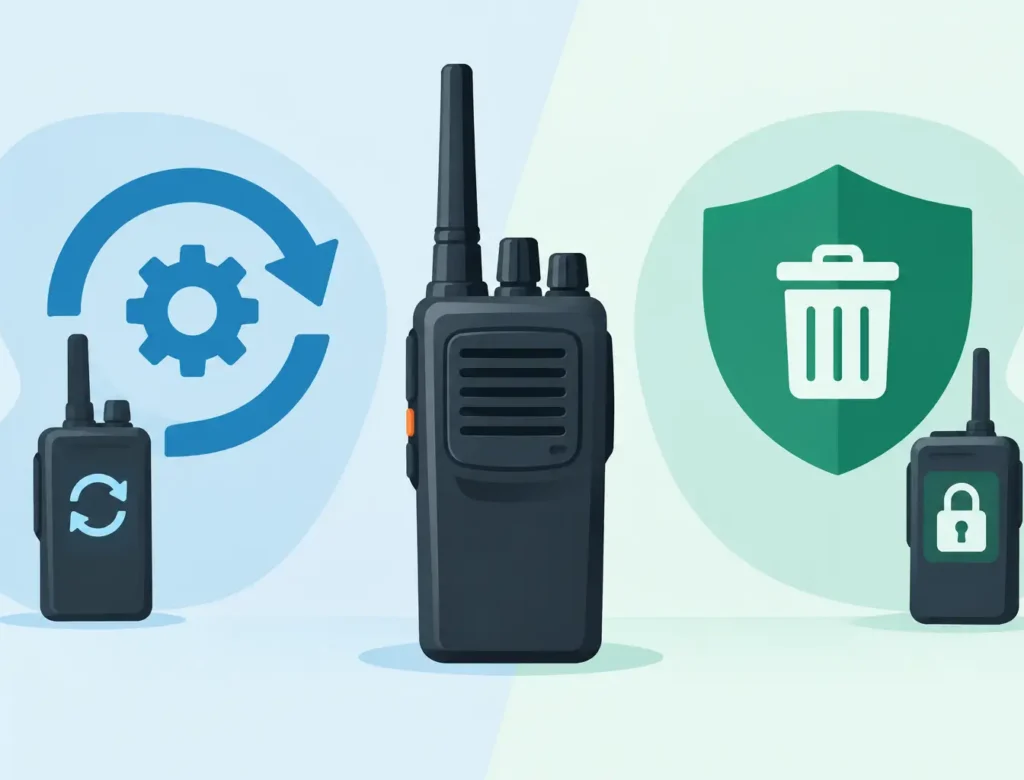
A radio fleet replacement can look simple on paper: issue new units, collect the old ones, and clear them before they leave the facility. But factory reset versus sanitization is not a minor technical distinction. For hospitals, utilities, municipalities, schools, manufacturers, and public agencies, it can determine whether retired two-way radios create an avoidable data-security and compliance exposure.
A factory reset changes a device’s operating state. Sanitization is a controlled process intended to make stored information unrecoverable to the level required by your organization’s policy, risk profile, and disposition path. Those outcomes may overlap on some equipment, but they are not automatically the same.
Factory Reset Versus Sanitization: The Core Difference
A factory reset generally restores a radio to a default or near-default configuration. Depending on the manufacturer and model, it may remove user settings, reset preferences, delete contacts, erase call history, or remove certain programmed values. It is often useful when troubleshooting equipment or preparing a unit for redeployment within the same organization.
That does not mean every area of storage has been addressed. Professional land mobile radio equipment can hold information beyond the settings visible on its screen or keypad. A portable, mobile, base station, accessory, or related communications device may contain channel plans, talkgroup assignments, radio IDs, unit labels, Wi-Fi or Bluetooth pairing details, network settings, GPS-related records, text messages, contacts, operational logs, or encryption-related material.
Sanitization begins with a different question: what information could remain on this asset, where is it stored, and what verified method is appropriate before the asset is reused, resold, returned, or recycled? The answer depends on the equipment family, its firmware and options, whether removable media or modules are present, and the sensitivity of the radio system it supported.
For a fleet serving public safety, critical infrastructure, healthcare operations, or secure facilities, clearing visible settings alone may not satisfy internal security requirements. Even a conventional business radio can expose operational details if programming data identifies locations, channels, dispatch structures, or personnel.
Why Retired Radios Need More Than a Quick Reset
Two-way radios are frequently managed outside the same workflows used for laptops and mobile phones. They may be issued to field teams, stored in vehicle consoles, left in charging banks, or collected by facilities staff during a system upgrade. That decentralization makes it easy to overlook what remains on each unit.
The risk is not limited to highly classified information. A channel alias can reveal a facility function. A contact list can expose employee names or extension patterns. A programmed frequency plan can provide insight into how an operation communicates. Encryption keys, key references, or security configurations demand even greater care because their handling may be governed by strict internal controls and vendor-specific procedures.
There is also a business consequence. Buyers and downstream partners need confidence that equipment is clear of customer information before it can enter a resale channel. If that confidence is absent, viable equipment may be treated as a liability rather than an asset with recoverable value. The result can be delayed disposition, reduced proceeds, and unnecessary recycling of equipment that could otherwise support a circular-equipment outcome.
A sound retirement process protects the organization on both fronts: it reduces data exposure and preserves the opportunity to recover fair-market value from eligible radios.
What Sanitization Should Look Like in Practice
Effective sanitization is a repeatable asset-disposition control, not a last-minute button press. It should be tied to inventory, custody, technical verification, and final disposition records.
Start with an accurate inventory
Before radios are collected, identify what is being retired. Record manufacturer, model, serial number, quantity, condition, assigned department where available, and any attached components. Include mobile radios, control stations, repeaters, chargers, batteries, microphones, speaker mics, and programming accessories when relevant.
This inventory creates accountability from collection through resale or recycling. It also helps identify equipment that may require a different handling path, such as units associated with encrypted systems, equipment containing removable modules, or radios subject to agency-specific controls.
Identify the data-bearing components
Not every device stores information in the same way. Some data may reside in internal memory, while other information may be tied to a removable card, encryption module, or connected accessory. The appropriate procedure should follow the manufacturer’s technical guidance and the organization’s security policy.
This is where a generic assumption creates problems. One model’s reset sequence may clear configuration data, while another may preserve items that require separate action through programming software or an authorized service process. If you do not know what the unit can retain, treat it as a device requiring evaluation rather than assuming it is clean.
Apply the right clearing method and verify it
Sanitization may involve approved software procedures, manufacturer-supported erase functions, removal and controlled handling of components, or physical destruction when secure clearing cannot be validated or resale is not appropriate. The correct method is determined by the asset, the data type, and your organization’s retention and security requirements.
Verification matters as much as the erase action itself. A technician or qualified disposition provider should confirm that the procedure was completed for the specific asset or batch. For sensitive fleets, the record should connect the device identifier to the method used and the final outcome.
Maintain chain of custody and documentation
Once retired radios leave a controlled location, the organization should be able to show where they went and how they were handled. A documented chain of custody helps prevent loss, unauthorized reuse, and confusion over final disposition.
For organizations with formal IT asset disposition, records management, procurement, or environmental programs, radio disposition should fit the same governance model. Documentation can support internal audits, vendor oversight, sustainability reporting, and incident response if questions arise later.
When a Factory Reset May Be Enough
There are circumstances where a factory reset may be an appropriate operational step. A radio being reassigned within the same department, for example, may only need a settings reset and reprogramming. A unit with no sensitive programming and no external disposition may present lower risk than equipment leaving organizational control.
Even then, the decision should be intentional. The relevant question is not whether the radio appears blank after a reset. It is whether the reset has removed the data your organization expects to remove, using a method appropriate for the next use of that device.
Factory reset may also be part of a sanitization workflow, but it should not be labeled sanitization without verification. Treating the terms as interchangeable can create a false sense of completion, particularly when multiple radio models, generations, or programming standards are in service.
Match the Process to the Disposition Path
The next destination of the equipment changes the level of control required. Internal redeployment, manufacturer return, trade-in, resale, donation, and recycling each have different operational considerations. A radio moving to a new owner deserves more scrutiny than one being temporarily reassigned within a controlled fleet.
Use a stricter review when equipment includes encryption capability, was used in secure operations, contains personally identifiable information, supports dispatch or SCADA-related functions, or has been managed by several departments over time. In these cases, involve the communications manager, information security team, and the party responsible for records or compliance before releasing assets.
For equipment that cannot be economically resold or securely cleared for reuse, compliant recycling is the responsible path. Recycling should not be a shortcut around data handling. Data-bearing components still need to be assessed before materials are processed, and the recycler should provide documentation consistent with your organization’s requirements.
A Better Offboarding Standard for LMR Equipment
The strongest radio retirement programs make disposition part of replacement planning, not an afterthought. Before new equipment arrives, define who collects legacy units, who approves the data-clearing method, how serial numbers are reconciled, and what documentation is required for assets that are sold or recycled.
This approach also reduces administrative friction. Instead of storing surplus radios in closets, vehicles, or warehouse cages for months, organizations can move equipment through a defined process that supports security, financial recovery, and responsible environmental outcomes. Eligible equipment can be valued for buyback or trade-in, while non-resalable material can be routed to compliant recycling.
Radiowell helps organizations manage this specialized process with nationwide pickup, documented data wiping, value recovery for eligible equipment, and compliant recycling for the rest. The goal is not simply to make old radios disappear. It is to close out communications assets with the same discipline used to deploy them.
Before your next fleet refresh, make one decision early: define what “cleared” means for every category of radio you retire. That single standard can protect sensitive operations, preserve recoverable value, and keep surplus equipment moving through a responsible next step.
More News
-
How Reverse Logistics Firms Recover Radio Value
Reverse logistics firms help organizations recover value from retired two-way radios while protecting data, meeting regulations, and reducing…
Asset Recovery for Retired Two-Way Radios
Asset recovery turns retired two-way radios into value while protecting sensitive data, simplifying logistics, and meeting applicable recycling…
Which Radios Need Data Wiping Before Disposal?
Learn which radios need data wiping before resale, trade-in, or recycling, and how to protect keys, contacts, network…

America’s largest buyer of used two-way radio equipment. Maximizing value, compliance, and sustainability for surplus LMR equipment.
Recycle and Partners